Bashir Khalid, Azad Aftab Mohammad, Hereiz Ayman, Bashir Mohammed Talha, Masood Maarij, Elmoheen Amr
Department of Emergency Medicine, Hamad General Hospital, Doha, Qatar.
University of Aberdeen School of Medicine and Dentistry, Aberdeen, Scotland, UK.
Open Access Emerg Med. 2021 May 18;13:177-182. doi: 10.2147/OAEM.S304153. eCollection 2021.
Point of care ultrasound (POCUS) has been a part of emergency medicine (EM) training for almost two decades. EM training program has a very broad and rigorous POCUS curricula which, in several cases, does not translate to routine application in clinical settings. This study therefore sought to compare the indications, utilization, barriers, and preferred POCUS educational method in a large Middle Eastern academic EM.
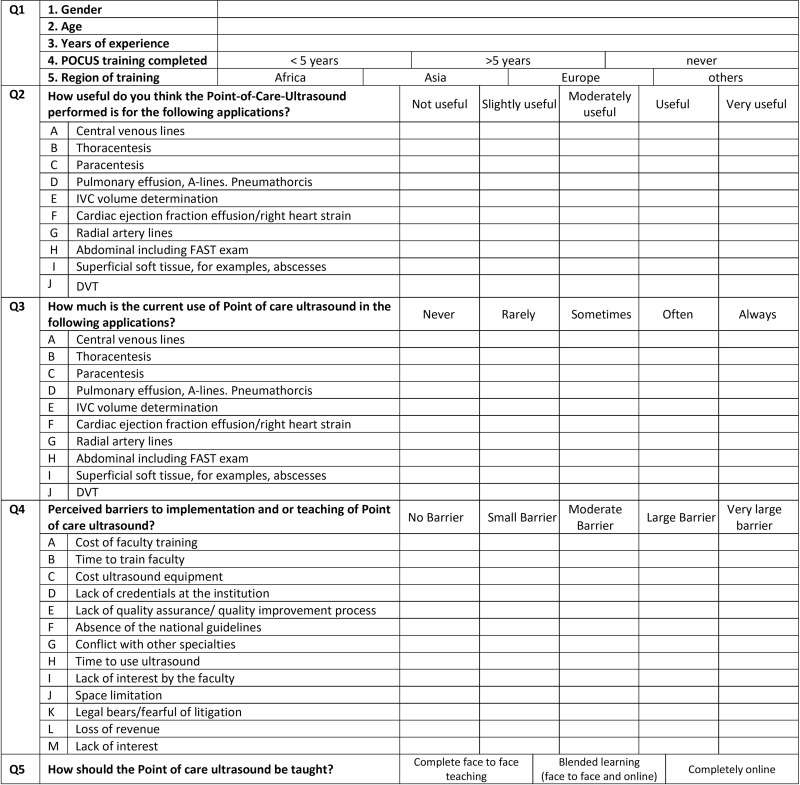
A validated questionnaire was emailed to 50 EM faculties between April and May 2019. Volunteer faculty members partook in a semi-structured interview to better understand the indications, current use, barriers, and preferred learning method. Responses were anonymous, and data were analyzed with descriptive statistics.
This was a mixed design study. 30/50 (60%) of faculty responded to the survey, with a mean age of 39.2 years and a mean number of years in practice, 13.1. 55% (n=28) completed POCUS training in less than five years, while 45% completed more than five years ago and 5% never completed it. Forty percent of EM physicians were trained in Africa, while 55% were qualified in Asia and 5% completed their training in Europe. The indications and frequently performed procedures were consistent with the previous research. The common barrier reported was lack of time, lack of credentialing, lack of quality assurance, and national guidelines. The majority of the faculty preferred a blended learning approach for POCUS.
POCUS perceived barriers to its full use include time constraints, lack of national guidelines, and credentialing (awarding POCUS qualifications) of the faculty. Blended learning appears to be the preferred approach towards acquiring the knowledge and skills of POCUS.
近二十年来,床旁超声(POCUS)一直是急诊医学(EM)培训的一部分。急诊医学培训项目拥有非常广泛且严格的床旁超声课程,但在某些情况下,这些课程并未转化为临床环境中的常规应用。因此,本研究旨在比较中东地区一所大型学术性急诊医学机构中床旁超声的应用指征、使用情况、障碍以及首选的教育方法。
2019年4月至5月期间,通过电子邮件向50名急诊医学教员发送了一份经过验证的问卷。志愿者教员参与了半结构化访谈,以更好地了解应用指征、当前使用情况、障碍以及首选的学习方法。回答是匿名的,数据采用描述性统计进行分析。
这是一项混合设计研究。50名教员中有30名(60%)回复了调查,平均年龄为39.2岁,平均从业年限为13.1年。55%(n = 28)在不到五年的时间内完成了床旁超声培训,而45%在五年多以前完成培训,5%从未完成培训。40%的急诊医学医生在非洲接受培训,55%在亚洲取得资质,5%在欧洲完成培训。应用指征和经常执行的操作与先前的研究一致。报告的常见障碍是时间不足、缺乏资质认证、缺乏质量保证以及国家指南。大多数教员更喜欢采用混合式学习方法进行床旁超声培训。
床旁超声全面应用中存在的障碍包括时间限制、缺乏国家指南以及教员的资质认证(授予床旁超声资格)。混合式学习似乎是获取床旁超声知识和技能的首选方法。