Christian Doppler Laboratory for Optimized Expression of Carbohydrate-active Enzymes, Research Division Biochemical Technology, Institute of Chemical, Environmental and Bioscience Engineering, TU Wien, 1060, Vienna, Austria.
Research Unit of Bioresource and Plant Science, Institute of Chemical, Environmental and Bioscience Engineering, TU Wien, 1060, Vienna, Austria.
Appl Microbiol Biotechnol. 2021 Jun;105(11):4467-4486. doi: 10.1007/s00253-021-11355-2. Epub 2021 May 27.
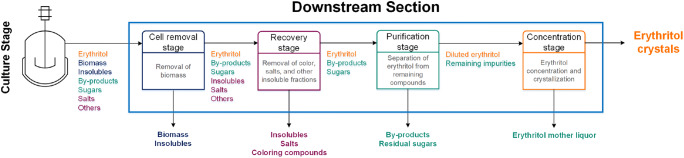
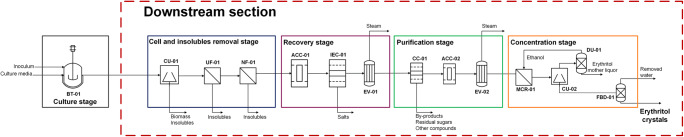
The reduction of sugar intake by adults has been stated by the World Health Organization as an important strategy to reduce the risk of non-communicable diseases. Erythritol is a four-carbon sugar alcohol that is considered as a highly suitable substitution for sucrose. This review article covers approaches for the separate stages of the biotechnological production of erythritol from cultivation to the downstream section. The first part focuses on the cultivation stage and compares the yields of erythritol and arising by-products achieved with different types of substrates (commercial versus alternative ones). The reported numbers obtained with the most prominently used microorganisms in different cultivation methods (batch, fed-batch or continuous) are presented. The second part focuses on the downstream section and covers the applied technologies for cell removal, recovery, purification and concentration of erythritol crystals, namely centrifugation, membrane separation, ion and preparative chromatography, crystallization and drying. The final composition of the culture broth and the preparative chromatography separation performance were identified as critical points in the production of a high-purity erythritol fraction with a minimum amount of losses. During the review, the challenges for a biotechnological production of erythritol in a circular economy context are discussed, in particular regarding the usage of sustainable resources and minimizing waste streams. KEY POINTS: • Substitution of sucrose by erythritol can be a step towards a healthier society • Biotechnological production of erythritol should follow a circular economy concept • Culture broth composition and preparative chromatography are keys for downstreaming • Substrate, mother liquor and nutrients are challenges for circular economy.
世界卫生组织指出,减少成年人的糖摄入量是降低非传染性疾病风险的重要策略。赤藓糖醇是一种四碳糖醇,被认为是蔗糖的理想替代品。本文综述了从培养到下游部分的生物技术生产赤藓糖醇的各个阶段的方法。第一部分侧重于培养阶段,并比较了不同类型基质(商业基质与替代基质)下赤藓糖醇和副产物的产量。介绍了在不同培养方法(分批、补料分批或连续)中使用最广泛的微生物获得的报告数量。第二部分侧重于下游部分,涵盖了去除细胞、回收、纯化和浓缩赤藓糖醇晶体的应用技术,即离心、膜分离、离子和制备色谱、结晶和干燥。发酵液的最终组成和制备色谱分离性能被确定为生产高纯度赤藓糖醇馏分和最小损失的关键点。在综述过程中,讨论了在循环经济背景下生物技术生产赤藓糖醇的挑战,特别是关于可持续资源的利用和减少废物流的问题。关键点:•用赤藓糖醇替代蔗糖可以成为建设更健康社会的一步•赤藓糖醇的生物技术生产应遵循循环经济理念•发酵液组成和制备色谱是下游的关键•基质、母液和营养物质是循环经济的挑战。