School of Informatics, Xiamen University, Xiamen, Fujian, China.
PLoS One. 2021 May 27;16(5):e0252287. doi: 10.1371/journal.pone.0252287. eCollection 2021.
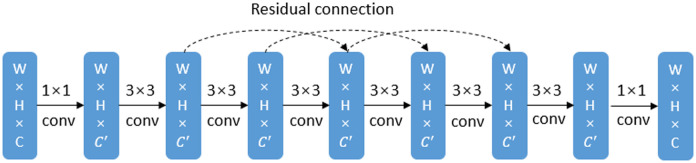
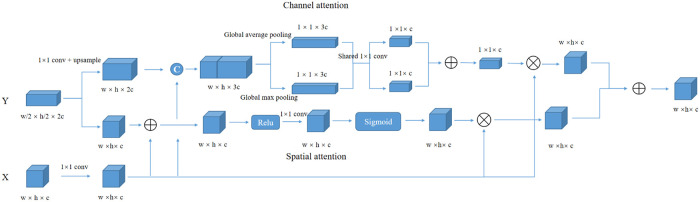
In recent years, the rapid development of deep neural networks has made great progress in automatic organ segmentation from abdominal CT scans. However, automatic segmentation for small organs (e.g., the pancreas) is still a challenging task. As an inconspicuous and small organ in the abdomen, the pancreas has a high degree of anatomical variability and is indistinguishable from the surrounding organs and tissues, which usually leads to a very vague boundary. Therefore, the accuracy of pancreatic segmentation is sometimes below satisfaction. In this paper, we propose a 2.5D U-net with an attention mechanism. The proposed network includes 2D convolutional layers and 3D convolutional layers, which means that it requires less computational resources than 3D segmentation models while it can capture more spatial information along the third dimension than 2D segmentation models. Then We use a cascaded framework to increase the accuracy of segmentation results. We evaluate our network on the NIH pancreas dataset and measure the segmentation accuracy by the Dice similarity coefficient (DSC). Experimental results demonstrate a better performance compared with state-of-the-art methods.
近年来,深度神经网络的快速发展在腹部 CT 扫描的自动器官分割方面取得了很大的进展。然而,对于小器官(如胰腺)的自动分割仍然是一个具有挑战性的任务。作为腹部中一个不显眼的小器官,胰腺具有高度的解剖变异性,与周围的器官和组织难以区分,通常导致边界非常模糊。因此,胰腺分割的准确性有时不尽如人意。在本文中,我们提出了一种具有注意力机制的 2.5D U-Net。所提出的网络包括 2D 卷积层和 3D 卷积层,这意味着它比 3D 分割模型需要更少的计算资源,但比 2D 分割模型能够沿着第三维捕获更多的空间信息。然后,我们使用级联框架来提高分割结果的准确性。我们在 NIH 胰腺数据集上评估我们的网络,并通过 Dice 相似系数(DSC)测量分割准确性。实验结果表明,与最先进的方法相比,我们的方法具有更好的性能。