Department of Health Sciences and Technology, Gachon Advanced Institute for Health Sciences and Technology (GAIHST), Gachon University, 1342, Seongnamdaero, Sujeong-gu, Seongnam-si, 13120, Republic of Korea.
Department of Biomedical Engineering, Gil Medical Center, Gachon University College of Medicine, 38-13, Dokjeon-ro 3beon-gil, Namdong-gu, Incheon, 21565, Republic of Korea.
Sci Rep. 2022 Mar 8;12(1):4075. doi: 10.1038/s41598-022-07848-3.
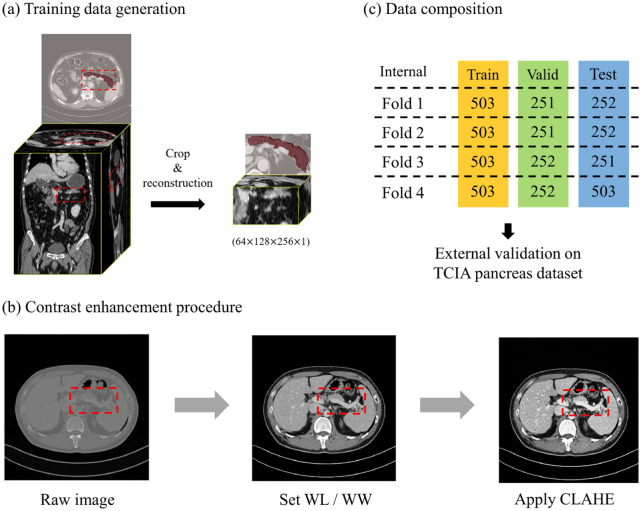
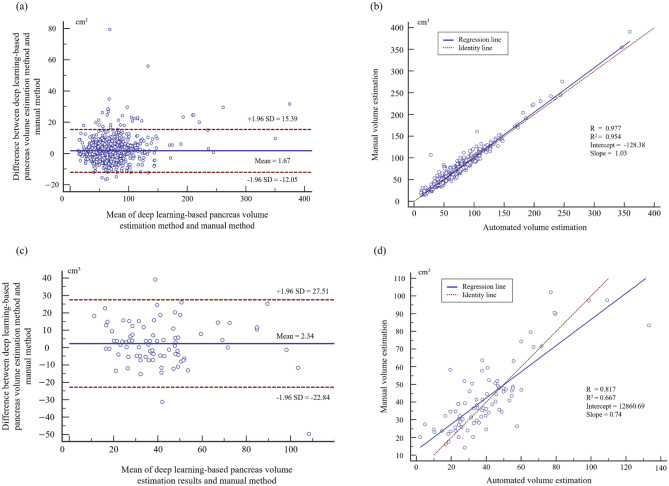
Pancreas segmentation is necessary for observing lesions, analyzing anatomical structures, and predicting patient prognosis. Therefore, various studies have designed segmentation models based on convolutional neural networks for pancreas segmentation. However, the deep learning approach is limited by a lack of data, and studies conducted on a large computed tomography dataset are scarce. Therefore, this study aims to perform deep-learning-based semantic segmentation on 1006 participants and evaluate the automatic segmentation performance of the pancreas via four individual three-dimensional segmentation networks. In this study, we performed internal validation with 1,006 patients and external validation using the cancer imaging archive pancreas dataset. We obtained mean precision, recall, and dice similarity coefficients of 0.869, 0.842, and 0.842, respectively, for internal validation via a relevant approach among the four deep learning networks. Using the external dataset, the deep learning network achieved mean precision, recall, and dice similarity coefficients of 0.779, 0.749, and 0.735, respectively. We expect that generalized deep-learning-based systems can assist clinical decisions by providing accurate pancreatic segmentation and quantitative information of the pancreas for abdominal computed tomography.
胰腺分割对于观察病变、分析解剖结构和预测患者预后是必要的。因此,许多研究都基于卷积神经网络设计了胰腺分割模型。然而,深度学习方法受到数据缺乏的限制,而且在大型 CT 数据集上进行的研究很少。因此,本研究旨在对 1006 名参与者进行基于深度学习的语义分割,并通过四个独立的三维分割网络评估胰腺的自动分割性能。在本研究中,我们使用 1006 名患者进行内部验证,并使用癌症成像档案胰腺数据集进行外部验证。我们通过四个深度学习网络中的相关方法获得了内部验证的平均精度、召回率和 Dice 相似系数分别为 0.869、0.842 和 0.842。使用外部数据集,深度学习网络的平均精度、召回率和 Dice 相似系数分别为 0.779、0.749 和 0.735。我们期望基于广义深度学习的系统能够通过提供腹部 CT 中胰腺的准确分割和定量信息来辅助临床决策。