EMBRAPA Recursos Geneticos e Biotecnologia, Brasilia, DF, Brazil.
Universidade Federal do Rio Grande do Sul, Porto Alegre, RS, Brazil.
Sci Rep. 2021 May 27;11(1):11097. doi: 10.1038/s41598-021-90607-7.
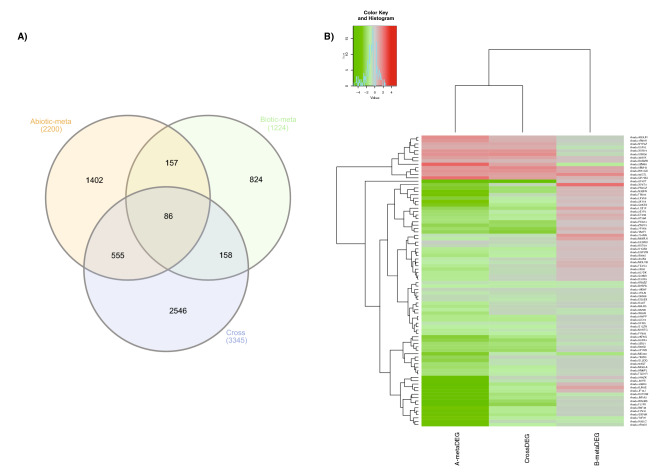
Nematodes and drought are major constraints in tropical agriculture and often occur simultaneously. Plant responses to these stresses are complex and require crosstalk between biotic and abiotic signaling pathways. In this study, we explored the transcriptome data of wild Arachis species subjected to drought (A-metaDEG) and the root-knot nematode Meloidogyne arenaria (B-metaDEG) via meta-analysis, to identify core-stress responsive genes to each individual and concurrent stresses in these species. Transcriptome analysis of a nematode/drought bioassay (cross-stress) showed that the set of stress responsive DEGs to concurrent stress is distinct from those resulting from overlapping A- and B-metaDEGs, indicating a specialized and unique response to combined stresses in wild Arachis. Whilst individual biotic and abiotic stresses elicit hormone-responsive genes, most notably in the jasmonic and abscisic acid pathways, combined stresses seem to trigger mainly the ethylene hormone pathway. The overexpression of a cross-stress tolerance candidate gene identified here, an endochitinase-encoding gene (AsECHI) from Arachis stenosperma, reduced up to 30% of M. incognita infection and increased post-drought recovery in Arabidopsis plants submitted to both stresses. The elucidation of the network of cross-stress responsive genes in Arachis contributes to better understanding the complex regulation of biotic and abiotic responses in plants facilitating more adequate crop breeding for combined stress tolerance.
线虫和干旱是热带农业的主要限制因素,且常同时发生。植物对这些胁迫的反应较为复杂,需要生物和非生物信号通路之间的串扰。在这项研究中,我们通过元分析探讨了野生花生物种在受到干旱(A-metaDEG)和根结线虫 Meloidogyne arenaria(B-metaDEG)胁迫时的转录组数据,以鉴定每个物种对单独胁迫和并发胁迫的核心应激响应基因。对线虫/干旱生物测定(交叉胁迫)的转录组分析表明,对并发胁迫的应激响应 DEG 集与来自重叠的 A-和 B-metaDEG 的 DEG 集不同,表明在野生花生中对联合胁迫有专门和独特的反应。虽然个体生物和非生物胁迫会引发激素响应基因,尤其是茉莉酸和脱落酸途径,但联合胁迫似乎主要触发乙烯激素途径。我们在这里鉴定了一个交叉胁迫耐受候选基因,即 Arachis stenosperma 中的一个内切几丁质酶编码基因(AsECHI),该基因的过表达可将 M. incognita 的感染率降低多达 30%,并增加了同时受到两种胁迫的拟南芥植物的干旱后恢复能力。阐明花生中交叉胁迫响应基因的网络有助于更好地理解植物中生物和非生物反应的复杂调控,从而为联合胁迫耐受的作物培育提供更多的支持。