Roguljic Hrvoje, Nincevic Vjera, Bojanic Kristina, Kuna Lucija, Smolic Robert, Vcev Aleksandar, Primorac Dragan, Vceva Andrijana, Wu George Y, Smolic Martina
Faculty of Medicine Osijek, J. J. Strossmayer University of Osijek, Osijek, Croatia.
University Hospital Osijek, Osijek, Croatia.
Front Pharmacol. 2021 May 11;12:678546. doi: 10.3389/fphar.2021.678546. eCollection 2021.
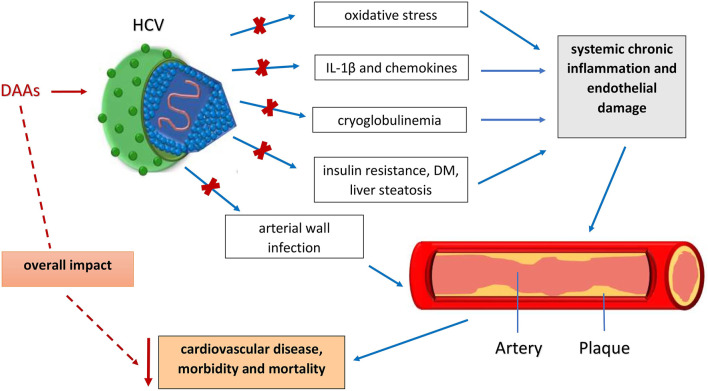
Hepatitis C virus (HCV) infection is a systemic disease associated with multiple significant extrahepatic manifestations. Emerging studies indicate association between the HCV infection and a higher incidence of major adverse cardiovascular events such as: coronary artery disease, heart failure, stroke and peripheral artery disease, when compared to general population. Atherosclerosis is a common pathophysiologic mechanism of cardiovascular disease (CVD) development which is the leading cause of mortality in the Western world. Proposed mechanisms of HCV-induced atherosclerosis includes systemic inflammation due to the chronic infection with increased levels of pro-atherogenic cytokines and chemokines. Furthermore, it has been demonstrated that HCV exists and replicates within atheroschlerotic plaques, supporting the theory of direct pro-atherogenic effect of the virus. Direct acting antiviral agents (DAAs) represent a safe and highly effective treatment of HCV infection. Beside the improvement in liver-related outcomes, DAAs exhibit a beneficial effect on extra-hepatic manifestations of chronic HCV infection. Recently, it has been shown that patients with chronic HCV infection treated with DAA-based therapeutic regimes had a 43% reduction of CVD events incidence risk. Moreover, eradication of HCV with DAAs results in a significant positive effect on risk factors for cardiovascular disease, despite a general worsening of the lipid profile. This positive effects is mainly due to an improvement of endothelial function and glucose metabolism. Although DAA treatment is associated with a beneficial impact on cardiovascular events, further studies are needed to fully elucidate the mechanisms responsible.
丙型肝炎病毒(HCV)感染是一种与多种严重肝外表现相关的全身性疾病。新出现的研究表明,与普通人群相比,HCV感染与主要不良心血管事件(如冠状动脉疾病、心力衰竭、中风和外周动脉疾病)的较高发病率相关。动脉粥样硬化是心血管疾病(CVD)发展的常见病理生理机制,而心血管疾病是西方世界的主要死亡原因。HCV诱导动脉粥样硬化的潜在机制包括由于慢性感染导致促动脉粥样硬化细胞因子和趋化因子水平升高而引起的全身炎症。此外,已证明HCV存在于动脉粥样硬化斑块中并在其中复制,支持了该病毒具有直接促动脉粥样硬化作用的理论。直接作用抗病毒药物(DAAs)是治疗HCV感染的一种安全且高效的方法。除了改善肝脏相关结局外,DAAs对慢性HCV感染的肝外表现也具有有益作用。最近的研究表明,接受基于DAA治疗方案治疗的慢性HCV感染患者发生CVD事件的风险降低了43%。此外,使用DAAs清除HCV对心血管疾病的危险因素产生了显著的积极影响,尽管血脂谱总体有所恶化。这种积极影响主要归因于内皮功能和葡萄糖代谢的改善。尽管DAA治疗对心血管事件有有益影响,但仍需要进一步研究以充分阐明其作用机制。