Ma Zhong-Ren, Idris Sakinah, Pan Qiu-Wei, Baloch Zulqarnain
Biomedical Research Center, Northwest Minzu University, Lanzhou 730030, Gansu Province, China.
Center for Molecular Medicine in Yunnan Province, Kunming University of Science and Technology, Kunming 650500, Yunnan Province, China.
World J Psychiatry. 2021 May 19;11(5):181-200. doi: 10.5498/wjp.v11.i5.181.
Measures for effective control of the coronavirus disease 2019 (COVID-19) pandemic include identifying the causal organisms, applying appropriate therapies, and developing vaccines, as well as improving understanding among the general public.
To evaluate the knowledge, awareness, perception, and response of the general public to COVID-19 in China.
A detailed questionnaire comprising 47 questions designed in both English and Chinese was developed. The survey was conducted WeChat, a multipurpose messaging, social media, and mobile payment app that is widely used by the Chinese population. In total, 1006 participants responded, and most of them were from different provinces of mainland China.
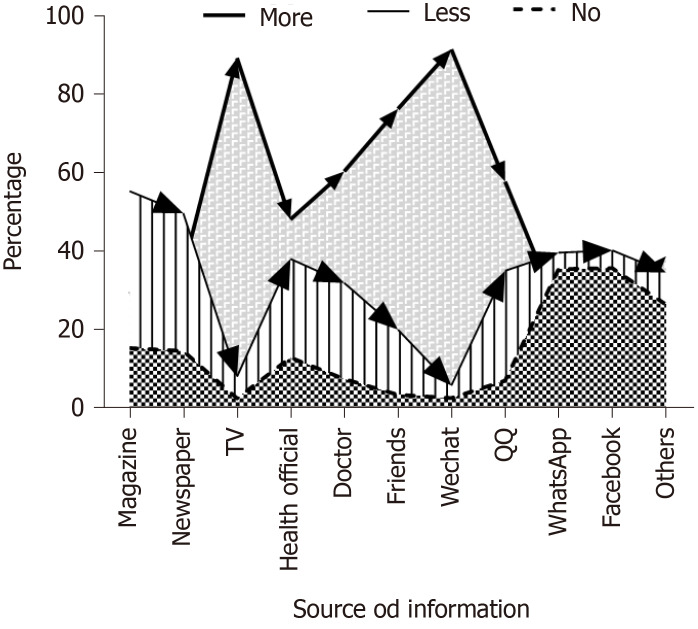
Overall, this comprehensive survey revealed that the general public in China is highly aware of the basic information concerning COVID-19 and its precautions. Interestingly, more respondents (99.3%) were aware of the term severe acute respiratory syndrome (SARS) than COVID-19 (97.2%) and Middle East respiratory syndrome (MERS) (73.4%). Among them, 2.4%, 1.6%, and 0.9% said that they or their family members or friends were affected by COVID-19, SARS, and MERS, respectively. The majority of the respondents (91.2%) indicated that knowledge about COVID-19 was received mainly from WeChat, followed by TV (89%), friends (76.1%), and QQ (a Chinese instant messaging software service) (57.7%).
The general public in China is highly aware of COVID-19 and the necessary precautions. Unexpectedly, 2.8% of the participants were unaware of the current epidemic. The remaining information gaps highlight the necessity of further enhancing awareness and preparedness.
有效控制2019年冠状病毒病(COVID-19)大流行的措施包括识别致病病原体、应用适当治疗方法、研发疫苗以及提高公众认知。
评估中国公众对COVID-19的知识、意识、认知和应对情况。
设计了一份包含47个问题的详细问卷,问卷有英文和中文两个版本。调查通过微信进行,微信是一款多功能即时通讯、社交媒体和移动支付应用程序,在中国广泛使用。共有1006名参与者做出回应,其中大多数来自中国大陆的不同省份。
总体而言,这项综合调查显示,中国公众对COVID-19及其预防措施的基本信息高度了解。有趣的是,知道严重急性呼吸综合征(SARS)一词的受访者(99.3%)比知道COVID-19(97.2%)和中东呼吸综合征(MERS)(73.4%)的受访者更多。其中,分别有2.4%、1.6%和0.9%的受访者表示他们自己或其家人或朋友受到了COVID-19、SARS和MERS的影响。大多数受访者(91.2%)表示,关于COVID-19的知识主要来自微信,其次是电视(89%)、朋友(76.1%)和QQ(一款中国即时通讯软件服务)(57.7%)。
中国公众对COVID-19和必要的预防措施高度了解。出乎意料的是,2.8%的参与者不知道当前的疫情。其余的信息差距凸显了进一步提高认识和做好准备的必要性。