Department of Clinical Sciences, Institute of Tropical Medicine, Antwerp, Belgium.
Department of Dermatology, University of Gondar Hospital, Gondar, Ethiopia.
PLoS Negl Trop Dis. 2021 May 28;15(5):e0009460. doi: 10.1371/journal.pntd.0009460. eCollection 2021 May.
Cutaneous leishmaniasis (CL) in Ethiopia, caused by Leishmania aethiopica, is often severe and hard to treat compared to CL caused by other species elsewhere. Miltefosine is the only oral anti-leishmanial drug, with a favorable side-effect profile compared to routinely available sodium stibogluconate (SSG), but evidence about its use for L. aethiopica is lacking.
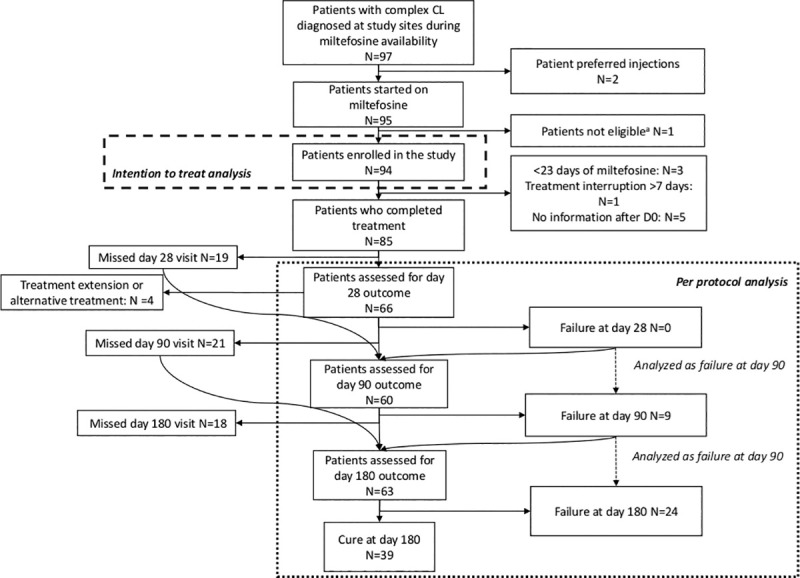
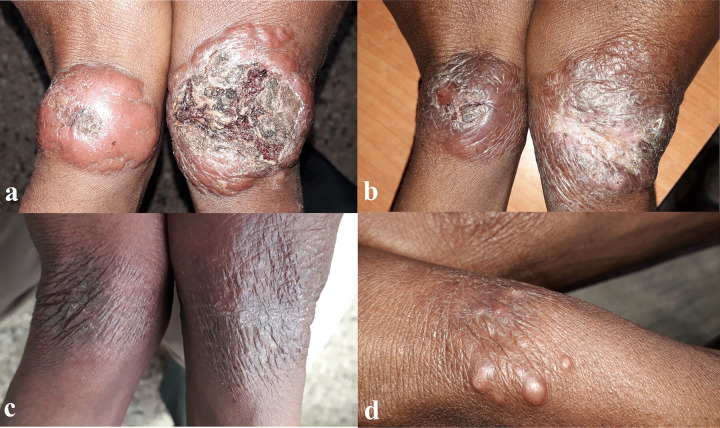
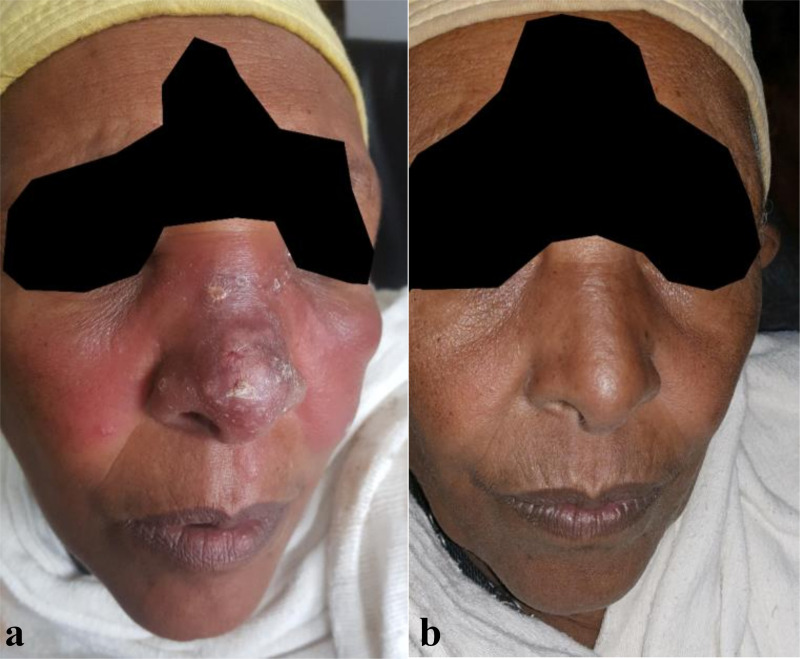
In an observational cohort study, treatment outcomes, safety and adherence among CL patients who required systemic treatment and received miltefosine for 28 days in Boru Meda Hospital and University of Gondar Hospital were studied. Patient cure was defined as 100% flattening for non-ulcerated lesions and 100% flattening and 100% re-epithelization for ulcerated lesions. Outcomes were documented for day 28, 90 and 180, both per site, and pooled, adjusting for site as a fixed effect with effect coding. Among 94 included patients (32 in Gondar, 62 in Boru Meda), median lesion duration was 12 months, median size six cm, and mucosal involvement (46.8%) and diffuse (30.9%) lesions were common. Adherence to miltefosine was good, and side-effects were tolerable. Initial outcomes at day 28 were promising, with 68.8% and 94.0% of patients having good improvement or cure in Gondar and Boru Meda respectively. In Boru Meda, outcomes were good with 72.7% and 72.9% cure at day 90 and day 180 respectively. In Gondar, results were less promising, with only 12.5% and 26.7% cure at day 90 and day 180, although confidence intervals were wide. In pooled estimates, 48.7% of patients reached cure at day 180, and 32.3% relapsed. Outcomes were better in Boru Meda Hospital, for smaller lesions and for mucosal lesions.
CONCLUSIONS/SIGNIFICANCE: Based on miltefosine's good initial response, tolerable side-effects, tablet-form, we propose to include miltefosine for future clinical trials using extended treatment schedules, combination therapy, or targeting specific subgroups.
ClinicalTrials.gov NCT04004754.
埃塞俄比亚的皮肤利什曼病(CL)由利什曼原虫引起,与其他地方由其他物种引起的 CL 相比,通常更为严重且难以治疗。米替福新是唯一的口服抗利什曼原虫药物,与常规使用的葡萄糖酸锑钠(SSG)相比,具有良好的副作用谱,但缺乏关于其用于利什曼原虫的证据。
在一项观察性队列研究中,研究了在博鲁梅达医院和贡德尔大学医院接受米替福新治疗 28 天的需要全身治疗的 CL 患者的治疗结果、安全性和依从性。患者治愈定义为非溃疡性病变完全平坦,溃疡性病变完全平坦和 100%再上皮化。在第 28、90 和 180 天,根据站点作为固定效应进行了调整,分别在每个站点和汇总站点记录结果,并进行了效果编码。在 94 名纳入的患者(32 名在贡德尔,62 名在博鲁梅达)中,中位病变持续时间为 12 个月,中位病变大小为 6 厘米,黏膜受累(46.8%)和弥漫性(30.9%)病变很常见。米替福新的依从性良好,副作用可耐受。第 28 天的初始结果很有希望,博鲁梅达和贡德尔分别有 68.8%和 94.0%的患者有良好的改善或治愈。在博鲁梅达,第 90 天和第 180 天的治愈率分别为 72.7%和 72.9%,结果良好。在贡德尔,结果不太乐观,第 90 天和第 180 天的治愈率分别仅为 12.5%和 26.7%,尽管置信区间较宽。在汇总估计中,48.7%的患者在第 180 天达到治愈,32.3%的患者复发。博鲁梅达医院的病变较小,黏膜病变的结果更好。
结论/意义:基于米替福新良好的初始反应、可耐受的副作用、片剂形式,我们建议将米替福新纳入未来的临床试验中,使用延长的治疗方案、联合治疗或针对特定亚组。
ClinicalTrials.gov NCT04004754。