Wienbergen Harm, Retzlaff Tina, Schmucker Johannes, Marin Luis Alberto Mata, Rühle Stephan, Garstka Daniela, Osteresch Rico, Fach Andreas, Hambrecht Rainer
Bremen Institute for Heart and Circulation Research (BIHKF) at the Klinikum Links der Weser, Bremen, Germany; Lübeck University Heart Center, Medical Clinic II, Lübeck, Germany.
Bremen Institute for Heart and Circulation Research (BIHKF) at the Klinikum Links der Weser, Bremen, Germany.
Am J Cardiol. 2021 Jul 15;151:10-14. doi: 10.1016/j.amjcard.2021.04.011. Epub 2021 Apr 27.
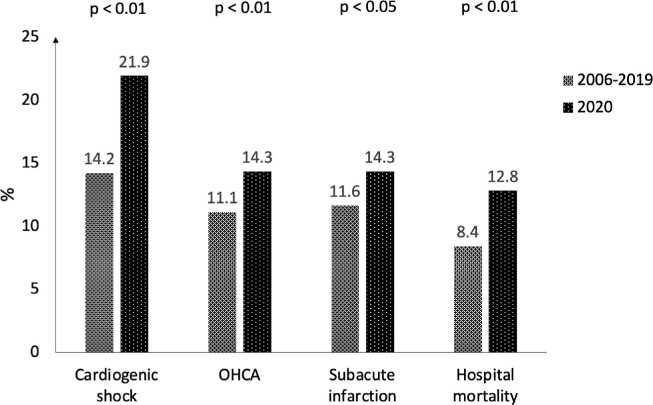
Impact of COVID-19 pandemic and pandemic-related social restrictions on clinical course of patients treated for acute ST-elevation myocardial infarction (STEMI) is unclear. In the present study presentation and outcome of patients with STEMI in the year 2020 were compared with the years before in a German registry that includes all patients hospitalized for acute STEMI in a region with approximately 1 million inhabitants. In the year 2020 726 patients with STEMI were registered compared with 10.226 patients in the years 2006 to 2019 (730 ± 57 patients per year). No significant differences were observed between the groups regarding age, gender and medical history of patients. However, in the year 2020 a significantly higher rate of patients admitted with cardiogenic shock (21.9% vs 14.2%, p <0.01) and out-of-hospital cardiac arrest (OHCA) (14.3% vs 11.1%, p <0.01) was observed. The rate of patients with subacute myocardial infarction (14.3% vs 11.6%, p <0.05) was elevated in 2020. Hospital mortality increased by 52% from the years 2006 to 2019 (8.4%) to the year 2020 (12.8%, p <0.01). Only 4 patients (0.6%) with STEMI in the year 2020 had SARS-CoV-2 infection, none of those died in-hospital. In conclusion, in the year 2020 a highly significant increase of STEMI-patients admitted to hospital with advanced infarction and poor prognosis was observed. As the structure of the emergency network to treat patients with STEMI was unchanged during the study period, the most obvious reason for these changes was COVID-19 pandemic-related lockdown and the fear of many people to contact medical staff during the pandemic.
2019冠状病毒病大流行及与大流行相关的社会限制措施对急性ST段抬高型心肌梗死(STEMI)患者临床病程的影响尚不清楚。在本研究中,将2020年STEMI患者的临床表现和转归与之前几年进行了比较,该研究基于德国一个登记处的数据,该登记处纳入了某地区(约100万居民)所有因急性STEMI住院的患者。2020年登记了726例STEMI患者,而2006年至2019年有10226例(每年730±57例)。两组患者在年龄、性别和病史方面未观察到显著差异。然而,2020年因心源性休克入院的患者比例显著更高(21.9%对14.2%,p<0.01),院外心脏骤停(OHCA)的比例也更高(14.3%对11.1%,p<0.01)。2020年亚急性心肌梗死患者的比例有所升高(14.3%对11.6%,p<0.05)。医院死亡率从2006年至2019年的8.4%上升至2020年的12.8%,增加了52%(p<0.01)。2020年仅有4例(0.6%)STEMI患者感染了严重急性呼吸综合征冠状病毒2(SARS-CoV-2),均未在医院死亡。总之,2020年观察到入院的STEMI患者中晚期梗死和预后不良的情况显著增加。由于在研究期间治疗STEMI患者的急诊网络结构未变,这些变化最明显的原因是2019冠状病毒病大流行相关的封锁措施以及大流行期间许多人对接触医护人员的恐惧。