Grandjean Philippe, Hu Howard, Till Christine, Green Rivka, Bashash Morteza, Flora David, Tellez-Rojo Martha Maria, Song Peter X K, Lanphear Bruce, Budtz-Jørgensen Esben
Department of Environmental Health, Harvard T.H. Chan School of Public Health, Boston, MA, USA.
Department of Public Health, University of Southern Denmark, Odense, Denmark.
Risk Anal. 2022 Mar;42(3):439-449. doi: 10.1111/risa.13767. Epub 2021 Jun 8.
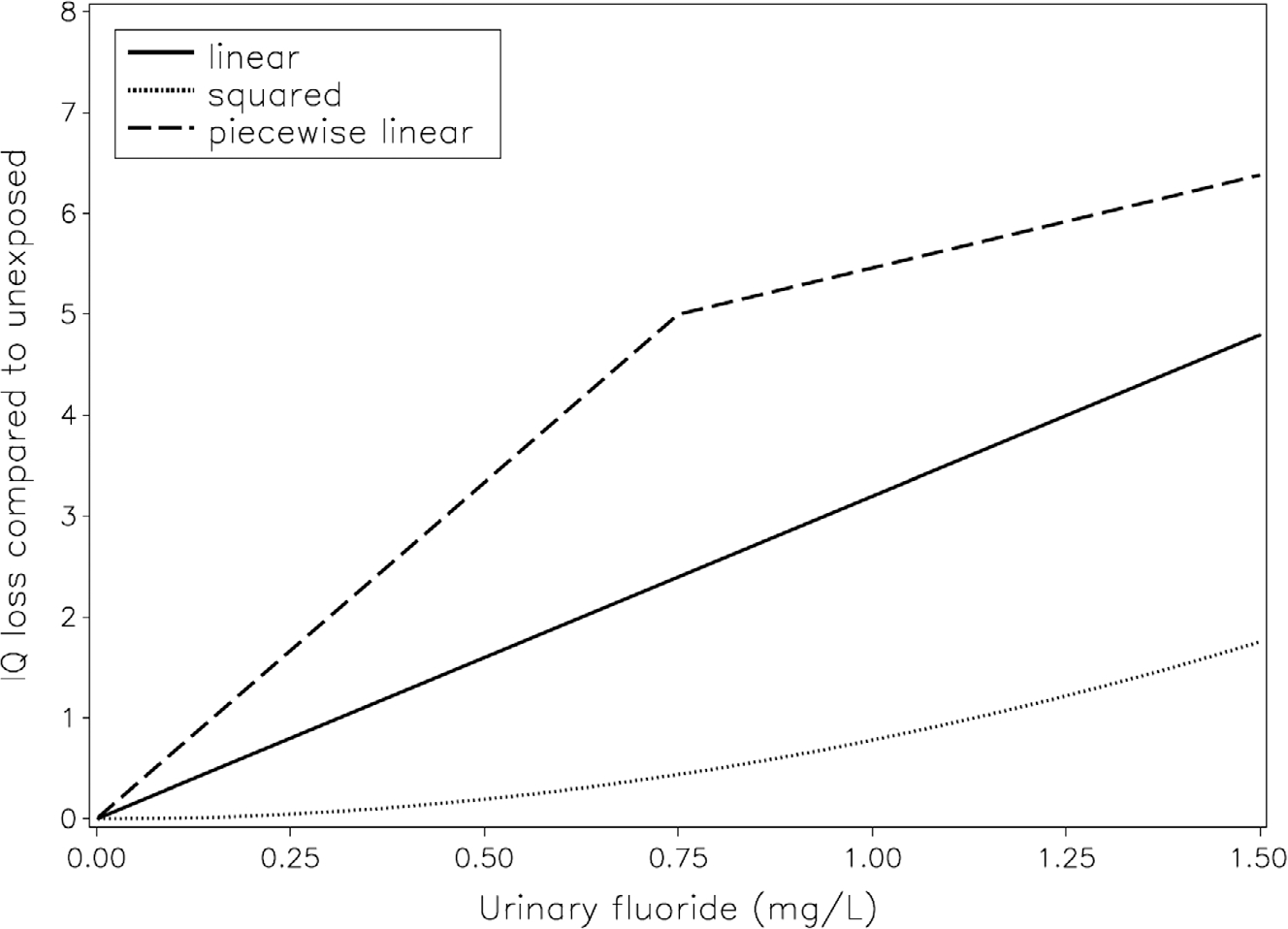
As a guide to establishing a safe exposure level for fluoride exposure in pregnancy, we applied benchmark dose modeling to data from two prospective birth cohort studies. We included mother-child pairs from the Early Life Exposures in Mexico to Environmental Toxicants (ELEMENT) cohort in Mexico and the Maternal-Infant Research on Environmental Chemicals (MIREC) cohort in Canada. Maternal urinary fluoride concentrations (U-F, in mg/L, creatinine-adjusted) were measured in urine samples obtained during pregnancy. Children were assessed for intelligence quotient (IQ) at age 4 (n = 211) and between six and 12 years (n = 287) in the ELEMENT cohort, and three to four years (n = 407) in the MIREC cohort. We calculated covariate-adjusted regression coefficients and their standard errors to assess the association of maternal U-F concentrations with children's IQ measures. Assuming a benchmark response of 1 IQ point, we derived benchmark concentrations (BMCs) and benchmark concentration levels (BMCLs). No deviation from linearity was detected in the dose-response relationships, but boys showed lower BMC values than girls. Using a linear slope for the joint cohort data, the BMC for maternal U-F associated with a 1-point decrease in IQ scores was 0.31 mg/L (BMCL, 0.19 mg/L) for the youngest boys and girls in the two cohorts, and 0.33 mg/L (BMCL, 0.20 mg/L) for the MIREC cohort and the older ELEMENT children. Thus, the joint data show a BMCL in terms of the adjusted U-F concentrations in the pregnant women of approximately 0.2 mg/L. These results can be used to guide decisions on preventing excess fluoride exposure in pregnant women.
为了确定孕期氟暴露的安全水平,我们对两项前瞻性出生队列研究的数据进行了基准剂量建模。我们纳入了来自墨西哥的“墨西哥早期生命环境毒物暴露研究”(ELEMENT)队列和加拿大的“环境化学物质母婴研究”(MIREC)队列中的母婴对。在孕期采集的尿液样本中测量了母亲的尿氟浓度(U-F,以mg/L为单位,经肌酐校正)。在ELEMENT队列中,对4岁(n = 211)以及6至12岁(n = 287)的儿童进行了智商(IQ)评估;在MIREC队列中,对3至4岁(n = 407)的儿童进行了智商评估。我们计算了协变量调整后的回归系数及其标准误差,以评估母亲U-F浓度与儿童IQ测量值之间的关联。假设基准反应为1个IQ点,我们得出了基准浓度(BMCs)和基准浓度水平(BMCLs)。在剂量反应关系中未检测到线性偏差,但男孩的BMC值低于女孩。对于联合队列数据,使用线性斜率,与IQ分数降低1分相关的母亲U-F的BMC,在两个队列中最年幼的男孩和女孩中为0.31 mg/L(BMCL,0.19 mg/L),在MIREC队列和ELEMENT队列中年龄较大的儿童中为0.33 mg/L(BMCL,0.20 mg/L)。因此,联合数据显示,孕妇经调整后的U-F浓度的BMCL约为0.2 mg/L。这些结果可用于指导预防孕妇过量氟暴露的决策。