Bojovic Neva, Stanisljevic Jovana, Giunti Guido
Kedge Business School, 33405 Talence, France.
Grenoble Ecole de Management, 38000 Grenoble, France.
Health Policy. 2021 Jul;125(7):841-858. doi: 10.1016/j.healthpol.2021.05.005. Epub 2021 May 17.
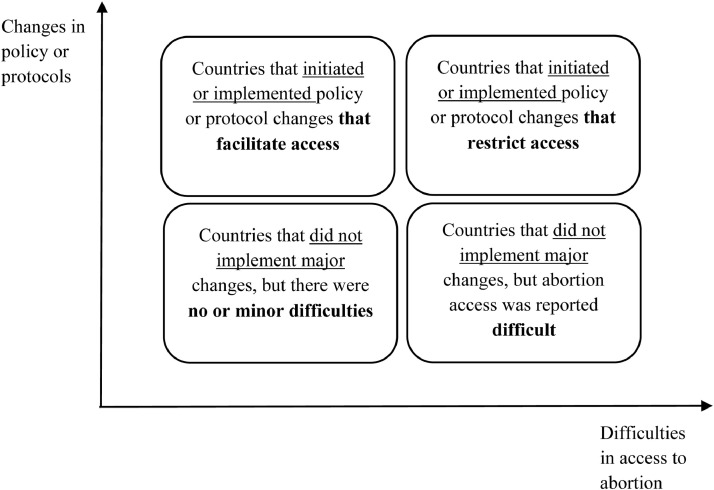
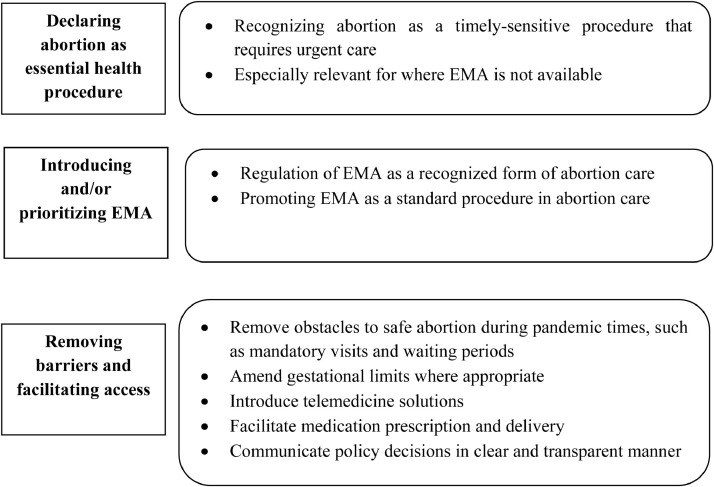
Government policies on abortion are a longstanding topic of heated political debates. The COVID-19 pandemic shook health systems to the core adding further to the complexity of this topic, as imposed national lockdowns and movement restrictions affected access to timely abortion for millions of women across the globe. In this paper, we examine how countries within the European Union and the United Kingdom responded to challenges brought by the COVID-19 crisis in terms of access to abortion. By combining information from various sources, we have explored different responses according to two dimensions: changes in policy and protocols, and reported difficulties in access. Our analysis shows significant differences across the observed regions and salient debates around abortion. While some countries made efforts to maintain and facilitate abortion care during the pandemic through the introduction or expansion of use of telemedicine and early medical abortion, others attempted to restrict it further. The situation was also diverse in the countries where governments did not change policies or protocols. Based on our data analysis, we provide a framework that can help policy makers improve abortion access.
政府关于堕胎的政策长期以来一直是激烈政治辩论的话题。新冠疫情使卫生系统受到重创,这一话题的复杂性进一步增加,因为国家实施的封锁和行动限制影响了全球数百万妇女获得及时堕胎服务的机会。在本文中,我们研究了欧盟国家和英国在堕胎服务可及性方面如何应对新冠疫情带来的挑战。通过整合来自各种来源的信息,我们从两个维度探讨了不同的应对措施:政策和协议的变化,以及报告的获取困难。我们的分析表明,在所观察的地区之间存在显著差异,围绕堕胎也存在突出的辩论。虽然一些国家在疫情期间通过引入或扩大远程医疗和早期药物流产的使用来努力维持和便利堕胎护理,但其他国家则试图进一步限制堕胎。在政府未改变政策或协议的国家,情况也各不相同。基于我们的数据分析,我们提供了一个有助于政策制定者改善堕胎服务可及性的框架。