Laboratorio de Inmunología, Centro de Referencia para Lactobacilos (CERELA-CONICET), San Miguel de Tucumán, Argentina.
Cátedra de Inmunología, Facultad de Bioquímica, Química y Farmacia, Universidad Nacional de Tucumán, San Miguel de Tucumán, Argentina.
Front Immunol. 2021 May 12;12:660854. doi: 10.3389/fimmu.2021.660854. eCollection 2021.
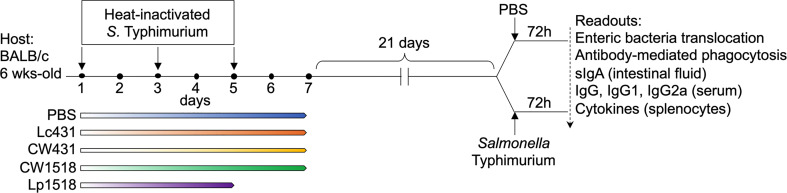
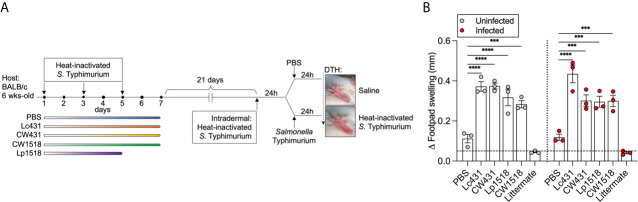
Probiotics have been associated with a variety of health benefits. They can act as adjuvant to enhance specific immune response. Bacterial cell wall (CW) molecules are key structures that interact with host receptors promoting probiotic effects. The adjuvant capacity underlying this sub-cellular fraction purified from CRL431 and CNCMI-1518 remains to be characterized. We interrogated the molecular and cellular events after oral feeding with probiotic-derived CW in addition to heat-inactivated Typhimurium and their subsequent protective capacity against Typhimurium challenge. Intact probiotic bacteria were orally administered for comparison. We find that previous oral feeding with probiotics or their sub-cellular fraction reduce bacterial burden in spleen and liver after challenge. Antibody responses after pathogen challenge were negligible, characterized by not major changes in the antibody-mediated phagocytic activity, and in the levels of total and -specific intestinal sIgA and serum IgG, respectively. Conversely, the beneficial effect of probiotic-derived CW after Typhimurium challenge were ascribed to a Th1-type cell-mediated immunity which was characterized by augmentation of the delayed-type hypersensitivity response. The cell-mediated immunity associated with the oral feeding with probiotic-derived CW was accompanied with a Th1-cell polarizing cytokines, distinguished by increase IFN-γ/IL-4 ratio. Similar results were observed with the intact probiotics. Our study identified molecular events associated with the oral administration of sub-cellular structures derived from probiotics and their adjuvant capacity to exert immune modulatory function.
益生菌与多种健康益处相关。它们可以作为佐剂增强特定的免疫反应。细菌细胞壁(CW)分子是与宿主受体相互作用促进益生菌效应的关键结构。从 CRL431 和 CNCMI-1518 中纯化的这种亚细胞级分的佐剂能力仍有待表征。我们研究了口服给予益生菌衍生的 CW 后以及热灭活的鼠伤寒沙门氏菌及其随后对鼠伤寒沙门氏菌攻击的保护能力后的分子和细胞事件。同时口服给予完整的益生菌进行比较。我们发现,先前口服给予益生菌或其亚细胞级分可减少 攻击后的脾和肝中的细菌负荷。病原体攻击后的抗体反应可忽略不计,其特征是抗体介导的吞噬活性以及总和 - 特异性肠道 sIgA 和血清 IgG 水平没有重大变化。相反,益生菌衍生的 CW 在 鼠伤寒沙门氏菌攻击后的有益作用归因于 Th1 型细胞介导的免疫,其特征是迟发型超敏反应的增强。与口服给予益生菌衍生的 CW 相关的细胞介导的免疫伴随着 Th1 细胞极化细胞因子,其特征是 IFN-γ/IL-4 比值增加。完整的益生菌也观察到类似的结果。我们的研究确定了与口服给予益生菌衍生的亚细胞结构相关的分子事件及其作为佐剂发挥免疫调节功能的能力。