Wu Liang, Hu Shunbo, Liu Changchun
School of Control Science and Engineering, Shandong University, Jinan 250061, China.
School of Information Science and Engineering, Linyi University, Linyi 276005, China.
Comput Intell Neurosci. 2021 May 4;2021:5577956. doi: 10.1155/2021/5577956. eCollection 2021.
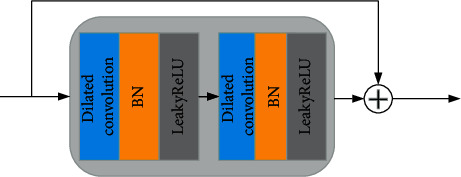
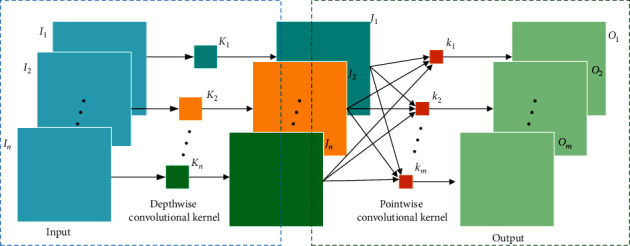
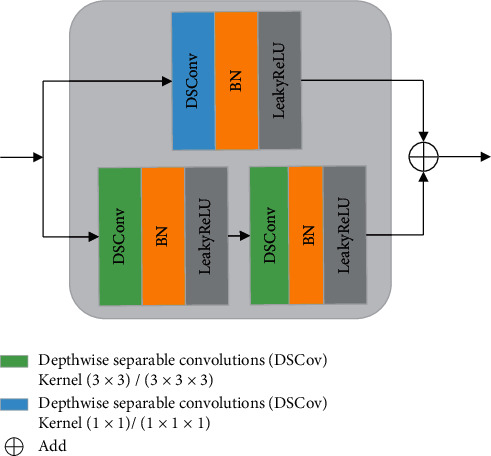
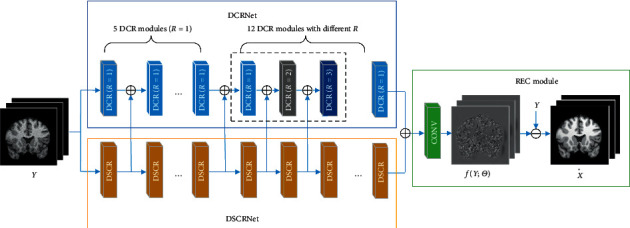
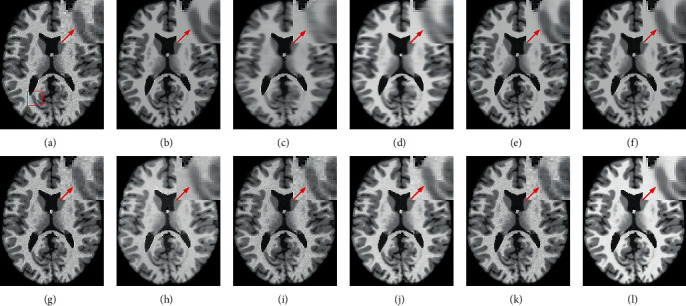
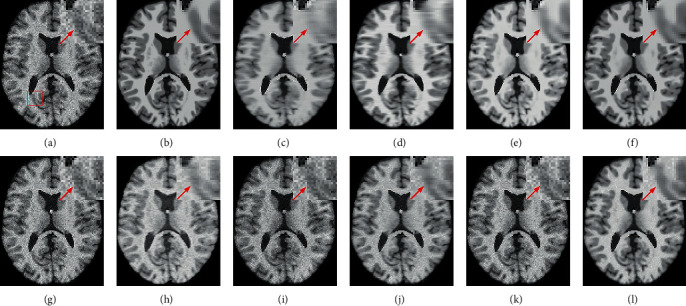
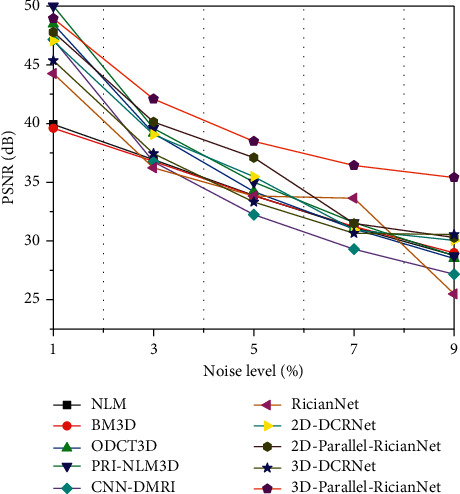
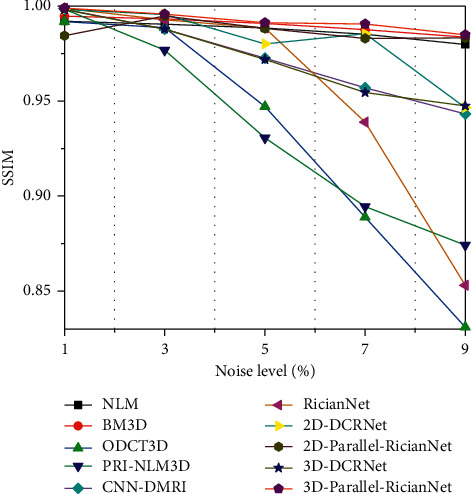
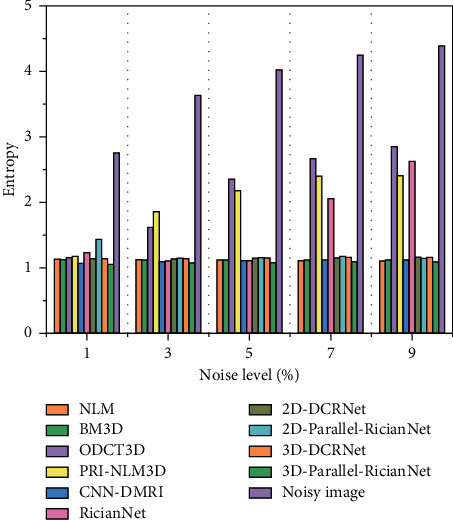
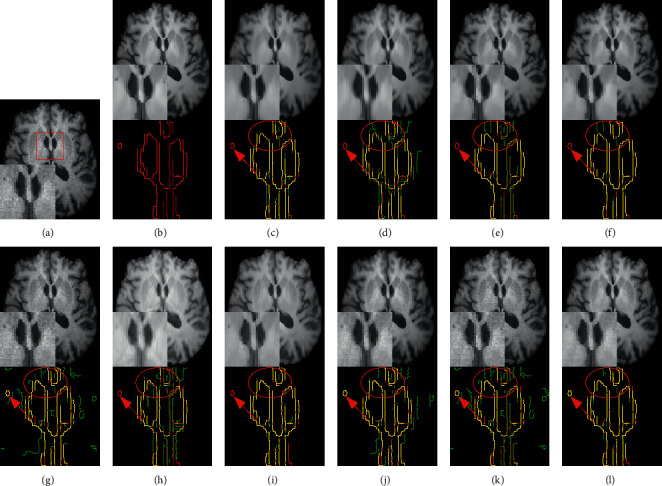
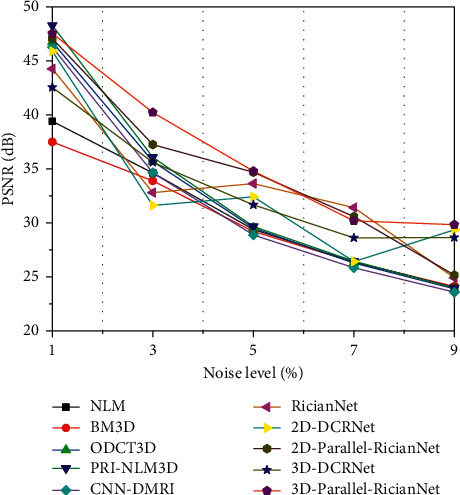
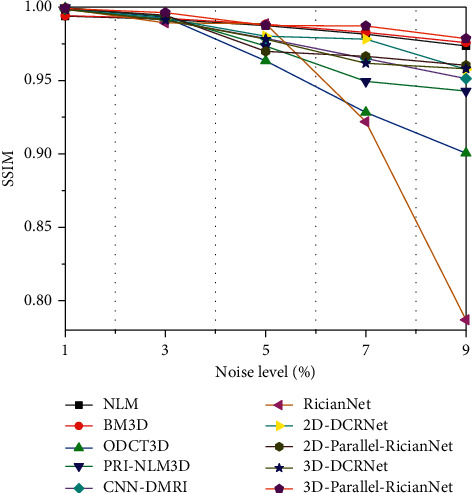
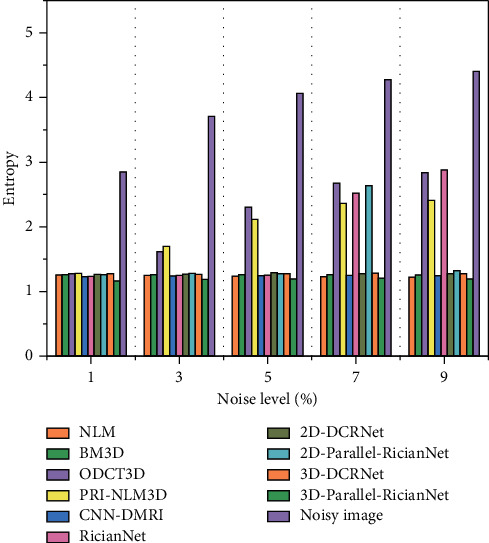
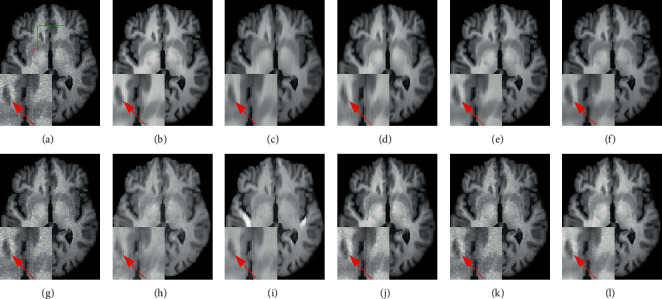
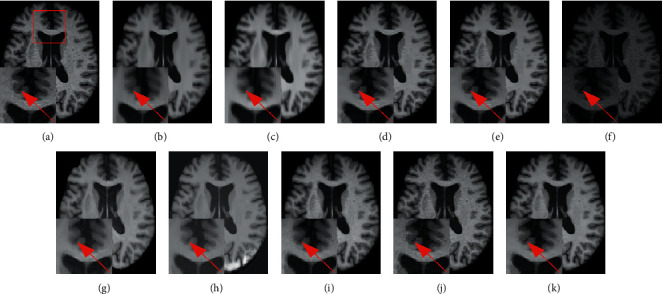
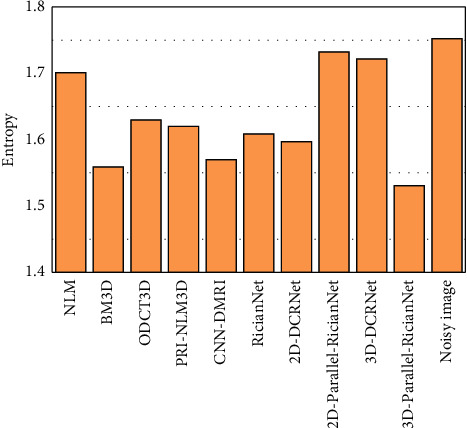
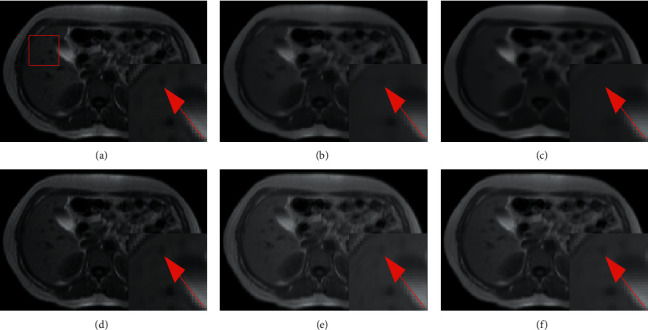
Magnetic resonance (MR) images often suffer from random noise pollution during image acquisition and transmission, which impairs disease diagnosis by doctors or automated systems. In recent years, many noise removal algorithms with impressive performances have been proposed. In this work, inspired by the idea of deep learning, we propose a denoising method named 3D-Parallel-RicianNet, which will combine global and local information to remove noise in MR images. Specifically, we introduce a powerful dilated convolution residual (DCR) module to expand the receptive field of the network and to avoid the loss of global features. Then, to extract more local information and reduce the computational complexity, we design the depthwise separable convolution residual (DSCR) module to learn the channel and position information in the image, which not only reduces parameters dramatically but also improves the local denoising performance. In addition, a parallel network is constructed by fusing the features extracted from each DCR module and DSCR module to improve the efficiency and reduce the complexity for training a denoising model. Finally, a reconstruction (REC) module aims to construct the clean image through the obtained noise deviation and the given noisy image. Due to the lack of ground-truth images in the real MR dataset, the performance of the proposed model was tested qualitatively and quantitatively on one simulated T1-weighted MR image dataset and then expanded to four real datasets. The experimental results show that the proposed 3D-Parallel-RicianNet network achieves performance superior to that of several state-of-the-art methods in terms of the peak signal-to-noise ratio, structural similarity index, and entropy metric. In particular, our method demonstrates powerful abilities in both noise suppression and structure preservation.
磁共振(MR)图像在图像采集和传输过程中经常受到随机噪声污染,这会影响医生或自动化系统的疾病诊断。近年来,已经提出了许多性能令人印象深刻的去噪算法。在这项工作中,受深度学习思想的启发,我们提出了一种名为3D-Parallel-RicianNet的去噪方法,该方法将结合全局和局部信息来去除MR图像中的噪声。具体来说,我们引入了一个强大的扩张卷积残差(DCR)模块来扩大网络的感受野并避免全局特征的丢失。然后,为了提取更多的局部信息并降低计算复杂度,我们设计了深度可分离卷积残差(DSCR)模块来学习图像中的通道和位置信息,这不仅显著减少了参数,还提高了局部去噪性能。此外,通过融合从每个DCR模块和DSCR模块提取的特征构建了一个并行网络,以提高效率并降低训练去噪模型的复杂度。最后,一个重建(REC)模块旨在通过获得的噪声偏差和给定的噪声图像来构建干净的图像。由于真实MR数据集中缺乏真实图像,所提出模型的性能在一个模拟的T1加权MR图像数据集上进行了定性和定量测试,然后扩展到四个真实数据集。实验结果表明,所提出的3D-Parallel-RicianNet网络在峰值信噪比、结构相似性指数和熵度量方面的性能优于几种先进方法。特别是,我们的方法在噪声抑制和结构保留方面都表现出强大的能力。