Yeh Yuan-Chieh, Chen Chin-Chang, Cheng Ching-Yi, Chang Hsin-Ning, Huang Tse-Hung
Department of Traditional Chinese Medicine, Chang Gung Memorial Hospital, Keelung, Taiwan.
Program in Molecular Medicine, School of Life Sciences, National Yang Ming University, Taipei, Taiwan.
Evid Based Complement Alternat Med. 2021 May 10;2021:1943181. doi: 10.1155/2021/1943181. eCollection 2021.
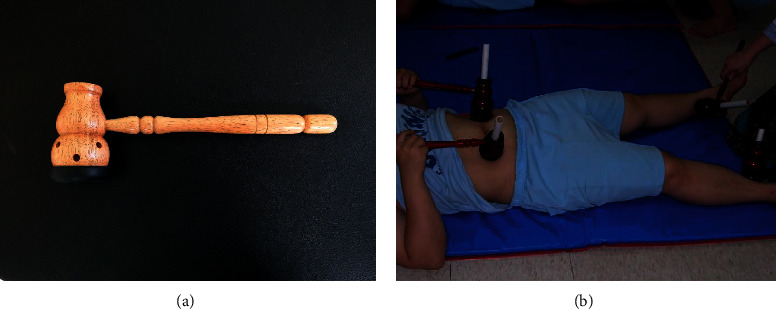
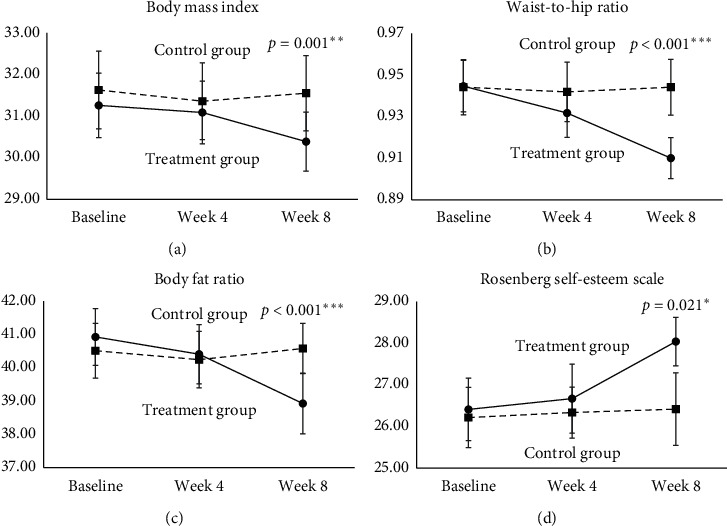
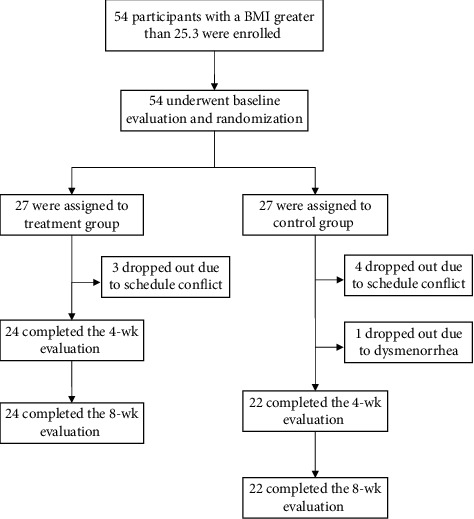
Among adolescent girls, overweight or obesity has both physical and psychological involvement. We conducted a randomized controlled trial of moxibustion using a moxa burner. Fifty-four eligible girls aged 15-18 years with a body mass index (BMI) greater than 25.3 were enrolled in the study. The girls were randomly allocated to the treatment ( = 27) and control ( = 27) groups. The girls underwent treatment three times per week for 8 weeks (24 treatments). Moxibustion was applied to the RN12, RN6, ST25, ST36, and SP6 acupoints. Physical assessments were BMI, waist-to-hip ratio (WHR), and body fat ratio (BFR). Psychological outcomes were measured using the Rosenberg Self-Esteem Scale (RSE). Data were collected at the beginning of the study (baseline), week 4, and week 8. Of the 54 participants, 46 completed the trial. The difference in mean BMI from baseline between the two groups was 0.097 (=0.655) at week 4 and -0.794 (=0.001) at week 8. The mean WHR of the treatment group was significantly reduced compared with baseline, with a -0.011 (=0.017) and -0.035 ( < 0.001) mean change at weeks 4 and 8, respectively. The mean BFR was slightly reduced (-0.253;=0.474 ) at week 4 compared with baseline in the treatment group. At week 8, it was significantly reduced (-2.068; < 0.001) from baseline in the treatment group. The mean RSE in the treatment group showed no significant increase from baseline at week 4 (0.155 points, =0.803), but it improved significantly from baseline at week 8 (1.606 points, =0.021) compared to that in the control group. No obvious adverse effect was reported during this study. Moxibustion using a moxa burner may be an effective and safe intervention for overweight adolescent girls, having both physical and psychological benefits.
在青春期女孩中,超重或肥胖涉及身体和心理两方面。我们使用艾灸盒进行了一项艾灸随机对照试验。54名年龄在15 - 18岁、体重指数(BMI)大于25.3的符合条件的女孩被纳入研究。这些女孩被随机分为治疗组(n = 27)和对照组(n = 27)。女孩们每周接受3次治疗,共8周(24次治疗)。艾灸应用于中脘穴(RN12)、气海穴(RN6)、天枢穴(ST25)、足三里穴(ST36)和三阴交穴(SP6)。身体评估指标为BMI、腰臀比(WHR)和体脂率(BFR)。心理结果使用罗森伯格自尊量表(RSE)进行测量。在研究开始时(基线)、第4周和第8周收集数据。54名参与者中,46人完成了试验。两组在第4周时与基线相比的平均BMI差异为0.097(P = 0.655),在第8周时为 - 0.794(P = 0.001)。治疗组的平均WHR与基线相比显著降低,在第4周和第8周时平均变化分别为 - 0.011(P = 0.017)和 - 0.035(P < 0.001)。治疗组在第4周时与基线相比,平均BFR略有降低( - 0.253;P = 0.474)。在第8周时,治疗组与基线相比显著降低( - 2.068;P < 0.001)。治疗组的平均RSE在第4周时与基线相比无显著增加(0.155分,P = 0.803),但在第8周时与对照组相比,与基线相比有显著改善(1.606分,P = 0.021)。在本研究期间未报告明显的不良反应。使用艾灸盒进行艾灸可能是一种对超重青春期女孩有效且安全的干预措施,对身体和心理都有益处。