Zheng Zongtai, Xu Feijia, Gu Zhuoran, Yan Yang, Xu Tianyuan, Liu Shenghua, Yao Xudong
Department of Urology, Shanghai Tenth People's Hospital, Tongji University School of Medicine, Shanghai, China.
Department of Radiology, Shanghai Tenth People's Hospital, Tongji University School of Medicine, Shanghai, China.
Front Oncol. 2021 May 13;11:619893. doi: 10.3389/fonc.2021.619893. eCollection 2021.
The treatment and prognosis for muscle-invasive bladder cancer (MIBC) and non-muscle-invasive bladder cancer (NMIBC) are different. We aimed to construct a nomogram based on the multiparametric MRI (mpMRI) radiomics signature and the Vesical Imaging-Reporting and Data System (VI-RADS) score for the preoperative differentiation of MIBC from NMIBC.
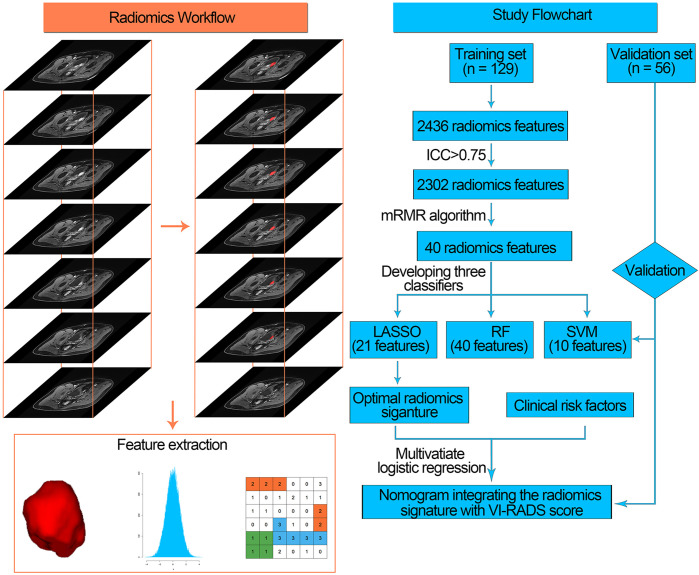
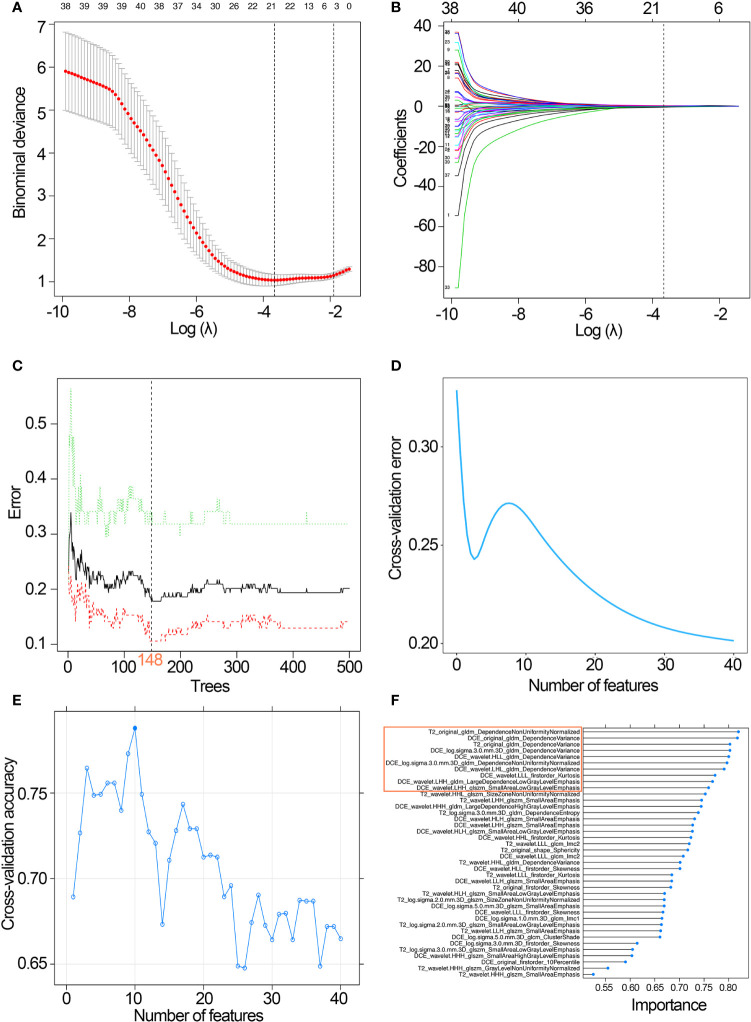
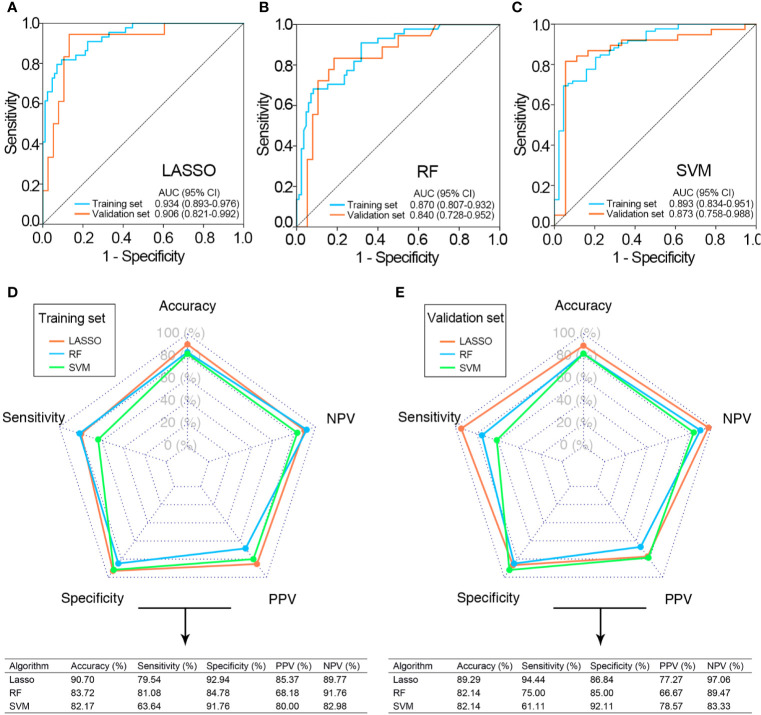
The retrospective study involved 185 pathologically confirmed bladder cancer (BCa) patients (training set: 129 patients, validation set: 56 patients) who received mpMRI before surgery between August 2014 to April 2020. A total of 2,436 radiomics features were quantitatively extracted from the largest lesion located on the axial T2WI and from dynamic contrast-enhancement images. The minimum redundancy maximum relevance (mRMR) algorithm was used for feature screening. The selected features were introduced to construct radiomics signatures using three classifiers, including least absolute shrinkage and selection operator (LASSO), support vector machines (SVM) and random forest (RF) in the training set. The differentiation performances of the three classifiers were evaluated using the area under the curve (AUC) and accuracy. Univariable and multivariable logistic regression were used to develop a nomogram based on the optimal radiomics signature and clinical characteristics. The performance of the radiomics signatures and the nomogram was assessed and validated in the validation set.
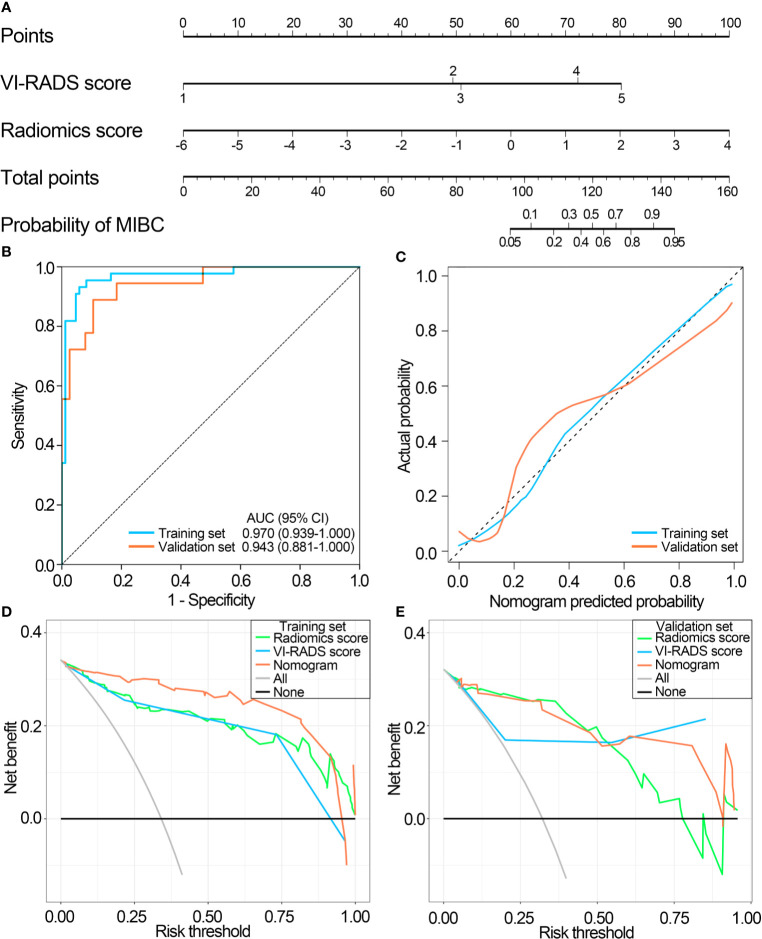
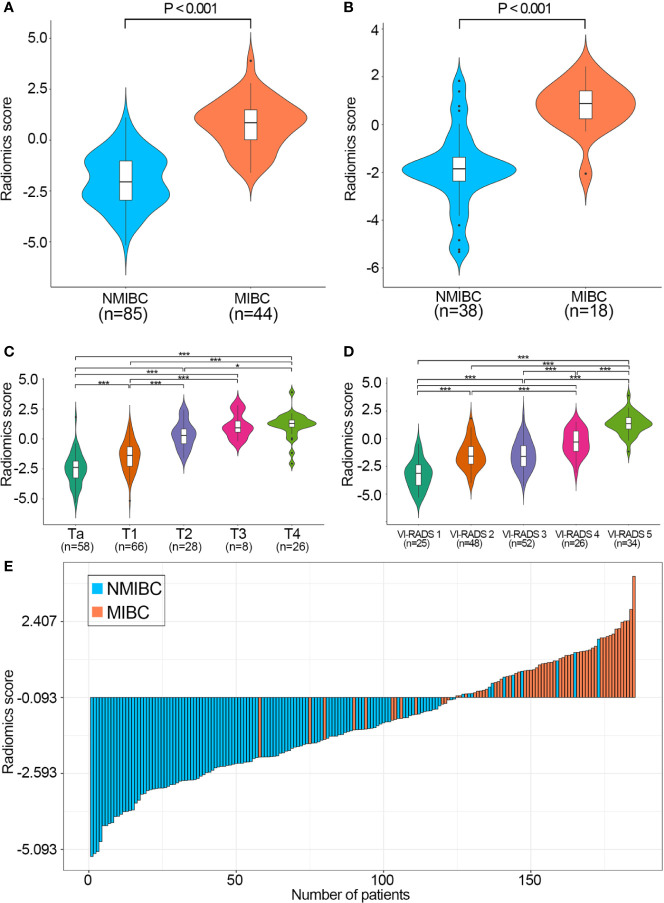
Compared to the RF and SVM classifiers, the LASSO classifier had the best capacity for muscle invasive status differentiation in both the training (accuracy: 90.7%, AUC: 0.934) and validation sets (accuracy: 87.5%, AUC: 0.906). Incorporating the radiomics signature and VI-RADS score, the nomogram demonstrated better discrimination and calibration both in the training set (accuracy: 93.0%, AUC: 0.970) and validation set (accuracy: 89.3%, AUC: 0.943). Decision curve analysis showed the clinical usefulness of the nomogram.
The mpMRI radiomics signature may be useful for the preoperative differentiation of muscle-invasive status in BCa. The proposed nomogram integrating the radiomics signature with the VI-RADS score may further increase the differentiation power and improve clinical decision making.
肌层浸润性膀胱癌(MIBC)和非肌层浸润性膀胱癌(NMIBC)的治疗方法和预后有所不同。我们旨在基于多参数MRI(mpMRI)影像组学特征和膀胱影像报告与数据系统(VI-RADS)评分构建列线图,用于术前鉴别MIBC和NMIBC。
这项回顾性研究纳入了185例经病理证实的膀胱癌(BCa)患者(训练集:129例患者,验证集:56例患者),这些患者在2014年8月至2020年4月期间接受了术前mpMRI检查。从轴位T2WI上的最大病灶以及动态对比增强图像中定量提取了总共2436个影像组学特征。采用最小冗余最大相关(mRMR)算法进行特征筛选。在训练集中,将所选特征引入使用三种分类器构建影像组学特征,这三种分类器包括最小绝对收缩和选择算子(LASSO)、支持向量机(SVM)和随机森林(RF)。使用曲线下面积(AUC)和准确率评估这三种分类器的鉴别性能。采用单变量和多变量逻辑回归,基于最佳影像组学特征和临床特征构建列线图。在验证集中评估并验证影像组学特征和列线图的性能。
与RF和SVM分类器相比,LASSO分类器在训练集(准确率:90.7%,AUC:0.934)和验证集(准确率:87.5%,AUC:0.906)中对肌层浸润状态的鉴别能力最佳。结合影像组学特征和VI-RADS评分,列线图在训练集(准确率:93.0%,AUC:0.970)和验证集(准确率:89.3%,AUC:0.943)中均表现出更好的鉴别能力和校准能力。决策曲线分析显示了列线图的临床实用性。
mpMRI影像组学特征可能有助于BCa肌层浸润状态的术前鉴别。所提出的将影像组学特征与VI-RADS评分相结合的列线图可能会进一步提高鉴别能力并改善临床决策。