• 文献检索
  • 文档翻译
  • 深度研究
  • 学术资讯
  • Suppr Zotero 插件Zotero 插件
  • 邀请有礼
  • 套餐&价格
  • 历史记录
应用&插件
Suppr Zotero 插件Zotero 插件浏览器插件Mac 客户端Windows 客户端微信小程序
定价
高级版会员购买积分包购买API积分包
服务
文献检索文档翻译深度研究API 文档MCP 服务
关于我们
关于 Suppr公司介绍联系我们用户协议隐私条款
关注我们

Suppr 超能文献

核心技术专利:CN118964589B侵权必究
粤ICP备2023148730 号-1Suppr @ 2026

文献检索

告别复杂PubMed语法,用中文像聊天一样搜索,搜遍4000万医学文献。AI智能推荐,让科研检索更轻松。

立即免费搜索

文件翻译

保留排版,准确专业,支持PDF/Word/PPT等文件格式,支持 12+语言互译。

免费翻译文档

深度研究

AI帮你快速写综述,25分钟生成高质量综述,智能提取关键信息,辅助科研写作。

立即免费体验

基于图像的人工智能在预测肌肉浸润性膀胱癌方面的准确性和质量。

The accuracy and quality of image-based artificial intelligence for muscle-invasive bladder cancer prediction.

作者信息

He Chunlei, Xu Hui, Yuan Enyu, Ye Lei, Chen Yuntian, Yao Jin, Song Bin

机构信息

Department of Radiology, West China Hospital, Sichuan University, Chengdu, 610041, China.

Department of Radiology, Sanya People's Hospital, Sanya, Hainan, 572000, China.

出版信息

Insights Imaging. 2024 Aug 1;15(1):185. doi: 10.1186/s13244-024-01780-y.

DOI:10.1186/s13244-024-01780-y
PMID:39090234
原文链接:https://pmc.ncbi.nlm.nih.gov/articles/PMC11294512/
Abstract

PURPOSE

To evaluate the diagnostic performance of image-based artificial intelligence (AI) studies in predicting muscle-invasive bladder cancer (MIBC). (2) To assess the reporting quality and methodological quality of these studies by Checklist for Artificial Intelligence in Medical Imaging (CLAIM), Radiomics Quality Score (RQS), and Prediction model Risk of Bias Assessment Tool (PROBAST).

MATERIALS AND METHODS

We searched Medline, Embase, Web of Science, and The Cochrane Library databases up to October 30, 2023. The eligible studies were evaluated using CLAIM, RQS, and PROBAST. Pooled sensitivity, specificity, and the diagnostic performances of these models for MIBC were also calculated.

RESULTS

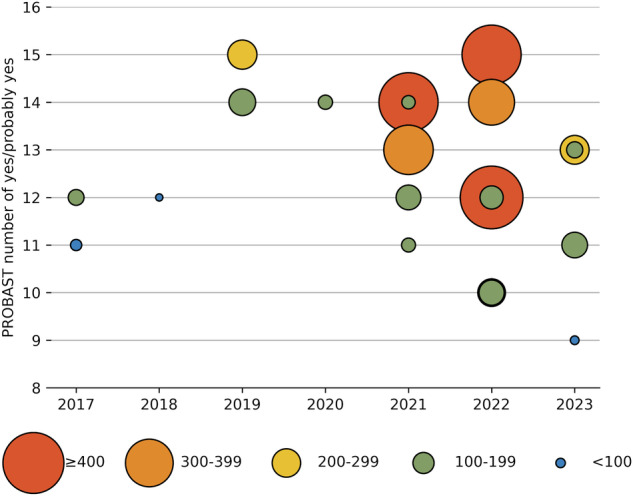
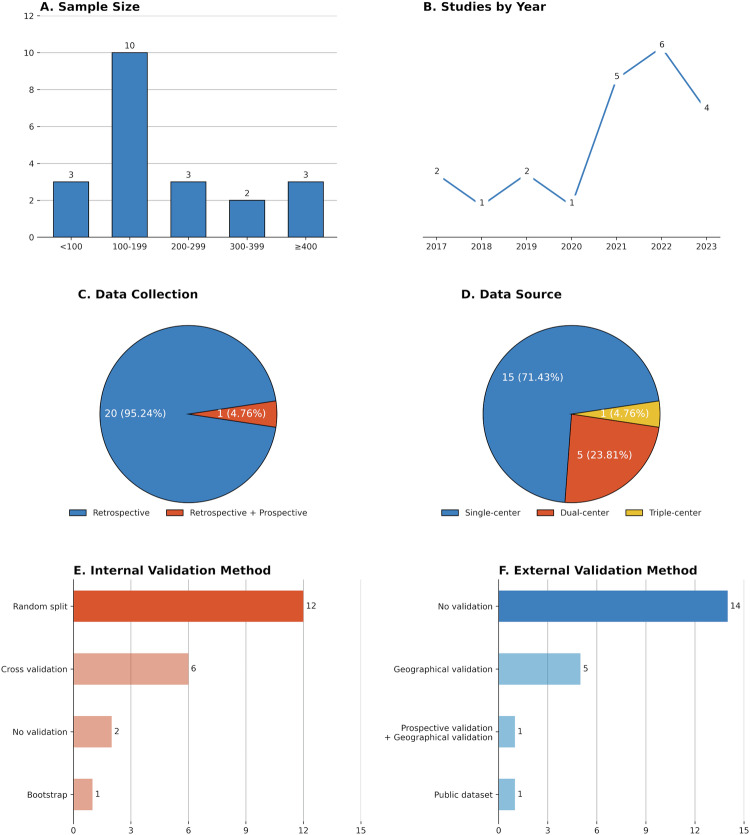
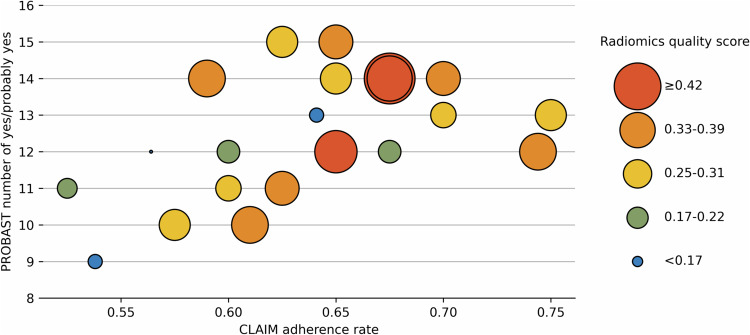
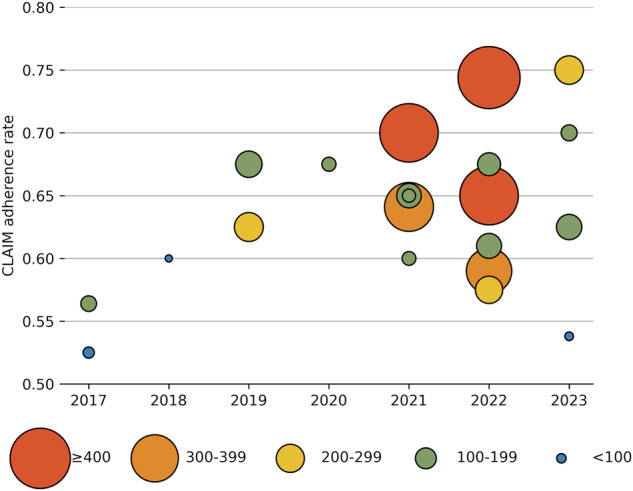
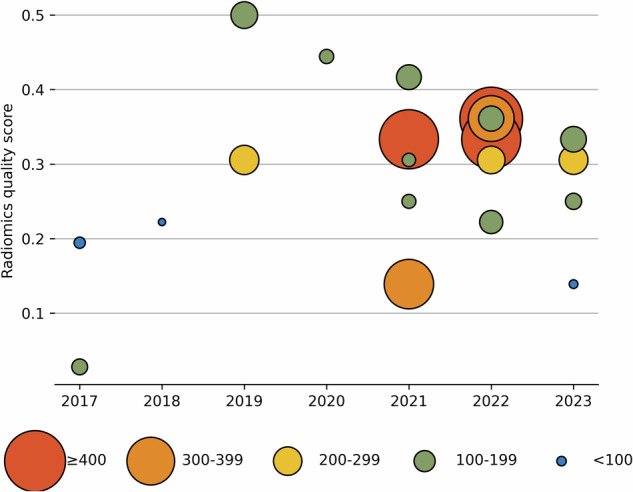
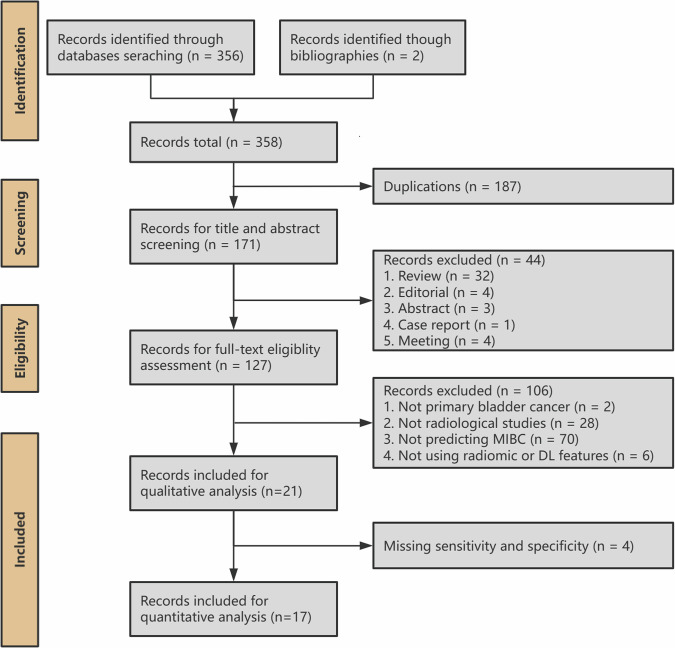
Twenty-one studies containing 4256 patients were included, of which 17 studies were employed for the quantitative statistical analysis. The CLAIM study adherence rate ranged from 52.5% to 75%, with a median of 64.1%. The RQS points of each study ranged from 2.78% to 50% points, with a median of 30.56% points. All models were rated as high overall ROB. The pooled area under the curve was 0.85 (95% confidence interval (CI) 0.81-0.88) for computed tomography, 0.92 (95% CI 0.89-0.94) for MRI, 0.89 (95% CI 0.86-0.92) for radiomics and 0.91 (95% CI 0.88-0.93) for deep learning, respectively.

CONCLUSION

Although AI-powered muscle-invasive bladder cancer-predictive models showed promising performance in the meta-analysis, the reporting quality and the methodological quality were generally low, with a high risk of bias.

CRITICAL RELEVANCE STATEMENT

Artificial intelligence might improve the management of patients with bladder cancer. Multiple models for muscle-invasive bladder cancer prediction were developed. Quality assessment is needed to promote clinical application.

KEY POINTS

Image-based artificial intelligence models could aid in the identification of muscle-invasive bladder cancer. Current studies had low reporting quality, low methodological quality, and a high risk of bias. Future studies could focus on larger sample sizes and more transparent reporting of pathological evaluation, model explanation, and failure and sensitivity analyses.

摘要

目的

评估基于图像的人工智能(AI)研究在预测肌层浸润性膀胱癌(MIBC)方面的诊断性能。(2)通过医学影像人工智能检查表(CLAIM)、影像组学质量评分(RQS)和预测模型偏倚风险评估工具(PROBAST)评估这些研究的报告质量和方法学质量。

材料与方法

我们检索了截至2023年10月30日的Medline、Embase、Web of Science和Cochrane图书馆数据库。使用CLAIM、RQS和PROBAST对符合条件的研究进行评估。还计算了这些模型对MIBC的合并敏感性、特异性和诊断性能。

结果

纳入了21项包含4256例患者的研究,其中17项研究用于定量统计分析。CLAIM研究的依从率在52.5%至75%之间,中位数为64.1%。每项研究的RQS分数在2.78%至50%之间,中位数为30.56%。所有模型的总体偏倚风险均被评为高。计算机断层扫描的合并曲线下面积为0.85(95%置信区间(CI)0.81 - 0.88),磁共振成像为0.92(95%CI 0.89 - 0.94),影像组学为0.89(95%CI 0.86 - 0.92),深度学习为0.91(95%CI 0.88 - 0.93)。

结论

尽管人工智能驱动的肌层浸润性膀胱癌预测模型在荟萃分析中显示出有前景的性能,但报告质量和方法学质量普遍较低,存在较高的偏倚风险。

关键相关性声明

人工智能可能改善膀胱癌患者的管理。已开发出多种肌层浸润性膀胱癌预测模型。需要进行质量评估以促进临床应用。

要点

基于图像的人工智能模型有助于识别肌层浸润性膀胱癌。当前研究的报告质量低、方法学质量低且偏倚风险高。未来的研究可以集中在更大的样本量以及更透明地报告病理评估、模型解释以及失败和敏感性分析。
https://cdn.ncbi.nlm.nih.gov/pmc/blobs/fe6e/11294512/915f84a9db7b/13244_2024_1780_Fig6_HTML.jpg
https://cdn.ncbi.nlm.nih.gov/pmc/blobs/fe6e/11294512/d0b9d4377ee9/13244_2024_1780_Fig1_HTML.jpg
https://cdn.ncbi.nlm.nih.gov/pmc/blobs/fe6e/11294512/425b2f5c2592/13244_2024_1780_Fig2_HTML.jpg
https://cdn.ncbi.nlm.nih.gov/pmc/blobs/fe6e/11294512/203123230b04/13244_2024_1780_Fig3_HTML.jpg
https://cdn.ncbi.nlm.nih.gov/pmc/blobs/fe6e/11294512/6ea6ab2f9c32/13244_2024_1780_Fig4_HTML.jpg
https://cdn.ncbi.nlm.nih.gov/pmc/blobs/fe6e/11294512/e27ab1edd52f/13244_2024_1780_Fig5_HTML.jpg
https://cdn.ncbi.nlm.nih.gov/pmc/blobs/fe6e/11294512/915f84a9db7b/13244_2024_1780_Fig6_HTML.jpg
https://cdn.ncbi.nlm.nih.gov/pmc/blobs/fe6e/11294512/d0b9d4377ee9/13244_2024_1780_Fig1_HTML.jpg
https://cdn.ncbi.nlm.nih.gov/pmc/blobs/fe6e/11294512/425b2f5c2592/13244_2024_1780_Fig2_HTML.jpg
https://cdn.ncbi.nlm.nih.gov/pmc/blobs/fe6e/11294512/203123230b04/13244_2024_1780_Fig3_HTML.jpg
https://cdn.ncbi.nlm.nih.gov/pmc/blobs/fe6e/11294512/6ea6ab2f9c32/13244_2024_1780_Fig4_HTML.jpg
https://cdn.ncbi.nlm.nih.gov/pmc/blobs/fe6e/11294512/e27ab1edd52f/13244_2024_1780_Fig5_HTML.jpg
https://cdn.ncbi.nlm.nih.gov/pmc/blobs/fe6e/11294512/915f84a9db7b/13244_2024_1780_Fig6_HTML.jpg

相似文献

1
The accuracy and quality of image-based artificial intelligence for muscle-invasive bladder cancer prediction.基于图像的人工智能在预测肌肉浸润性膀胱癌方面的准确性和质量。
Insights Imaging. 2024 Aug 1;15(1):185. doi: 10.1186/s13244-024-01780-y.
2
Role of Radiomics in the Prediction of Muscle-invasive Bladder Cancer: A Systematic Review and Meta-analysis.基于放射组学的膀胱癌肌层浸润预测:系统综述与 Meta 分析。
Eur Urol Focus. 2022 May;8(3):728-738. doi: 10.1016/j.euf.2021.05.005. Epub 2021 Jun 5.
3
Artificial intelligence with magnetic resonance imaging for prediction of pathological complete response to neoadjuvant chemoradiotherapy in rectal cancer: A systematic review and meta-analysis.人工智能结合磁共振成像预测直肠癌新辅助放化疗后的病理完全缓解:一项系统评价和荟萃分析。
Front Oncol. 2022 Oct 12;12:1026216. doi: 10.3389/fonc.2022.1026216. eCollection 2022.
4
Artificial intelligence model on chest imaging to diagnose COVID-19 and other pneumonias: A systematic review and meta-analysis.用于诊断新冠肺炎及其他肺炎的胸部影像人工智能模型:一项系统评价与荟萃分析。
Eur J Radiol Open. 2022;9:100438. doi: 10.1016/j.ejro.2022.100438. Epub 2022 Aug 18.
5
Diagnostic Performance of Vesical Imaging Reporting and Data System for the Prediction of Muscle-invasive Bladder Cancer: A Systematic Review and Meta-analysis.膀胱影像报告和数据系统在预测肌层浸润性膀胱癌中的诊断性能:系统评价和荟萃分析。
Eur Urol Oncol. 2020 Jun;3(3):306-315. doi: 10.1016/j.euo.2020.02.007. Epub 2020 Mar 19.
6
Artificial Intelligence-Driven Radiomics in Head and Neck Cancer: Current Status and Future Prospects.人工智能驱动的头颈部癌症放射组学:现状与未来展望。
Int J Med Inform. 2024 Aug;188:105464. doi: 10.1016/j.ijmedinf.2024.105464. Epub 2024 Apr 23.
7
Radiomics for the identification of extraprostatic extension with prostate MRI: a systematic review and meta-analysis.基于 MRI 的前列腺癌外扩的影像组学分析:一项系统综述和荟萃分析。
Eur Radiol. 2024 Jun;34(6):3981-3991. doi: 10.1007/s00330-023-10427-3. Epub 2023 Nov 13.
8
Prospective Assessment of Vesical Imaging Reporting and Data System (VI-RADS) and Its Clinical Impact on the Management of High-risk Non-muscle-invasive Bladder Cancer Patients Candidate for Repeated Transurethral Resection.前瞻性评估膀胱影像报告和数据系统(VI-RADS)及其对高危非肌肉浸润性膀胱癌患者重复经尿道切除术候选者管理的临床影响。
Eur Urol. 2020 Jan;77(1):101-109. doi: 10.1016/j.eururo.2019.09.029. Epub 2019 Nov 5.
9
An updated systematic review of radiomics in osteosarcoma: utilizing CLAIM to adapt the increasing trend of deep learning application in radiomics.骨肉瘤中放射组学的最新系统评价:利用CLAIM适应放射组学中深度学习应用的增长趋势。
Insights Imaging. 2022 Aug 20;13(1):138. doi: 10.1186/s13244-022-01277-6.
10
Evaluation of Risk of Bias in Neuroimaging-Based Artificial Intelligence Models for Psychiatric Diagnosis: A Systematic Review.基于神经影像学的人工智能模型在精神疾病诊断中的偏倚风险评估:系统综述。
JAMA Netw Open. 2023 Mar 1;6(3):e231671. doi: 10.1001/jamanetworkopen.2023.1671.

引用本文的文献

1
The Use of Artificial Intelligence in Urologic Oncology: Current Insights and Challenges.人工智能在泌尿外科肿瘤学中的应用:当前见解与挑战
Res Rep Urol. 2025 Aug 21;17:293-308. doi: 10.2147/RRU.S526184. eCollection 2025.
2
Evolving and Novel Applications of Artificial Intelligence in Cancer Imaging.人工智能在癌症成像中的不断发展与新应用
Cancers (Basel). 2025 Apr 30;17(9):1510. doi: 10.3390/cancers17091510.
3
Evaluation of the Diagnostic Efficacy of the AI-Based Software INF-M01 in Detecting Suspicious Areas of Bladder Cancer Using Cystoscopy Images.

本文引用的文献

1
METhodological RadiomICs Score (METRICS): a quality scoring tool for radiomics research endorsed by EuSoMII.方法学放射组学评分(METRICS):一种由欧洲医学影像信息学会(EuSoMII)认可的放射组学研究质量评分工具。
Insights Imaging. 2024 Jan 17;15(1):8. doi: 10.1186/s13244-023-01572-w.
2
A Guide to Cross-Validation for Artificial Intelligence in Medical Imaging.医学成像中人工智能的交叉验证指南
Radiol Artif Intell. 2023 May 24;5(4):e220232. doi: 10.1148/ryai.220232. eCollection 2023 Jul.
3
Evaluating medical tests: introducing the Cochrane Handbook for Systematic Reviews of Diagnostic Test Accuracy.
基于人工智能的软件INF-M01利用膀胱镜检查图像检测膀胱癌可疑区域的诊断效能评估。
J Clin Med. 2024 Nov 24;13(23):7110. doi: 10.3390/jcm13237110.
4
Artificial Intelligence can Facilitate Application of Risk Stratification Algorithms to Bladder Cancer Patient Case Scenarios.人工智能可促进风险分层算法在膀胱癌患者病例场景中的应用。
Clin Med Insights Oncol. 2024 Nov 17;18:11795549241296781. doi: 10.1177/11795549241296781. eCollection 2024.
评估医学检验:介绍《Cochrane诊断试验准确性系统评价手册》
Cochrane Database Syst Rev. 2023 Jul 20;7(7):ED000163. doi: 10.1002/14651858.ED000163.
4
MRI-Based Radiomics in Bladder Cancer: A Systematic Review and Radiomics Quality Score Assessment.基于MRI的膀胱癌影像组学:系统评价与影像组学质量评分评估
Diagnostics (Basel). 2023 Jul 6;13(13):2300. doi: 10.3390/diagnostics13132300.
5
CheckList for EvaluAtion of Radiomics research (CLEAR): a step-by-step reporting guideline for authors and reviewers endorsed by ESR and EuSoMII.放射组学研究评估清单(CLEAR):由欧洲放射学会(ESR)和欧洲医学影像信息学会(EuSoMII)认可的作者和审稿人分步报告指南。
Insights Imaging. 2023 May 4;14(1):75. doi: 10.1186/s13244-023-01415-8.
6
Performing Automatic Identification and Staging of Urothelial Carcinoma in Bladder Cancer Patients Using a Hybrid Deep-Machine Learning Approach.使用混合深度机器学习方法对膀胱癌患者的尿路上皮癌进行自动识别和分期
Cancers (Basel). 2023 Mar 8;15(6):1673. doi: 10.3390/cancers15061673.
7
Predicting muscle invasion in bladder cancer based on MRI: A comparison of radiomics, and single-task and multi-task deep learning.基于MRI预测膀胱癌的肌肉浸润:放射组学、单任务和多任务深度学习的比较。
Comput Methods Programs Biomed. 2023 May;233:107466. doi: 10.1016/j.cmpb.2023.107466. Epub 2023 Mar 5.
8
CT-based deep learning radiomics signature for the preoperative prediction of the muscle-invasive status of bladder cancer.基于CT的深度学习影像组学特征用于膀胱癌肌层浸润状态的术前预测
Front Oncol. 2022 Dec 5;12:1019749. doi: 10.3389/fonc.2022.1019749. eCollection 2022.
9
Integrating radiomics with the vesical imaging-reporting and data system to predict muscle invasion of bladder cancer.将影像组学与膀胱成像报告和数据系统相结合,以预测膀胱癌的肌肉浸润。
Urol Oncol. 2023 Jun;41(6):294.e1-294.e8. doi: 10.1016/j.urolonc.2022.10.024. Epub 2022 Dec 14.
10
Predicting muscle invasion in bladder cancer by deep learning analysis of MRI: comparison with vesical imaging-reporting and data system.通过MRI深度学习分析预测膀胱癌的肌肉浸润:与膀胱影像报告和数据系统的比较
Eur Radiol. 2023 Apr;33(4):2699-2709. doi: 10.1007/s00330-022-09272-7. Epub 2022 Nov 25.