Department of Animal Sciences and Production, Université Evangélique en Afrique, Bukavu 3323, Democratic Republic of Congo.
Department of Molecular Biology and Biotechnology, Pan African University Institute of Basic Sciences, Technology and Innovation, Nairobi 62000-00200, Kenya.
J Vet Sci. 2021 May;22(3):e35. doi: 10.4142/jvs.2021.22.e35.
African swine fever (ASF) is an infectious viral disease of domestic pigs that presents as a hemorrhagic fever, and for which no effective vaccine is available. The disease has a serious negative social and economic impact on pig keepers. There is limited information on the potential risk factors responsible for the spread of ASF in South Kivu.
The aim of this study was to determine the potential risk factors associated with ASF infection in suspected ASF virus (ASFV)-infected pigs.
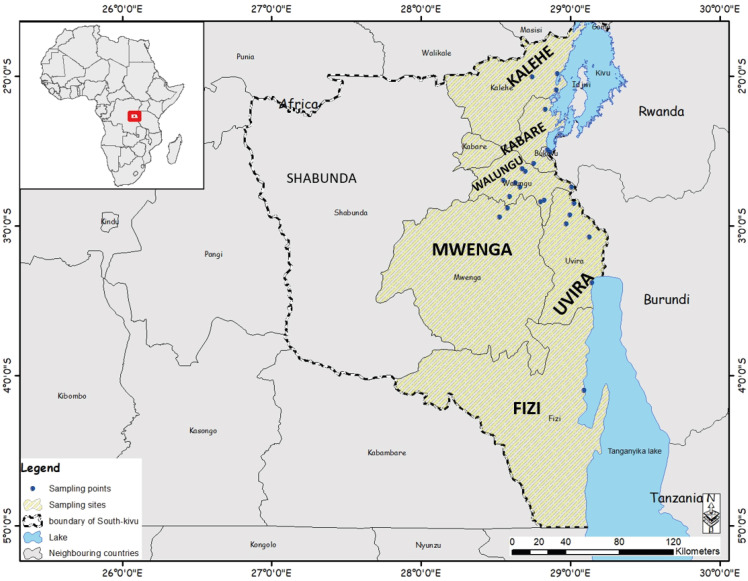
We sampled whole blood from 391 pigs. Additionally, 300 pig farmers were interviewed using a structured questionnaire. Viral DNA was detected by using the real-time polymerase chain reaction technique.
The majority of pigs sampled, 78% (95% confidence interval [CI], 74.4-82.6), were of local breeds. Over half, 60.4% (95% CI, 55.5-65.2), were female, and most of them, 90.5% (95% CI, 87.6-93.4), were adult pigs (> 1 year old). Viral DNA was detected in 72 of the 391 sampled pigs, indicating an overall infection rate of 18.4% (95% CI, 14.5-22.4). Multivariable logistic regression analysis revealed several risk factors positively associated with ASFV infection: feeding with swill in pen (odds ratio [OR], 3.8; 95% CI, 2.12-6.77); mixed ages of pigs in the same pen (OR, 3.3; 95% CI, 1.99-5.57); introduction of new animals to the farm (OR, 5.4; 95% CI, 1.91-15.28). The risk factors that were negatively (protective) correlated with ASFV positivity were the presence of male animals and the use of an in-pen breeding system.
Local pig farmers should be encouraged to adopt proper husbandry and feeding practices in order to increase the number of ASF-free farms.
非洲猪瘟(ASF)是一种感染家猪的传染性病毒病,表现为出血热,目前尚无有效的疫苗。这种疾病对养猪户造成了严重的负面社会和经济影响。关于导致ASF 在南基伍省传播的潜在风险因素的信息有限。
本研究旨在确定与疑似 ASF 病毒(ASFV)感染猪 ASF 感染相关的潜在风险因素。
我们从 391 头猪中采集全血。此外,我们还使用结构化问卷对 300 名养猪户进行了访谈。通过实时聚合酶链反应技术检测病毒 DNA。
我们采集的大多数猪,78%(95%置信区间[CI],74.4-82.6)为本地品种。超过一半,60.4%(95% CI,55.5-65.2)为雌性,其中 90.5%(95% CI,87.6-93.4)为成年猪(>1 岁)。在 391 头采样猪中,有 72 头检测到病毒 DNA,表明总感染率为 18.4%(95% CI,14.5-22.4)。多变量逻辑回归分析显示,一些风险因素与 ASFV 感染呈正相关:在猪圈内用泔水喂养(比值比[OR],3.8;95% CI,2.12-6.77);同一圈内猪的年龄混合(OR,3.3;95% CI,1.99-5.57);向农场引入新动物(OR,5.4;95% CI,1.91-15.28)。与 ASFV 阳性呈负相关(保护)的风险因素是雄性动物的存在和圈养繁殖系统的使用。
应该鼓励当地养猪户采用适当的饲养和喂养措施,以增加无 ASF 农场的数量。