Glenn Biggs Institute of Alzheimer's and Neurodegenerative Diseases, University of Texas Health Science Center, San Antonio, TX, USA.
Boston University School of Public Health, Boston, MA, USA.
J Alzheimers Dis. 2021;82(2):593-605. doi: 10.3233/JAD-200957.
An association between chronic infectious diseases and development of dementia has been suspected for decades, based on the finding of pathogens in postmortem brain tissue and on serological evidence. However, questions remain regarding confounders, reverse causality, and how accurate, reproducible and generalizable those findings are.
Investigate whether exposure to Herpes simplex (manifested as herpes labialis), Chlamydophila pneumoniae (C. pneumoniae), Helicobacter pylori (H. pylori), and cytomegalovirus (CMV) modifies the risk of dementia in a populational cohort.
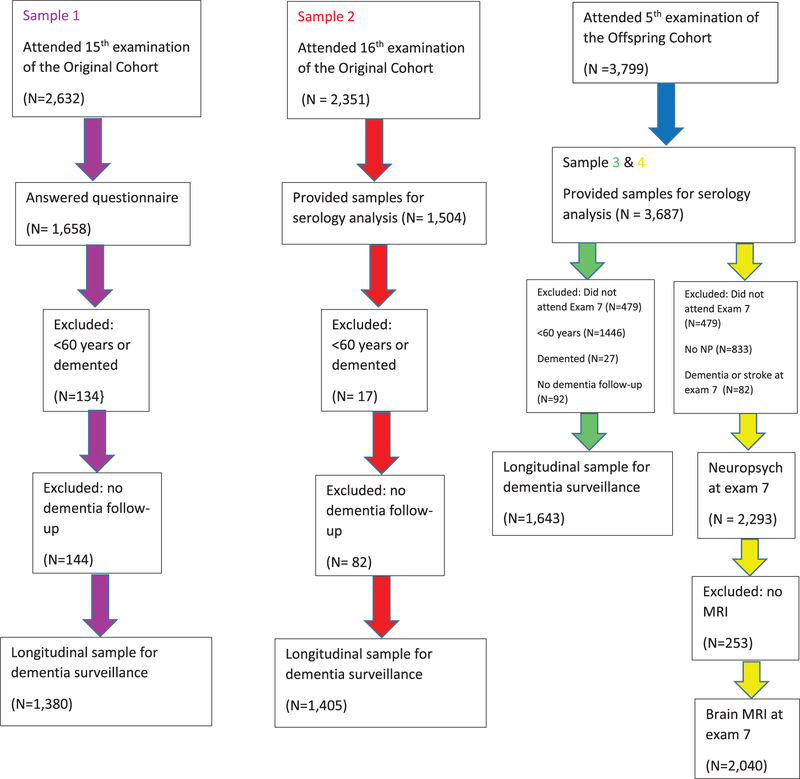
Questionnaires regarding incidence of herpes infections were administered to Original Framingham Study participants (n = 2,632). Serologies for C. pneumoniae, H. pylori, and CMV were obtained in Original (n = 2,351) and Offspring cohort (n = 3,687) participants. Participants are under continuous dementia surveillance. Brain MRI and neuropsychological batteries were administered to Offspring participants from 1999-2005. The association between each infection and incident dementia was tested with Cox models. Linear models were used to investigate associations between MRI or neuropsychological parameters and serologies.
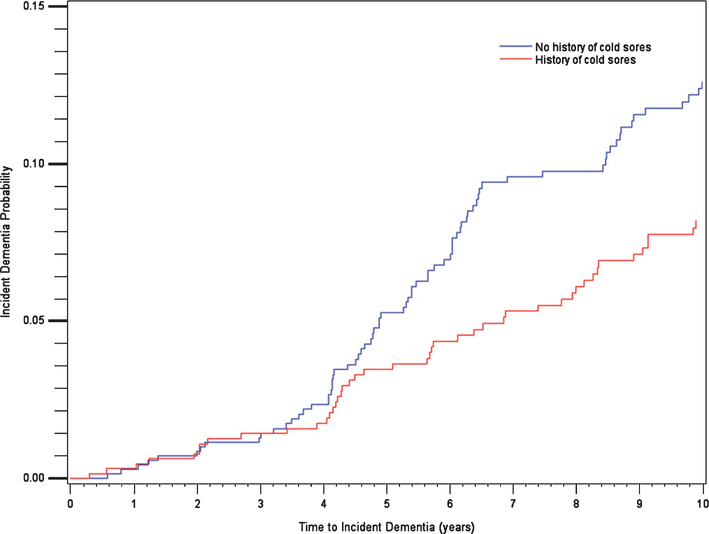
There was no association between infection serologies and dementia incidence, total brain volume, and white matter hyperintensities. Herpes labialis was associated with reduced 10-year dementia risk (HR 0.66, CI 0.46-0.97), but not for the duration of follow-up. H. pylori antibodies were associated with worse global cognition (β -0.14, CI -0.22, -0.05).
We found no association between measures of chronic infection and incident dementia, except for a reduction in 10-year dementia risk for patients with herpes labialis. This unexpected result requires confirmation and further characterization, concerning antiviral treatment effects and capture of episodes.
基于尸检脑组织中病原体的发现和血清学证据,几十年来,人们一直怀疑慢性传染病与痴呆的发展之间存在关联。然而,关于混杂因素、反向因果关系以及这些发现的准确性、可重复性和普遍性仍存在疑问。
在人群队列中研究单纯疱疹(表现为唇疱疹)、肺炎衣原体(C. pneumoniae)、幽门螺杆菌(H. pylori)和巨细胞病毒(CMV)感染暴露是否会改变痴呆的风险。
对原始弗雷明汉研究参与者(n=2632)进行疱疹感染发病率的问卷调查。在原始队列(n=2351)和后代队列(n=3687)参与者中获得肺炎衣原体、幽门螺杆菌和巨细胞病毒的血清学检测结果。参与者接受持续的痴呆监测。对后代参与者进行脑部 MRI 和神经心理学测试,时间为 1999-2005 年。使用 Cox 模型检验每种感染与新发痴呆之间的关系。使用线性模型研究 MRI 或神经心理学参数与血清学之间的关联。
感染血清学与痴呆发病率、总脑容量和白质高信号之间无关联。唇疱疹与 10 年痴呆风险降低相关(HR 0.66,CI 0.46-0.97),但与随访时间无关。幽门螺杆菌抗体与整体认知能力下降相关(β -0.14,CI -0.22,-0.05)。
除了唇疱疹患者 10 年痴呆风险降低外,我们未发现慢性感染指标与新发痴呆之间存在关联。这一意外结果需要进一步确认和表征,包括抗病毒治疗效果和发作的捕获。