Bühler Anneke, Thrul Johannes, Gomes de Matos Elena
Hochschule für angewandte Wissenschaften Kempten, Bahnhofstr. 61, 87435, Kempten, Deutschland.
Johns Hopkins University, Baltimore, USA.
Bundesgesundheitsblatt Gesundheitsforschung Gesundheitsschutz. 2021 Jun;64(6):737-746. doi: 10.1007/s00103-021-03342-9. Epub 2021 May 31.
A substantial group of adolescents and young adults engage in risky alcohol use and there is a need for alcohol prevention. The 2020 BZgA review of reviews on addiction prevention provides the best available scientific knowledge on effectiveness of prevention measures for young people.
Which approaches show preventive effects on alcohol use in different prevention settings?
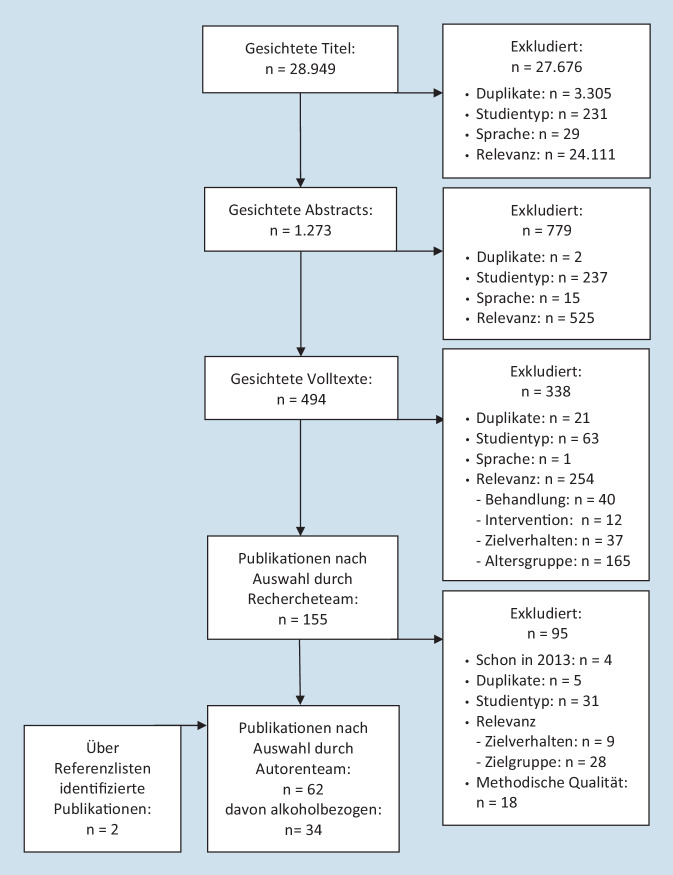
A systematic literature search in June 2017 in seven international databases resulted in 28,949 hits. Inclusion criteria were a review or meta-analysis study type, a 2012-2017 publication date, a universal or selective target group, age up to 25 years, and a target behavior of alcohol consumption. Exclusion criteria were target group people with substance use disorders and target behavior risk factors. The three authors performed a systematic content analysis of 34 alcohol-related publications and assessed their methodology using AMSTAR (A MeaSurement Tool to Assess systematic Reviews). Conclusions and recommendations were framed by consensus among all authors.
Based on a total number of 53 conclusions on the effectiveness of alcohol prevention approaches depending on setting (family, school, college, media, health care, and community) and target group, it can be recommended - among other things - to implement family programs and parenting training, behavioral programs targeting specific personal and social skills, brief interventions with feedback, and mentoring programs. No recent reviews that investigated the effectiveness of alcohol policies at the community or national level could be identified.
Behavioral alcohol prevention is effective. It is recommended to address specific age and target groups in different settings by using specific interventions. Consensus is needed with regard to what kind of evidence proves effectiveness of environmental prevention measures.
相当一部分青少年和青年存在危险饮酒行为,因此需要进行酒精预防。2020年德国中央健康教育中心(BZgA)对成瘾预防综述进行的审查提供了关于青少年预防措施有效性的最佳现有科学知识。
在不同的预防环境中,哪些方法对酒精使用有预防作用?
2017年6月在七个国际数据库中进行了系统的文献检索,共得到28949条结果。纳入标准为综述或荟萃分析研究类型、2012年至2017年的出版日期、普遍或特定目标群体、年龄在25岁以下以及饮酒的目标行为。排除标准为患有物质使用障碍的目标群体和目标行为风险因素。三位作者对34篇与酒精相关的出版物进行了系统的内容分析,并使用AMSTAR(评估系统评价的测量工具)评估了它们的方法。所有作者通过共识形成了结论和建议。
基于总共53条关于酒精预防方法有效性的结论,这些结论取决于环境(家庭、学校、学院、媒体、医疗保健和社区)和目标群体,除其他事项外,可以建议实施家庭计划和育儿培训、针对特定个人和社交技能的行为计划、有反馈的简短干预以及指导计划。未发现近期有研究社区或国家层面酒精政策有效性的综述。
行为酒精预防是有效的。建议在不同环境中针对特定年龄和目标群体采用特定干预措施。对于何种证据能证明环境预防措施的有效性,需要达成共识。