Department of Bioinformatics and Medical Engineering, Asia University, Taichung, Taiwan.
Center for Artificial Intelligence and Precision Medicine Research, Asia University, Taichung, Taiwan.
BMC Bioinformatics. 2021 May 25;22(Suppl 10):270. doi: 10.1186/s12859-021-04189-2.
Clear cell renal cell carcinoma (ccRCC) is the most common subtype of renal carcinoma and patients at advanced stage showed poor survival rate. Despite microRNAs (miRNAs) are used as potential biomarkers in many cancers, miRNA biomarkers for predicting the tumor stage of ccRCC are still limitedly identified. Therefore, we proposed a new integrated machine learning (ML) strategy to identify a novel miRNA signature related to tumor stage and prognosis of ccRCC patients using miRNA expression profiles. A multivariate Cox regression model with three hybrid penalties including Least absolute shrinkage and selection operator (Lasso), Adaptive lasso and Elastic net algorithms was used to screen relevant prognostic related miRNAs. The best subset regression (BSR) model was used to identify optimal prognostic model. Five ML algorithms were used to develop stage classification models. The biological significance of the miRNA signature was analyzed by utilizing DIANA-mirPath.
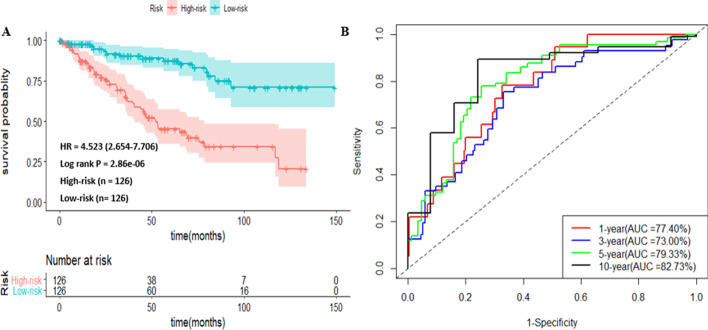
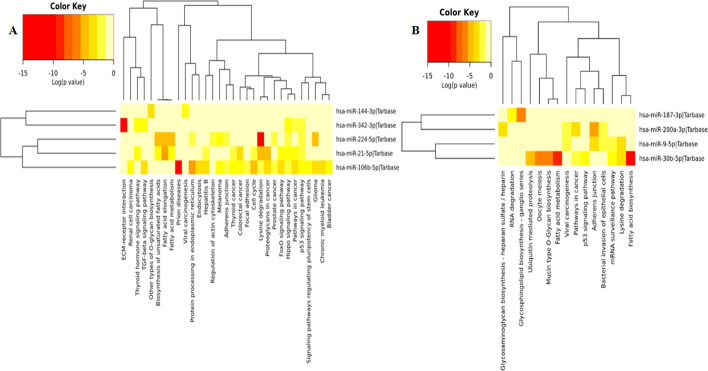
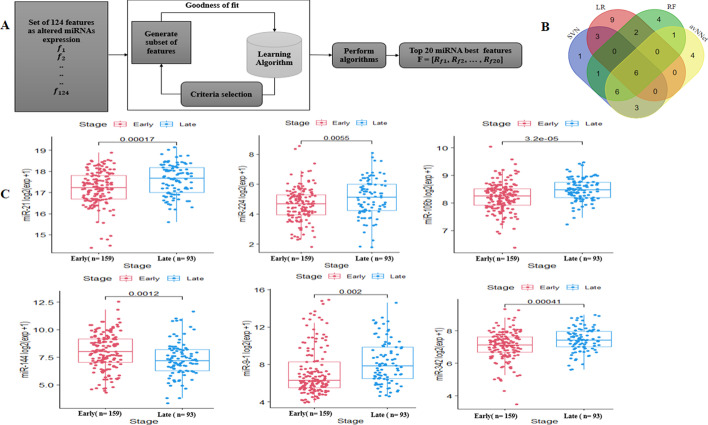
A four-miRNA signature associated with survival was identified and the expression of this signature was strongly correlated with high risk patients. The high risk patients had unfavorable overall survival compared with the low risk group (HR = 4.523, P-value = 2.86e-08). Univariate and multivariate analyses confirmed independent and translational value of this predictive model. A combined ML algorithm identified six miRNA signatures for cancer staging prediction. After using the data balancing algorithm SMOTE, the Support Vector Machine (SVM) algorithm achieved the best classification performance (accuracy = 0.923, sensitivity = 0.927, specificity = 0.919, MCC = 0.843) when compared with other classifiers. Furthermore, enrichment analysis indicated that the identified miRNA signature involved in cancer-associated pathways.
A novel miRNA classification model using the identified prognostic and tumor stage associated miRNA signature will be useful for risk and stage stratification for clinical practice, and the identified miRNA signature can provide promising insight to understand the progression mechanism of ccRCC.
透明细胞肾细胞癌(ccRCC)是肾细胞癌最常见的亚型,晚期患者的生存率较差。尽管 microRNAs(miRNAs)已被用作许多癌症的潜在生物标志物,但用于预测 ccRCC 肿瘤分期的 miRNA 生物标志物仍有限。因此,我们提出了一种新的集成机器学习(ML)策略,使用 miRNA 表达谱来识别与 ccRCC 患者肿瘤分期和预后相关的新型 miRNA 特征。使用包括最小绝对收缩和选择算子(Lasso)、自适应lasso 和弹性网络算法在内的三种混合惩罚的多变量 Cox 回归模型来筛选相关的预后相关 miRNA。最佳子集回归(BSR)模型用于识别最佳预后模型。使用五种 ML 算法来开发分期分类模型。通过利用 DIANA-mirPath 分析 miRNA 特征的生物学意义。
确定了与生存相关的四个 miRNA 特征,该特征的表达与高危患者密切相关。高危患者的总生存期明显差于低危组(HR=4.523,P 值=2.86e-08)。单因素和多因素分析证实了该预测模型的独立和转化价值。一种组合的 ML 算法可识别用于癌症分期预测的六个 miRNA 特征。在使用数据平衡算法 SMOTE 后,支持向量机(SVM)算法在与其他分类器相比时具有最佳的分类性能(准确率=0.923,灵敏度=0.927,特异性=0.919,MCC=0.843)。此外,富集分析表明,所鉴定的 miRNA 特征涉及癌症相关途径。
使用鉴定的与预后和肿瘤分期相关的 miRNA 特征的新型 miRNA 分类模型将有助于临床实践中的风险和分期分层,所鉴定的 miRNA 特征可为理解 ccRCC 的进展机制提供有前途的见解。