Knowles Sarah E, Allen Dawn, Donnelly Ailsa, Flynn Jackie, Gallacher Kay, Lewis Annmarie, McCorkle Grace, Mistry Manoj, Walkington Pat, Drinkwater Jess
Centre for Reviews and Dissemination, University of York, York, YO10 5DD, UK.
Patients in the Learning Health System PPI Group, NIHR Collaboration for Leadership in Applied Health Research and Care Greater Manchester University of Manchester, Manchester, UK.
Res Involv Engagem. 2021 May 31;7(1):34. doi: 10.1186/s40900-021-00262-5.
Knowledge mobilisation requires the effective elicitation and blending of different types of knowledge or ways of knowing, to produce hybrid knowledge outputs that are valuable to both knowledge producers (researchers) and knowledge users (health care stakeholders). Patients and service users are a neglected user group, and there is a need for transparent reporting and critical review of methods used to co-produce knowledge with patients. This study aimed to explore the potential of participatory codesign methods as a mechanism of supporting knowledge sharing, and to evaluate this from the perspective of both researchers and patients.
A knowledge mobilisation research project using participatory codesign workshops to explore patient involvement in using health data to improve services. To evaluate involvement in the project, multiple qualitative data sources were collected throughout, including a survey informed by the Generic Learning Outcomes framework, an evaluation focus group, and field notes. Analysis was a collective dialogic reflection on project processes and impacts, including comparing and contrasting the key issues from the researcher and contributor perspectives.
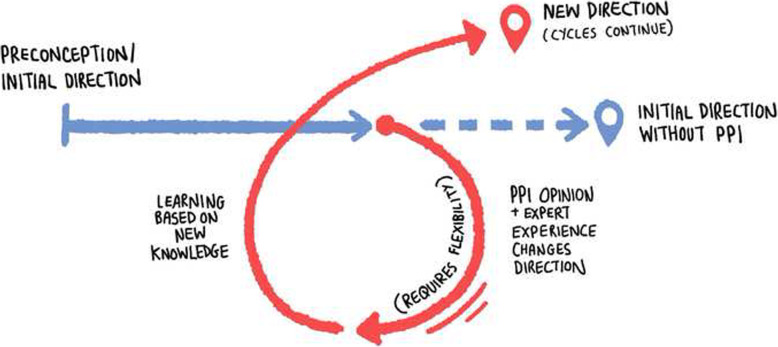
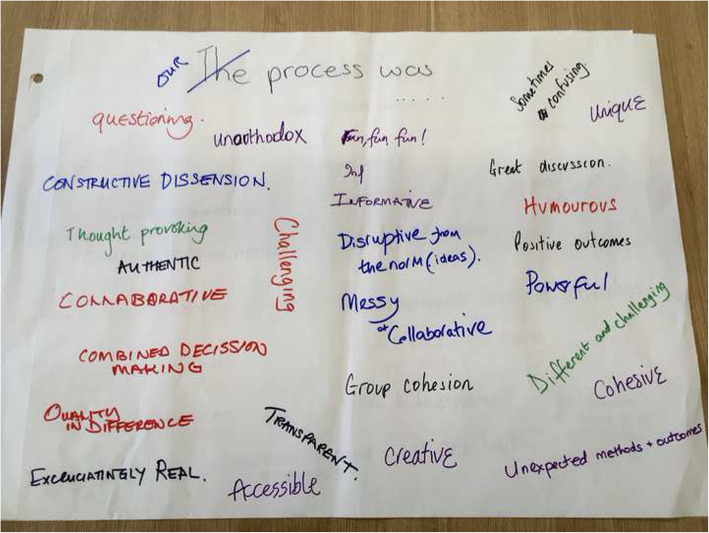
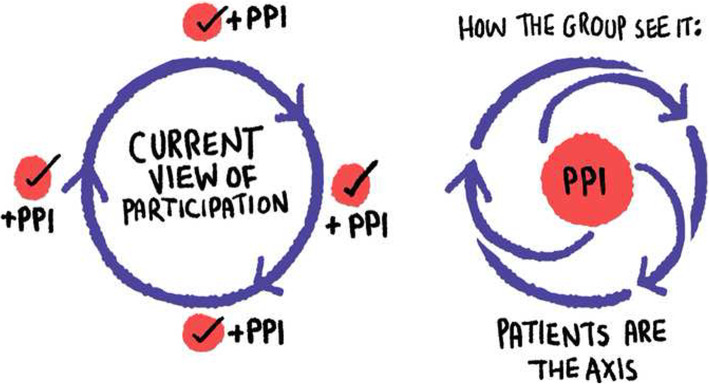
Authentic involvement was seen as the result of "space to talk" and "space to change". "Space to talk" refers to creating space for shared dialogue, including space for tension and disagreement, and recognising contributor and researcher expertise as equally valuable to the discussion. 'Space to change' refers to space to adapt in response to contributor feedback. These were partly facilitated by the use of codesign methods which emphasise visual and iterative working, but contributors emphasised that relational openness was more crucial, and that this needed to apply to the study overall (specifically, how contributors were reimbursed as a demonstration of how their input was valued) to build trust, not just to processes within the workshops.
Specific methods used within involvement are only one component of effective involvement practice. The relationship between researcher and contributors, and particularly researcher willingness to change their approach in response to feedback, were considered most important by contributors. Productive tension was emphasised as a key mechanism in leading to genuinely hybrid outputs that combined contributor insight and experience with academic knowledge and understanding.
知识转化需要有效地引出和融合不同类型的知识或认知方式,以产生对知识生产者(研究人员)和知识使用者(医疗保健利益相关者)都有价值的混合知识成果。患者和服务使用者是一个被忽视的用户群体,需要对与患者共同生产知识所使用的方法进行透明报告和批判性审查。本研究旨在探索参与式协同设计方法作为支持知识共享机制的潜力,并从研究人员和患者的角度对其进行评估。
一个知识转化研究项目,使用参与式协同设计研讨会来探讨患者在利用健康数据改善服务方面的参与情况。为了评估对该项目的参与情况,在整个过程中收集了多个定性数据源,包括基于通用学习成果框架的调查、评估焦点小组和实地笔记。分析是对项目过程和影响的集体对话式反思,包括从研究人员和参与者的角度比较和对比关键问题。
真实的参与被视为“交谈空间”和“改变空间”的结果。“交谈空间”是指为共享对话创造空间,包括存在紧张和分歧的空间,并认识到参与者和研究人员的专业知识对讨论同样有价值。“改变空间”是指根据参与者的反馈进行调整的空间。这在一定程度上得益于使用强调可视化和迭代工作的协同设计方法,但参与者强调关系开放性更为关键,并且这需要适用于整个研究(具体而言,参与者如何获得报酬以表明对其投入的重视程度)以建立信任,而不仅仅适用于研讨会中的过程。
参与过程中使用的具体方法只是有效参与实践的一个组成部分。参与者认为研究人员与参与者之间的关系,特别是研究人员根据反馈改变其方法的意愿最为重要。富有成效的紧张关系被强调为产生真正混合成果的关键机制,这种成果将参与者的见解和经验与学术知识和理解相结合。