Zengin Orhan, Onder Mustafa Erkut
Department of Rheumatology, Dr Ersin Arslan Training and Research Hospital, Gaziantep, TR-27500, Turkey.
Department of Rheumatology, Aksaray University Training and Research Hospital, Aksaray, TR-68100, Turkey.
Clin Rheumatol. 2021 Oct;40(10):4243-4251. doi: 10.1007/s10067-021-05793-6. Epub 2021 May 31.
INTRODUCTION/OBJECTIVES: A progressively growing number of rheumatologists have integrated musculoskeletal ultrasound (MSUS) as a prized tool in their daily clinical practice over the past two decades. Lately, YouTube is often used by healthcare professionals as an educational tool. This study aimed to analyze the quality of educational information available on YouTube pertaining to MSUS.
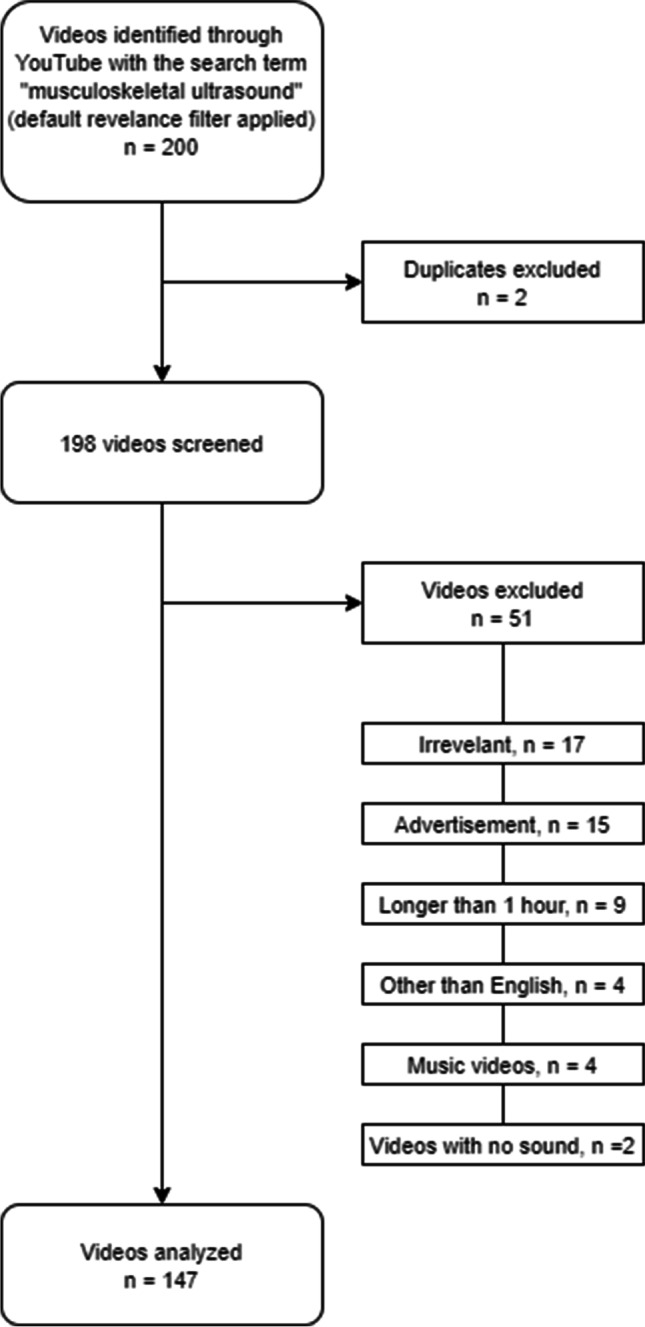
We performed a search using the keyword "musculoskeletal ultrasound" on YouTube in January 2021. Of the first 200 videos screened, 147 met the inclusion criteria. The quality and reliability of the videos were evaluated using the global quality score (GQS) and modified DISCERN score, and their popularity was assessed using the Video Power Index (VPI).
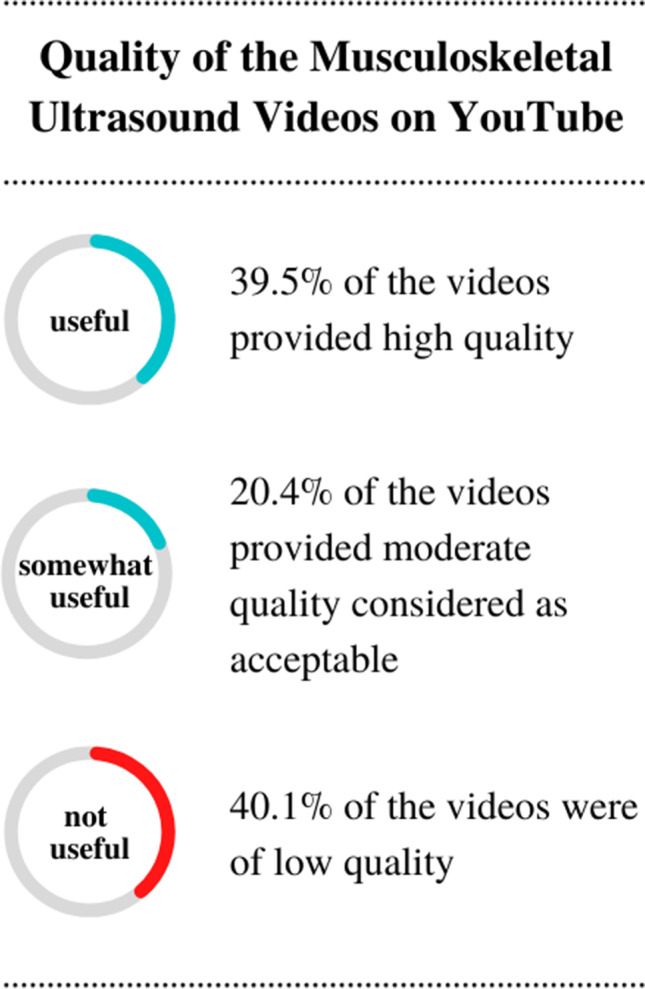
Of the 147 videos evaluated, 58 (39.5%) were of high quality, 30 (20.4%) were of moderate quality, while 59 (40.1%) were of low quality. The modified DISCERN score and the duration of the videos were significantly higher in the high-quality videos than the moderate- and low-quality videos (p < 0.001 for all). The median number of views per day, likes, comments, and the popularity of the videos assessed with VPI were significantly higher in the high- and moderate-quality group compared to the low-quality videos (p < 0.001, p < 0.001, p = 0.007, and p < 0.001, respectively).
The quality of YouTube videos as an educational source on MSUS is unsatisfactory. Professional organizations and physicians should consider creating more high-quality MSUS videos. YouTube should consider filtering out poor-quality videos in collaboration with experts in the field. Key Points • Although rheumatologists are increasingly using ultrasound as an extension of their exam, accessing musculoskeletal ultrasound training is still facing some challenges. • YouTube is commonly used as an educational source by medical students and healthcare professionals. • Approximately 60% of the videos related to musculoskeletal ultrasound on YouTube revealed high and moderate quality, while the remaining 40% were of low quality and not suitable for medical education. • A filtering mechanism is required to improve the quality of YouTube content on MSUS.
引言/目的:在过去二十年中,越来越多的风湿病学家将肌肉骨骼超声(MSUS)作为日常临床实践中的一项重要工具。近来,YouTube常被医疗保健专业人员用作教育工具。本研究旨在分析YouTube上与MSUS相关的教育信息质量。
我们于2021年1月在YouTube上使用关键词“肌肉骨骼超声”进行搜索。在前200个筛选的视频中,147个符合纳入标准。使用全球质量评分(GQS)和改良的DISCERN评分评估视频的质量和可靠性,并使用视频影响力指数(VPI)评估其受欢迎程度。
在评估的147个视频中,58个(39.5%)质量高,30个(20.4%)质量中等,59个(40.1%)质量低。高质量视频的改良DISCERN评分和视频时长显著高于中等质量和低质量视频(所有p值均<0.001)。与低质量视频相比,高质量和中等质量组视频的每日观看次数中位数、点赞数、评论数以及用VPI评估的视频受欢迎程度均显著更高(分别为p<0.001、p<0.001、p = 0.007和p<0.001)。
YouTube视频作为MSUS教育资源的质量不尽人意。专业组织和医生应考虑制作更多高质量的MSUS视频。YouTube应考虑与该领域专家合作过滤掉低质量视频。要点 • 尽管风湿病学家越来越多地将超声作为其检查的延伸,但获取肌肉骨骼超声培训仍面临一些挑战。 • YouTube常被医学生和医疗保健专业人员用作教育资源。 • YouTube上约60%与肌肉骨骼超声相关的视频质量高和中等,其余40%质量低,不适合医学教育。 • 需要一种过滤机制来提高YouTube上MSUS内容的质量。