Nouatin Odilon, Mengue Juliana Boex, Dejon-Agobé Jean Claude, Fendel Rolf, Ibáñez Javier, Ngoa Ulysse Ateba, Edoa Jean Ronald, Adégbité Bayodé Roméo, Honkpéhédji Yabo Josiane, Zinsou Jeannot Fréjus, Hounkpatin Aurore Bouyoukou, Moutairou Kabirou, Homoet Andreas, Esen Meral, Kreidenweiss Andrea, Hoffman Stephen L, Theisen Michael, Luty Adrian J F, Lell Bertrand, Agnandji Selidji Todagbe, Mombo-Ngoma Ghyslain, Ramharter Michael, Kremsner Peter, Mordmüller Benjamin, Adegnika Ayôla Akim
Centre de Recherches Médicales de Lambaréné, Lambaréné, Gabon.
Institut für Tropenmedizin, Universität Tübingen, Tübingen, Germany.
PLoS Negl Trop Dis. 2021 Jun 1;15(6):e0009361. doi: 10.1371/journal.pntd.0009361. eCollection 2021 Jun.
Helminths can modulate the host immune response to Plasmodium falciparum and can therefore affect the risk of clinical malaria. We assessed here the effect of helminth infections on both the immunogenicity and efficacy of the GMZ2 malaria vaccine candidate, a recombinant protein consisting of conserved domains of GLURP and MSP3, two asexual blood-stage antigens of P. falciparum. Controlled human malaria infection (CHMI) was used to assess the efficacy of the vaccine.
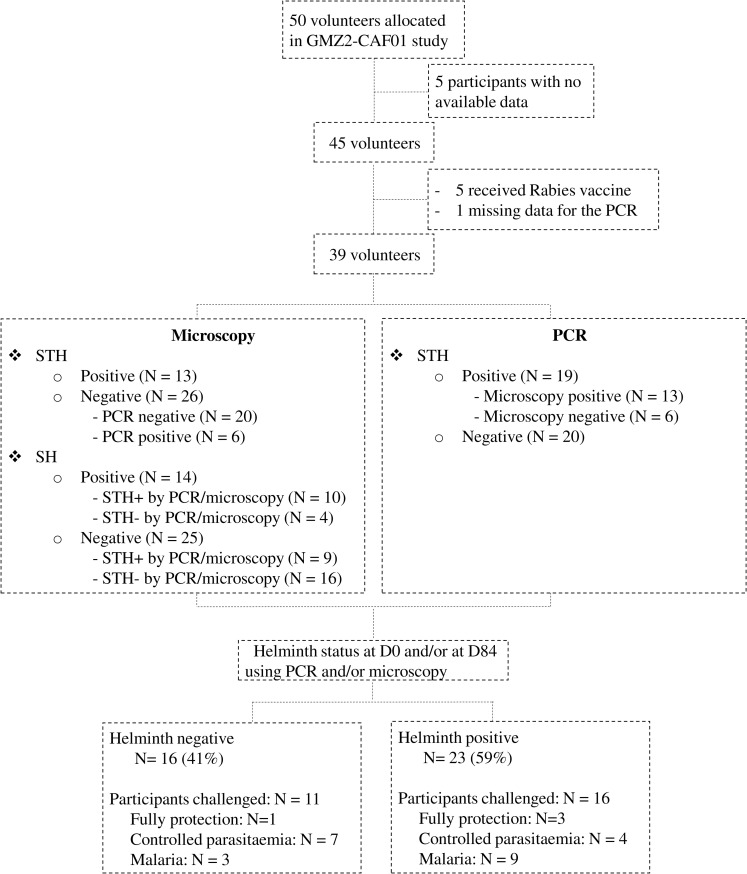
In a randomized, double-blind Phase I clinical trial, fifty, healthy, lifelong malaria-exposed adult volunteers received three doses of GMZ2 adjuvanted with either Cationic Adjuvant Formulation (CAF) 01 or Alhydrogel, or a control vaccine (Rabies) on days (D) 0, D28 and D56, followed by direct venous inoculation (DVI) of 3,200 P. falciparum sporozoites (PfSPZ Challenge) approximately 13 weeks after last vaccination to assess vaccine efficacy. Participants were followed-up on a daily basis with clinical examinations and thick blood smears to monitor P. falciparum parasitemia for 35 days. Malaria was defined as the presence of P. falciparum parasites in the blood associated with at least one symptom that can be associated to malaria over 35 days following DVI of PfSPZ Challenge. Soil-transmitted helminth (STH) infection was assessed by microscopy and by polymerase chain reaction (PCR) on stool, and Schistosoma infection was assessed by microscopy on urine. Participants were considered as infected if positive for any helminth either by PCR and/or microscopy at D0 and/or at D84 (Helm+) and were classified as mono-infection or co-infection. Total vaccine-specific IgG concentrations assessed on D84 were analysed as immunogenicity outcome.
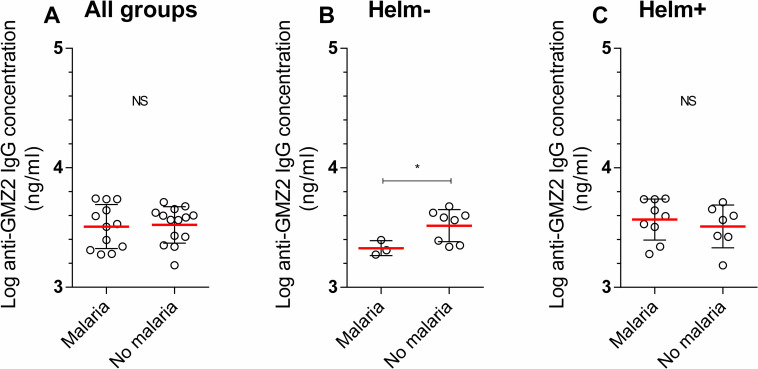
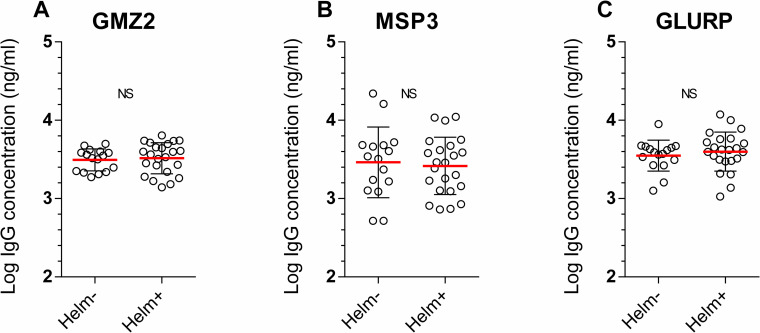
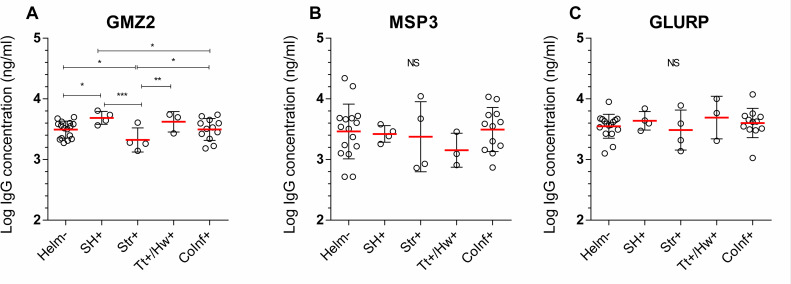
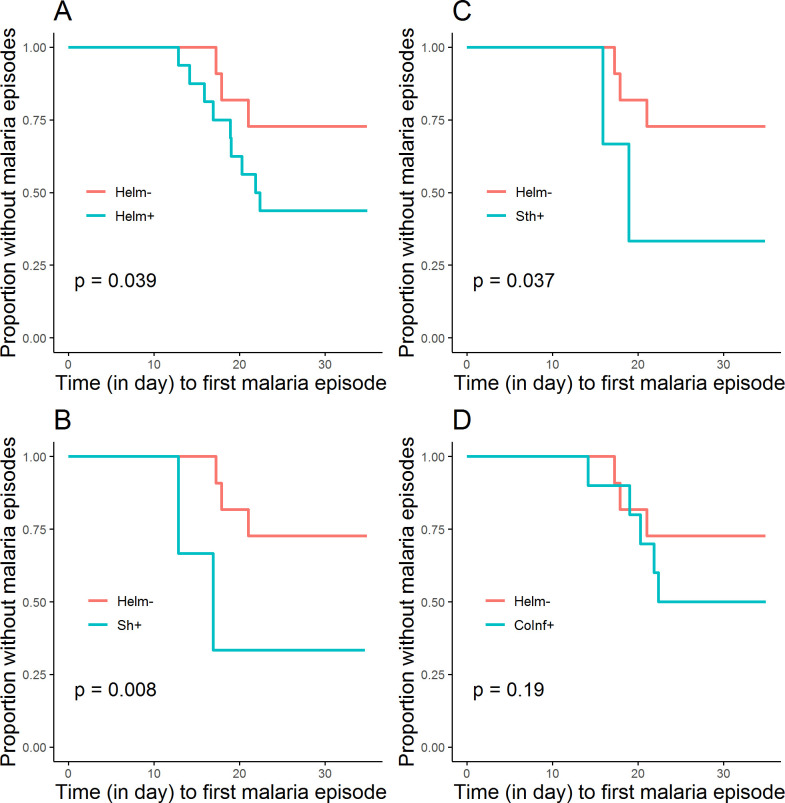
The helminth in mono-infection, particularly Schistosoma haematobium and STH were significantly associated with earlier malaria episodes following CHMI, while no association was found in case of coinfection. In further analyses, the anti-GMZ2 IgG concentration on D84 was significantly higher in the S. haematobium-infected and significantly lower in the Strongyloides stercoralis-infected groups, compared to helminth-negative volunteers. Interesting, in the absence of helminth infection, a high anti-GMZ2 IgG concentration on D84 was significantly associated with protection against malaria.
Our results suggest that helminth infection may reduce naturally acquired and vaccine-induced protection against malaria. Vaccine-specific antibody concentrations on D84 may be associated with protection in participants with no helminth infection. These results suggest that helminth infection affect malaria vaccine immunogenicity and efficacy in helminth endemic countries.
蠕虫可调节宿主对恶性疟原虫的免疫反应,因此可能影响临床疟疾的发病风险。我们在此评估蠕虫感染对GMZ2疟疾候选疫苗免疫原性和效力的影响,GMZ2是一种重组蛋白,由恶性疟原虫的两个无性血液期抗原GLURP和MSP3的保守结构域组成。采用受控人体疟疾感染(CHMI)来评估该疫苗的效力。
在一项随机、双盲的I期临床试验中,50名终生接触疟疾的健康成年志愿者在第0天、第28天和第56天接受三剂分别佐以阳离子佐剂配方(CAF)01或氢氧化铝的GMZ2,或一种对照疫苗(狂犬病疫苗),然后在最后一次接种疫苗约13周后进行3200个恶性疟原虫子孢子的直接静脉接种(PfSPZ攻击)以评估疫苗效力。每天对参与者进行临床检查和厚血涂片检查,持续35天以监测恶性疟原虫血症。疟疾定义为在PfSPZ攻击后的35天内,血液中存在恶性疟原虫寄生虫且伴有至少一种可能与疟疾相关的症状。通过粪便显微镜检查和聚合酶链反应(PCR)评估土壤传播蠕虫(STH)感染,通过尿液显微镜检查评估血吸虫感染。如果参与者在第0天和/或第84天通过PCR和/或显微镜检查发现任何蠕虫呈阳性(Helm+),则被视为感染,并分为单一感染或混合感染。将在第84天评估的总疫苗特异性IgG浓度作为免疫原性结果进行分析。
单一感染中的蠕虫,特别是埃及血吸虫和STH与CHMI后较早出现疟疾发作显著相关,而混合感染则未发现相关性。在进一步分析中,与蠕虫阴性志愿者相比,埃及血吸虫感染组在第84天的抗GMZ2 IgG浓度显著更高,而粪类圆线虫感染组则显著更低。有趣的是,在没有蠕虫感染的情况下,第84天较高的抗GMZ2 IgG浓度与预防疟疾显著相关。
我们的结果表明,蠕虫感染可能会降低自然获得的和疫苗诱导的抗疟疾保护作用。第84天的疫苗特异性抗体浓度可能与无蠕虫感染参与者的保护作用相关。这些结果表明,蠕虫感染会影响蠕虫流行国家疟疾疫苗的免疫原性和效力。