Hsu Po-Chih, Chen Yi-Hsuan, Cheng Ching-Feng, Kuo Chan-Yen, Sytwu Huey-Kang
National Defense Medical Center, Graduate Institute of Medical Sciences, Taipei 114, Taiwan.
Department of Dentistry, Taipei Tzu Chi Hospital, Buddhist Tzu Chi Medical Foundation, New Taipei City 231, Taiwan.
Life (Basel). 2021 May 5;11(5):423. doi: 10.3390/life11050423.
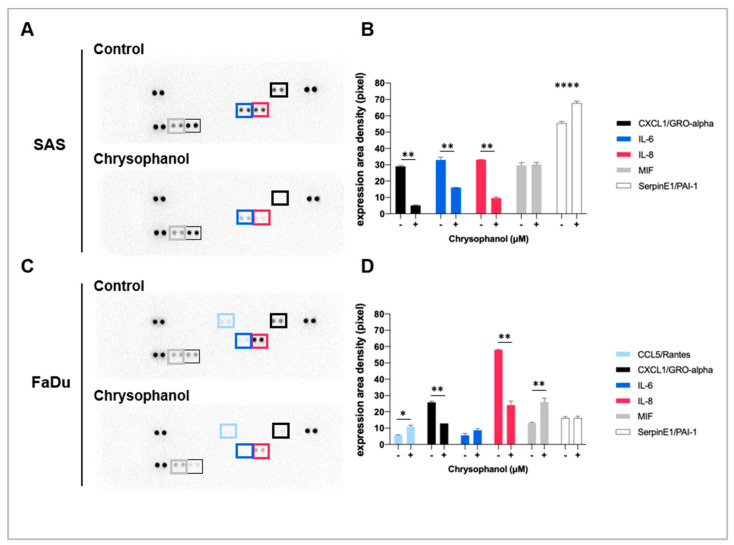
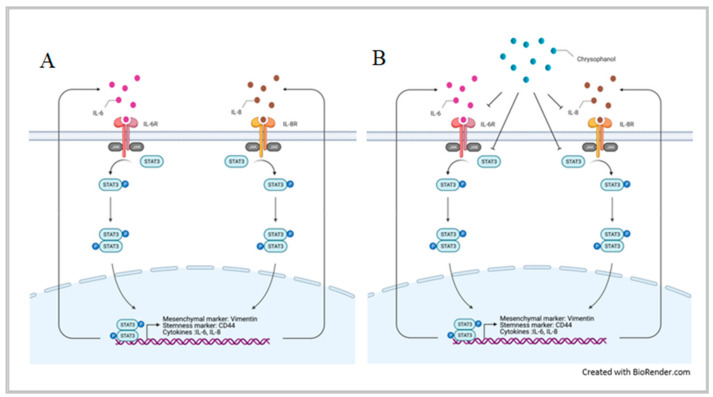
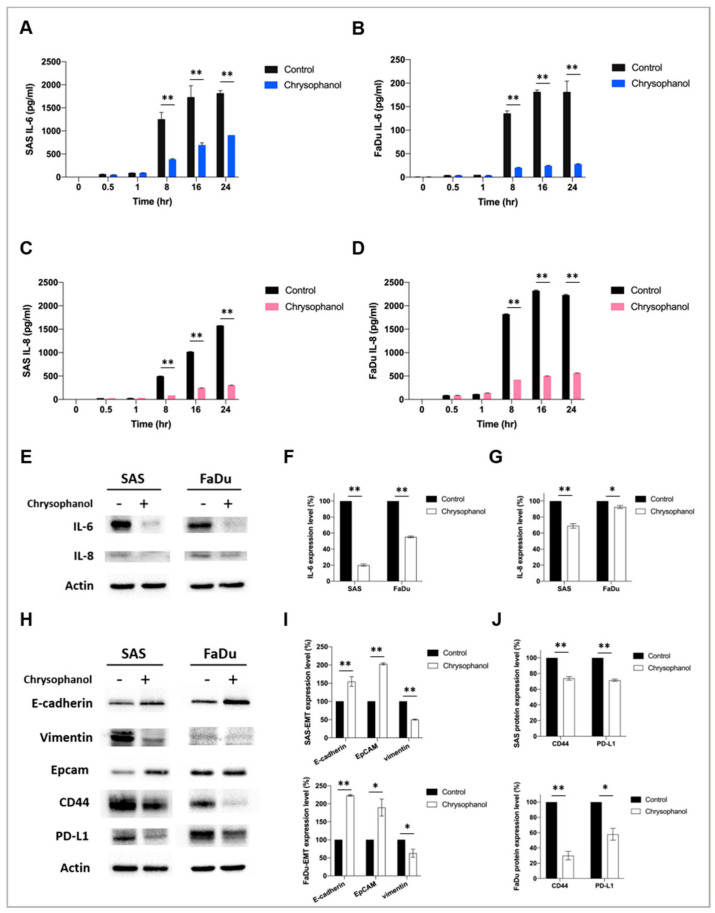
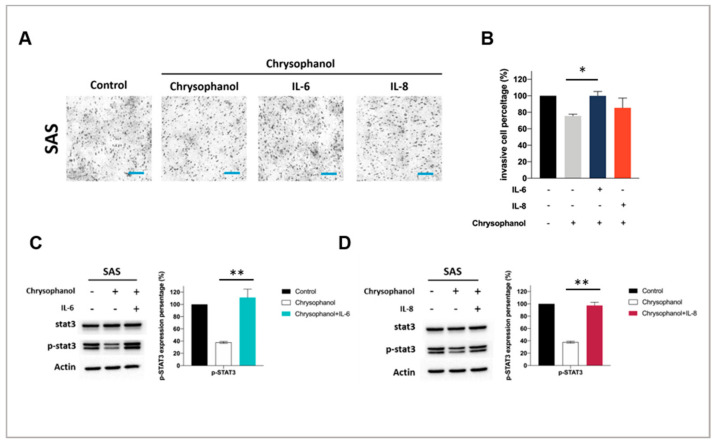
The tumor microenvironment plays a critical role in the control of metastasis. The epithelial-mesenchymal transition (EMT) is strongly associated with tumor metastasis, and consists of several protein markers, including E-cadherin and vimentin. We discovered that chrysophanol causes oral cancer cell apoptosis and the inhibition of migration/invasion and EMT. However, the detailed mechanisms of chrysophanol and its role in oral cancer with respect to the tumor microenvironment remain unknown. In the clinic, proinflammatory cytokines, such as IL-6 and IL-8, exhibit a higher expression in patients with oral cancer. However, the effect of chrysophanol on the production of IL-6 and IL-8 is unknown. We evaluated the expression of IL-6 and IL-8 in human SAS and FaDu oral cancer cell lines in the presence or absence of chrysophanol. The migration and invasion abilities were also determined using a Boyden chamber assay. Our results showed that treatment with chrysophanol significantly decreased the expression of IL-6 and IL-8, as well as the invasion ability of oral cancer cells. Moreover, chrysophanol also attenuated the EMT by increasing the expression of E-cadherin and reducing the expression of vimentin. Mechanistically, chrysophanol inhibited IL-6- and IL-8-induced invasion and STAT3 phosphorylation. IL-6 and IL-8 promote EMT and cell invasion, which is potentially related to the STAT3 signaling pathway in oral cancer. These findings provide insight into new aspects of chrysophanol activity and may contribute to the development of new therapeutic strategies for oral cancer.
肿瘤微环境在转移控制中起着关键作用。上皮-间质转化(EMT)与肿瘤转移密切相关,由几种蛋白质标志物组成,包括E-钙黏蛋白和波形蛋白。我们发现大黄酚可导致口腔癌细胞凋亡,并抑制迁移/侵袭和EMT。然而,大黄酚的详细机制及其在口腔癌中相对于肿瘤微环境的作用仍不清楚。在临床上,促炎细胞因子,如IL-6和IL-8,在口腔癌患者中表达较高。然而,大黄酚对IL-6和IL-8产生的影响尚不清楚。我们评估了在有或没有大黄酚存在的情况下,人SAS和FaDu口腔癌细胞系中IL-6和IL-8的表达。还使用博伊登小室试验测定了迁移和侵袭能力。我们的结果表明,用大黄酚处理可显著降低IL-6和IL-8的表达以及口腔癌细胞的侵袭能力。此外,大黄酚还通过增加E-钙黏蛋白的表达和降低波形蛋白的表达来减弱EMT。从机制上讲,大黄酚抑制IL-6和IL-8诱导的侵袭和STAT3磷酸化。IL-6和IL-8促进EMT和细胞侵袭,这可能与口腔癌中的STAT3信号通路有关。这些发现为大黄酚活性的新方面提供了见解,并可能有助于开发口腔癌的新治疗策略。