Health and Physical Education Department, Prince Sultan University, Riyadh 11586, Saudi Arabia.
Nuestra Señora de las Mercedes School, Tarancón, 16400 Cuenca, Spain.
Int J Environ Res Public Health. 2021 May 2;18(9):4857. doi: 10.3390/ijerph18094857.
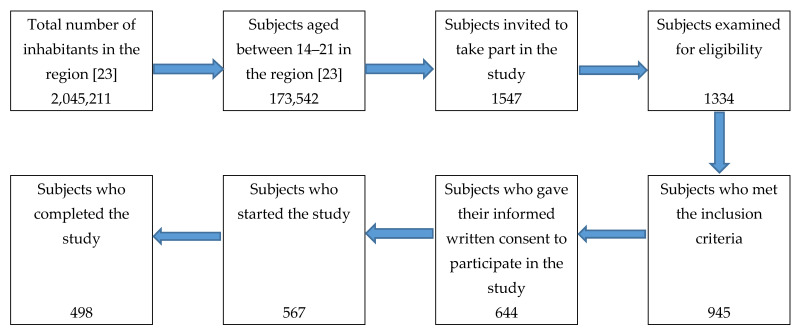
The present study aimed to determine the epidemiology of sport-related injuries in amateur and professional adolescent athletes and the incidence of different risk factors on those injuries. Four hundred ninety-eight athletes aged 14 to 21 voluntarily participated in this prospective injury surveillance, conducted from 1 January 2019 to 31 December 2019. The information collected included: personal data, sports aspects, characteristics of the injuries, and lifestyle. Forty point four percent of the participants suffered an injury in 2019 (39% of them in a previously injured area). The average injury rate was 2.64 per 1000 h. Soccer presented the highest rate (7.21). The most common injuries were: lumbar muscle strains (12.24%), ankle sprains (11.98%), and bone fractures (9.31%). Ankles (36.12%), knees (19.32%), and shoulders (6.47%) concentrated the highest number of injuries. Fifty-nine point twenty-eight percent of the injuries occurred during practices, and 40.72% during competition or peri-competition. Higher injury rates were associated (in this order) with the following factors: (a) Greater number of hours of practice per week. (b) Not performing warm-ups. (c) Using inadequate sports facilities. (d) Being aged 14-17. (e) Not performing physical preparation. (f) Inappropriate training load. (g) Not performing injury-preventive activities. (h) Performing sports technique without the supervision of one sports coach. (i) Inadequate sports equipment. In conclusion, since most injury risk factors are modifiable, it is imperative to implement strategies to reduce amateur and professional adolescent athletes' injury rates.
本研究旨在确定业余和职业青少年运动员运动相关损伤的流行病学,以及不同危险因素对这些损伤的发生率。498 名年龄在 14 至 21 岁的运动员自愿参加了这项前瞻性损伤监测研究,研究时间为 2019 年 1 月 1 日至 12 月 31 日。收集的信息包括:个人数据、运动方面、损伤特征和生活方式。40.4%的参与者在 2019 年受伤(其中 39%在以前受伤的部位受伤)。平均损伤发生率为每 1000 小时 2.64 次。足球的发生率最高(7.21)。最常见的损伤是:腰背部肌肉拉伤(12.24%)、踝关节扭伤(11.98%)和骨折(9.31%)。踝关节(36.12%)、膝关节(19.32%)和肩部(6.47%)集中了最高数量的损伤。59.28%的损伤发生在训练中,40.72%发生在比赛或比赛期间。较高的损伤率与以下因素相关(按顺序):(a)每周练习的小时数增加。(b)不进行热身运动。(c)使用不适当的运动设施。(d)年龄在 14-17 岁之间。(e)不进行身体准备。(f)训练负荷不当。(g)不进行预防损伤的活动。(h)在没有一名运动教练监督的情况下进行运动技术。(i)运动设备不足。总之,由于大多数损伤危险因素是可以改变的,因此必须实施策略来降低业余和职业青少年运动员的损伤率。