Department of Biochemistry, Faculty of Medicine, University of Medicine and Pharmacy of Craiova, Str. Petru Rares nr. 2-4, 710204 Craiova, Romania.
Department of Surgery, Faculty of Medicine, University of Medicine and Pharmacy of Craiova, Str. Petru Rares nr. 2-4, 710204 Craiova, Romania.
Int J Mol Sci. 2021 May 2;22(9):4830. doi: 10.3390/ijms22094830.
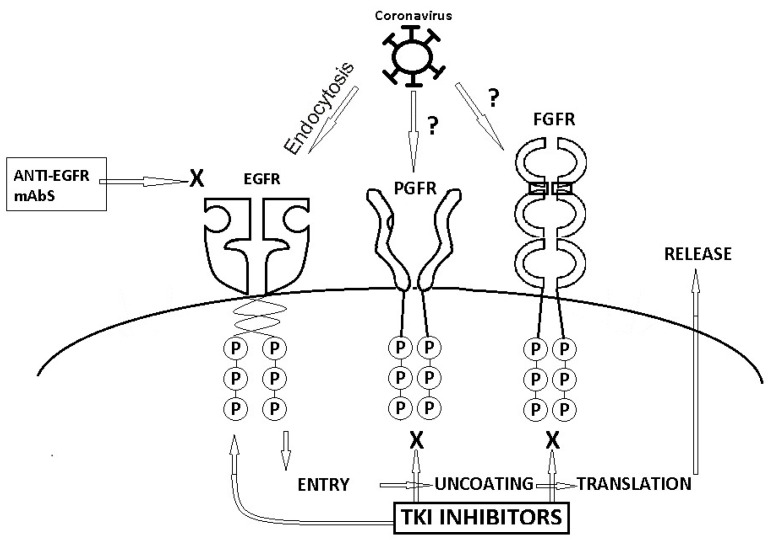
Cancer and viruses have a long history that has evolved over many decades. Much information about the interplay between viruses and cell proliferation and metabolism has come from the history of clinical cases of patients infected with virus-induced cancer. In addition, information from viruses used to treat some types of cancer is valuable. Now, since the global coronavirus pandemic erupted almost a year ago, the scientific community has invested countless time and resources to slow down the infection rate and diminish the number of casualties produced by this highly infectious pathogen. A large percentage of cancer cases diagnosed are strongly related to dysregulations of the tyrosine kinase receptor (TKR) family and its downstream signaling pathways. As such, many therapeutic agents have been developed to strategically target these structures in order to hinder certain mechanisms pertaining to the phenotypic characteristics of cancer cells such as division, invasion or metastatic potential. Interestingly, several authors have pointed out that a correlation between coronaviruses such as the SARS-CoV-1 and -2 or MERS viruses and dysregulations of signaling pathways activated by TKRs can be established. This information may help to accelerate the repurposing of clinically developed anti-TKR cancer drugs in COVID-19 management. Because the need for treatment is critical, drug repurposing may be an advantageous choice in the search for new and efficient therapeutic compounds. This approach would be advantageous from a financial point of view as well, given that the resources used for research and development would no longer be required and can be potentially redirected towards other key projects. This review aims to provide an overview of how SARS-CoV-2 interacts with different TKRs and their respective downstream signaling pathway and how several therapeutic agents targeted against these receptors can interfere with the viral infection. Additionally, this review aims to identify if SARS-CoV-2 can be repurposed to be a potential viral vector against different cancer types.
癌症与病毒之间的关系由来已久,可以追溯到几十年前。大量关于病毒与细胞增殖和代谢相互作用的信息来自于病毒感染引起的癌症患者的临床病例历史。此外,用于治疗某些类型癌症的病毒的信息也很有价值。自全球冠状病毒大流行爆发近一年以来,科学界投入了无数的时间和资源来减缓感染率并减少这种高度传染性病原体造成的伤亡人数。诊断出的大部分癌症病例与酪氨酸激酶受体(TKR)家族及其下游信号通路的失调密切相关。因此,已经开发出许多治疗剂来有针对性地靶向这些结构,以阻止与癌细胞表型特征相关的某些机制,例如分裂、侵袭或转移潜力。有趣的是,有几位作者指出,可以建立冠状病毒(如 SARS-CoV-1 和 -2 或 MERS 病毒)与 TKR 激活的信号通路失调之间的相关性。这些信息可能有助于加速将临床开发的抗 TKR 癌症药物重新用于 COVID-19 管理。由于治疗的需求至关重要,因此药物再利用可能是寻找新的有效治疗化合物的有利选择。从财务角度来看,这种方法也很有优势,因为不再需要用于研发的资源,并且可以潜在地重新用于其他关键项目。本综述旨在概述 SARS-CoV-2 如何与不同的 TKR 及其各自的下游信号通路相互作用,以及几种针对这些受体的治疗剂如何干扰病毒感染。此外,本综述旨在确定 SARS-CoV-2 是否可以被重新用于作为针对不同癌症类型的潜在病毒载体。