Mocanu Alexandra, Noja Gratiela Georgiana, Istodor Alin Viorel, Moise Georgiana, Leretter Marius, Rusu Laura-Cristina, Marza Adina Maria, Mederle Alexandru Ovidiu
Department XIII, Discipline of Infectious Diseases, "Victor Babes" University of Medicine and Pharmacy Timisoara, 2 Eftimie Murgu Square, 300041 Timisoara, Romania.
Department of Marketing and International Economic Relations, Faculty of Economics and Business Administration, West University of Timisoara, 16 Pestalozzi Street, 300115 Timisoara, Romania.
J Clin Med. 2021 May 2;10(9):1958. doi: 10.3390/jcm10091958.
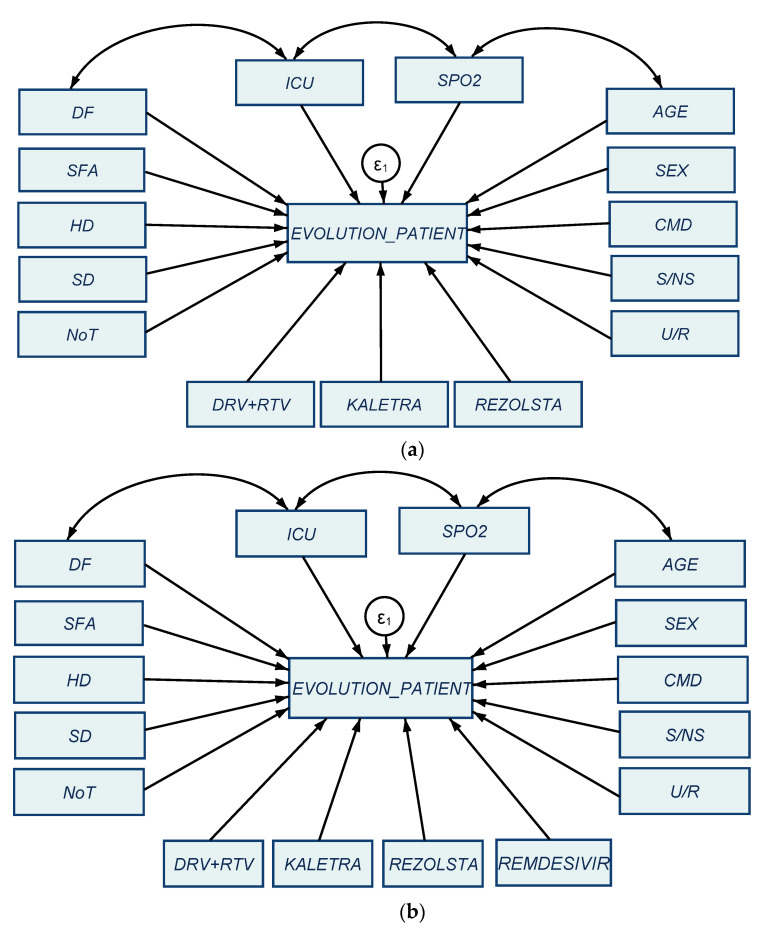
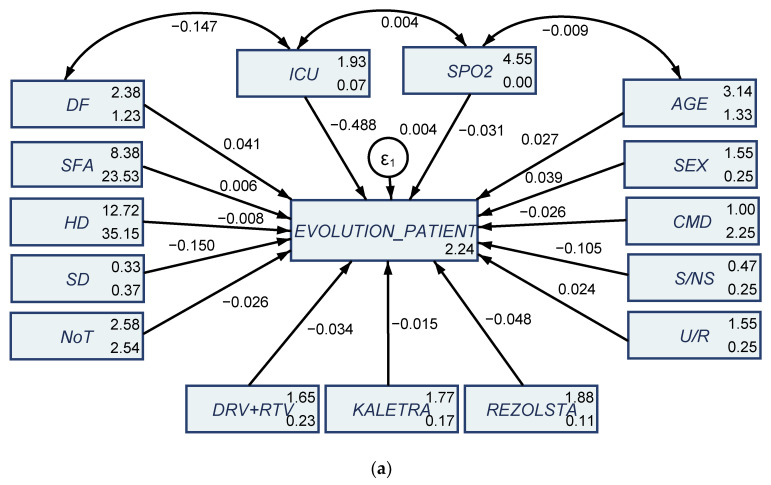
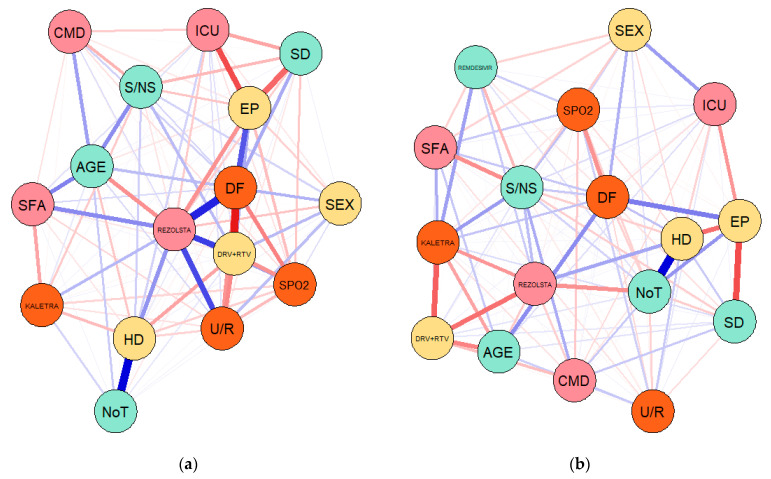
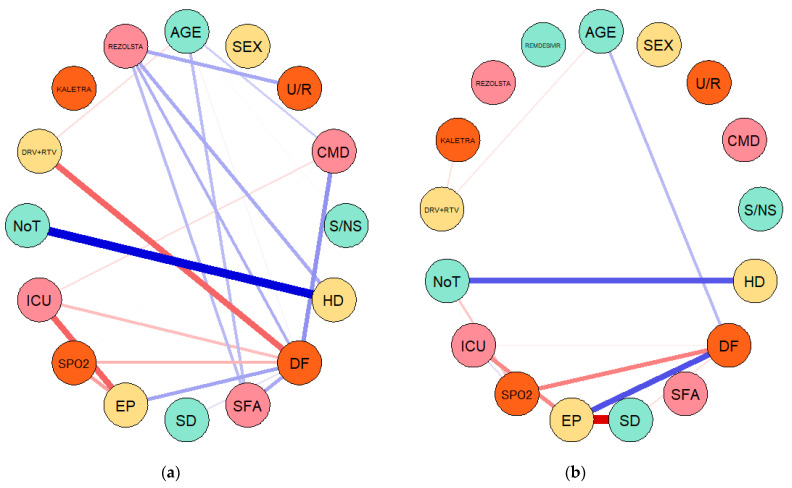
This study examines the role played by individual characteristics and specific treatment methods in the evolution of hospitalized patients with coronavirus disease 2019 (COVID-19), through the lens of an observational study performed in a comparative approach between the first and second waves of coronavirus pandemic in Romania. The research endeavor is configured on a two-fold approach, including a detailed observation of the evolution of 274 hospitalized patients with COVID-19 (145 in the first wave and 129 in the second wave of infection) according to specific treatment methods applied and patients' individual features, as well as an econometric (quantitative) analysis through structural equation modeling and Gaussian graphical models designed to acknowledge the correlations and causal relationship between all considered coordinates. The main results highlight that the specific treatment methods applied had a positive influence on the evolution of COVID-19 patients, particularly in the second wave of coronavirus pandemic. In case of the first wave of COVID-19 infection, GGM results entail that there is a strong positive correlation between the evolution of the patients and the COVID-19 disease form, which is further positively correlated with the treatment scheme. The evolution of the patients is strongly and inversely correlated with the symptomatology and the ICU hospitalization. Moreover, the disease form is strongly and inversely correlated with oxygen saturation and the residence of patients (urban/rural). The symptomatology at first appearance also strongly depends on the age of the patients (positive correlation) and of the fact that the patient is a smoker or non-smoker and has other comorbidities. Age and gender are also important credentials that shape the disease degree and patient evolution in responding to treatment as well, our study attesting strong interconnections between these coordinates, the form of disease, symptomatology and overall evolution of the patients.
本研究通过在罗马尼亚新冠疫情第一波和第二波期间进行的对比性观察研究,探讨了个体特征和特定治疗方法在2019年冠状病毒病(COVID-19)住院患者病情演变中所起的作用。该研究采用了双重方法,包括根据所应用的特定治疗方法和患者个体特征,对274例COVID-19住院患者(第一波感染中有145例,第二波感染中有129例)的病情演变进行详细观察,以及通过结构方程模型和高斯图形模型进行计量经济学(定量)分析,以确认所有考虑因素之间的相关性和因果关系。主要结果表明,所应用的特定治疗方法对COVID-19患者的病情演变有积极影响,特别是在新冠疫情的第二波期间。在第一波COVID-19感染中,高斯图形模型的结果表明,患者的病情演变与COVID-19疾病类型之间存在强烈的正相关,而疾病类型又与治疗方案呈正相关。患者的病情演变与症状和入住重症监护病房呈强烈的负相关。此外,疾病类型与血氧饱和度和患者居住地(城市/农村)呈强烈的负相关。初次出现的症状也很大程度上取决于患者的年龄(正相关),以及患者是否吸烟、是否有其他合并症。年龄和性别也是影响疾病程度和患者对治疗反应的重要因素,我们的研究证明了这些因素、疾病类型、症状和患者总体病情演变之间存在紧密的相互联系。