Wang Tzu-Hao, Lee Cheng-Yang, Lee Tzong-Yi, Huang Hsien-Da, Hsu Justin Bo-Kai, Chang Tzu-Hao
Graduate Institute of Biomedical Informatics, College of Medical Science and Technology, Taipei Medical University, Taipei 110, Taiwan.
School of Medicine, College of Medicine, Taipei Medical University, Taipei 110, Taiwan.
Cancers (Basel). 2021 May 21;13(11):2528. doi: 10.3390/cancers13112528.
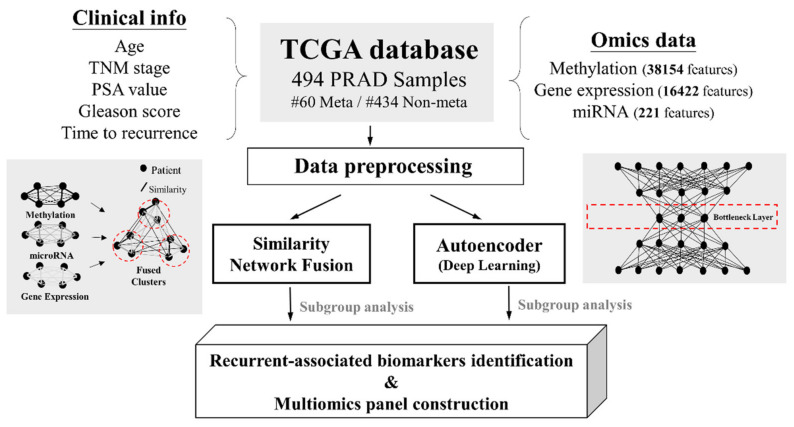
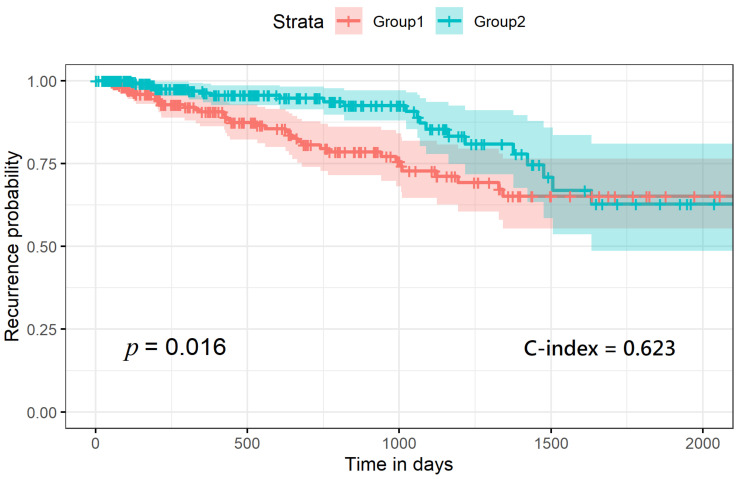
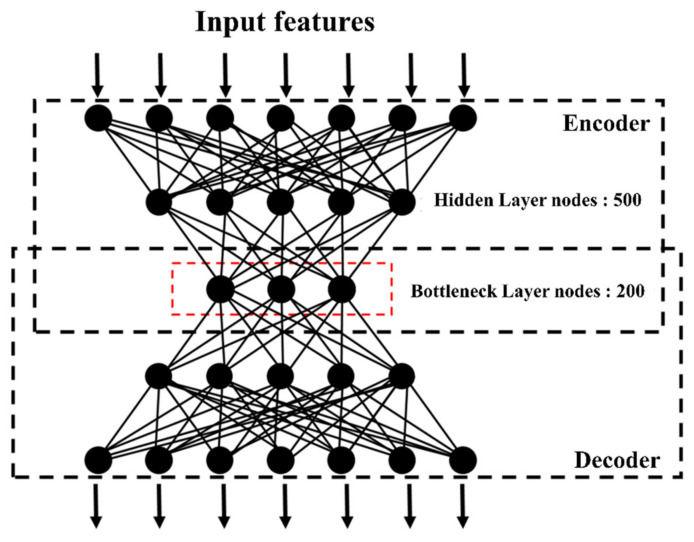
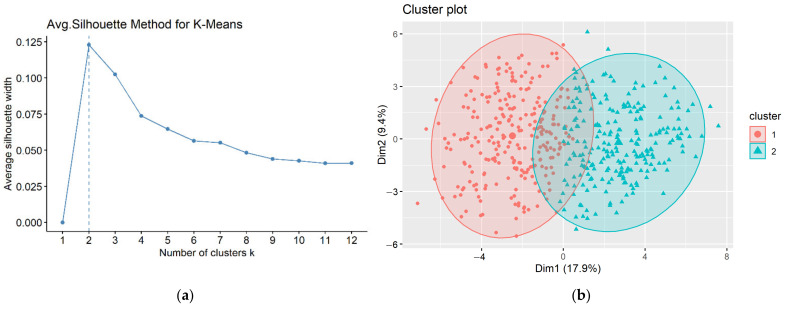
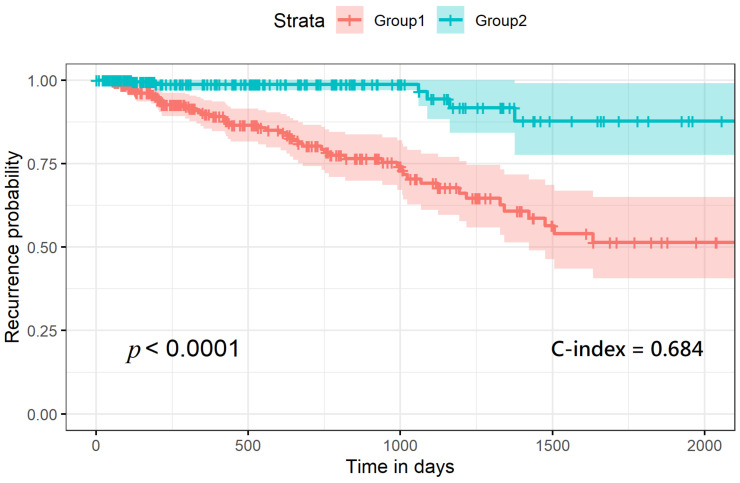
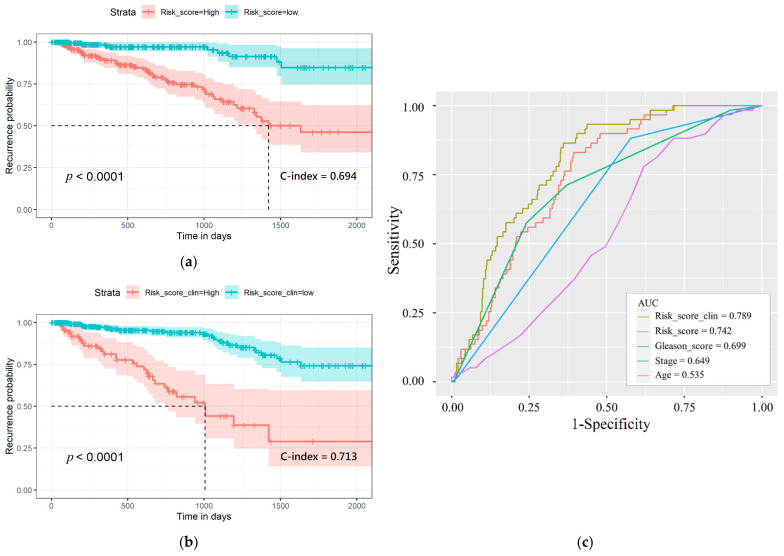
This study is to identify potential multiomics biomarkers for the early detection of the prognostic recurrence of PC patients. A total of 494 prostate adenocarcinoma (PRAD) patients (60-recurrent included) from the Cancer Genome Atlas (TCGA) portal were analyzed using the autoencoder model and similarity network fusion. Then, multiomics panels were constructed according to the intersected omics biomarkers identified from the two models. Six intersected omics biomarkers, , cg00687383 (), and cg02318866 (; ), were collected for multiomics panel construction. The difference between the Kaplan-Meier curves of high and low recurrence-risk groups generated from the multiomics panel achieved -value = 5.33 × 10, which is better than the former study (-value = 5 × 10). Additionally, when evaluating the selected multiomics biomarkers with clinical information (Gleason score, age, and cancer stage), a high-performance prediction model was generated with C-index = 0.713, -value = 2.97 × 10, and AUC = 0.789. The risk score generated from the selected multiomics biomarkers worked as an effective indicator for the prediction of PRAD recurrence. This study helps us to understand the etiology and pathways of PRAD and further benefits both patients and physicians with potential prognostic biomarkers when making clinical decisions after surgical treatment.
本研究旨在识别潜在的多组学生物标志物,用于早期检测前列腺癌(PC)患者的预后复发情况。使用自动编码器模型和相似性网络融合技术,对来自癌症基因组图谱(TCGA)门户的总共494例前列腺腺癌(PRAD)患者(包括60例复发患者)进行了分析。然后,根据从这两个模型中识别出的交叉组学生物标志物构建多组学面板。收集了六个交叉组学生物标志物,即cg00687383()和cg02318866(;),用于构建多组学面板。由多组学面板生成的高复发风险组和低复发风险组的Kaplan-Meier曲线之间的差异达到 - 值 = 5.33 × 10,优于先前的研究(- 值 = 5 × 10)。此外,当用临床信息(Gleason评分、年龄和癌症分期)评估所选的多组学生物标志物时,生成了一个高性能预测模型,其C指数 = 0.713,- 值 = 2.97 × 10,AUC = 0.789。从所选多组学生物标志物生成的风险评分可作为预测PRAD复发的有效指标。本研究有助于我们了解PRAD的病因和途径,并在手术治疗后做出临床决策时,为患者和医生提供潜在的预后生物标志物,从而使双方受益。