Roque-Borda Cesar Augusto, da Silva Patricia Bento, Rodrigues Mosar Corrêa, Azevedo Ricardo Bentes, Di Filippo Leonardo, Duarte Jonatas L, Chorilli Marlus, Festozo Vicente Eduardo, Pavan Fernando Rogério
Tuberculosis Research Laboratory, School of Pharmaceutical Sciences, São Paulo State University (UNESP), Araraquara 14800-903, Brazil.
Laboratory of Nanobiotechnology, Department of Genetics and Morphology, Institute of Biological Sciences, University of Brasilia, Brasilia 70910-900, Brazil.
Pharmaceutics. 2021 May 21;13(6):773. doi: 10.3390/pharmaceutics13060773.
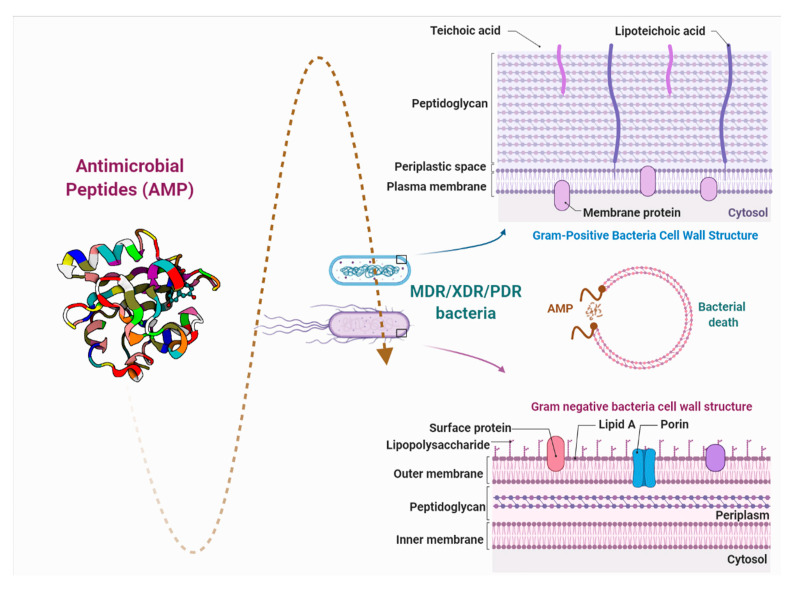
Bacterial resistance has intensified in recent years due to the uncontrolled use of conventional drugs, and new bacterial strains with multiple resistance have been reported. This problem may be solved by using antimicrobial peptides (AMPs), which fulfill their bactericidal activity without developing much bacterial resistance. The rapid interaction between AMPs and the bacterial cell membrane means that the bacteria cannot easily develop resistance mechanisms. In addition, various drugs for clinical use have lost their effect as a conventional treatment; however, the synergistic effect of AMPs with these drugs would help to reactivate and enhance antimicrobial activity. Their efficiency against multi-resistant and extensively resistant bacteria has positioned them as promising molecules to replace or improve conventional drugs. In this review, we examined the importance of antimicrobial peptides and their successful activity against critical and high-priority bacteria published in the WHO list.
近年来,由于传统药物的无节制使用,细菌耐药性增强,已报道出现了具有多重耐药性的新菌株。使用抗菌肽(AMPs)或许可以解决这个问题,抗菌肽可发挥杀菌活性,且不易产生大量细菌耐药性。抗菌肽与细菌细胞膜之间的快速相互作用意味着细菌难以轻易产生耐药机制。此外,各种临床使用的药物作为传统治疗手段已经失效;然而,抗菌肽与这些药物的协同作用将有助于恢复并增强抗菌活性。它们对多重耐药菌和广泛耐药菌的有效性使其成为有望替代或改进传统药物的分子。在本综述中,我们研究了抗菌肽的重要性及其针对世界卫生组织名单中关键和高度优先细菌的成功活性。