Division of Clinical Care and Research, Institute of Human Virology, University of Maryland School of Medicine, Baltimore, MD 21201, USA.
Institute of Human Virology, University of Maryland School of Medicine, Baltimore, MD 21201, USA.
Cells. 2021 May 4;10(5):1097. doi: 10.3390/cells10051097.
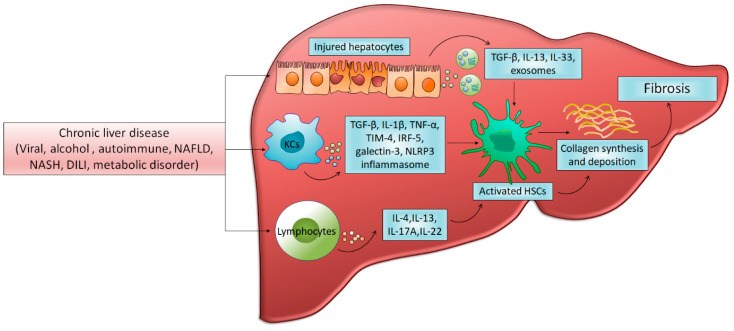
Hepatic fibrosis is a dynamic process that occurs as a wound healing response against liver injury. During fibrosis, crosstalk between parenchymal and non-parenchymal cells, activation of different immune cells and signaling pathways, as well as a release of several inflammatory mediators take place, resulting in inflammation. Excessive inflammation drives hepatic stellate cell (HSC) activation, which then encounters various morphological and functional changes before transforming into proliferative and extracellular matrix (ECM)-producing myofibroblasts. Finally, enormous ECM accumulation interferes with hepatic function and leads to liver failure. To overcome this condition, several therapeutic approaches have been developed to inhibit inflammatory responses, HSC proliferation and activation. Preclinical studies also suggest several targets for the development of anti-fibrotic therapies; however, very few advanced to clinical trials. The pathophysiology of hepatic fibrosis is extremely complex and requires comprehensive understanding to identify effective therapeutic targets; therefore, in this review, we focus on the various cellular and molecular mechanisms associated with the pathophysiology of hepatic fibrosis and discuss potential strategies to control or reverse the fibrosis.
肝纤维化是一种动态过程,是肝脏损伤后作为一种伤口愈合反应而发生的。在纤维化过程中,实质细胞和非实质细胞之间发生串扰,不同的免疫细胞和信号通路被激活,以及几种炎症介质的释放,导致炎症。过度的炎症会驱动肝星状细胞(HSC)的激活,然后在转化为增殖和细胞外基质(ECM)产生的肌成纤维细胞之前,经历各种形态和功能的变化。最后,大量的 ECM 积累会干扰肝功能并导致肝衰竭。为了克服这种情况,已经开发了几种治疗方法来抑制炎症反应、HSC 的增殖和激活。临床前研究还为抗纤维化治疗的发展提出了几个靶点;然而,很少有靶点能进入临床试验。肝纤维化的病理生理学极其复杂,需要全面了解才能确定有效的治疗靶点;因此,在这篇综述中,我们重点关注与肝纤维化病理生理学相关的各种细胞和分子机制,并讨论控制或逆转纤维化的潜在策略。