Department of Nutrition and Dietetics, Faculty of Health Sciences, Gazi University, Emek, Ankara 06490, Turkey.
Department of Agricultural Sciences, University of Naples Federico II, 80055 Naples, Italy.
Nutrients. 2021 May 4;13(5):1550. doi: 10.3390/nu13051550.
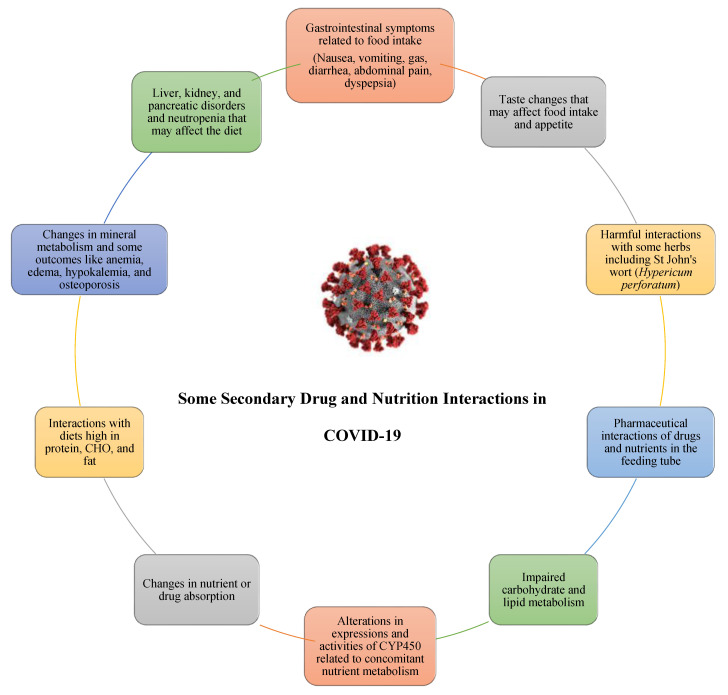
Coronaviruses are a large family of viruses that are known to cause respiratory tract infections ranging from colds to more severe diseases, such as Middle East Respiratory Syndrome (MERS) and the Severe Acute Respiratory Syndrome (SARS). New Coronavirus Disease 2019 (COVID-19), which led to deaths as well as social and economic disruptions, is an ongoing worldwide pandemic caused by Severe Acute Respiratory Syndrome Coronavirus 2 (SARS-CoV-2). Currently, there is no approved treatment for COVID-19. Hence, only supportive care has been approved by the World Health Organization (WHO) for now. Pharmacological agents used for the adjunctive treatment of COVID-19 following the current literature and clinical experiences include antiviral, anti-inflammatory, and anti-malaria drugs, and other traditional or untraditional treatments. However, it has been reported that the use of these drugs may have some negative effects and comorbidities. Moreover, the current data have indicated that the risk of drug-drug interactions may also be high in polypharmacy cases, especially in elderly people, some comorbidity situations, and intensive care unit (ICU) patients. It is highly possible that these situations can not only increase the risk of drug-drug interactions but also increase the risk of food/nutrition-drug interactions and affect the nutritional status. However, this issue has not yet been entirely discussed in the literature. In this review, current information on the possible mechanisms as well as pharmacokinetic and pharmacodynamic effects of some pharmacological agents used in the treatment of COVID-19 and/or their secondary interactions with nutrition were evaluated and some future directions were given.
冠状病毒是一大类病毒,已知可引起从感冒到更严重疾病的呼吸道感染,例如中东呼吸综合征(MERS)和严重急性呼吸综合征(SARS)。由严重急性呼吸综合征冠状病毒 2(SARS-CoV-2)引起的新型冠状病毒病 2019(COVID-19)导致了死亡以及社会和经济混乱,这是一种正在全球范围内持续流行的疾病。目前,COVID-19 没有经过批准的治疗方法。因此,世界卫生组织(WHO)目前仅批准了支持性护理。根据目前的文献和临床经验,用于 COVID-19 辅助治疗的药物包括抗病毒药、抗炎药和抗疟药,以及其他传统或非传统治疗方法。然而,据报道,这些药物的使用可能会产生一些副作用和合并症。此外,目前的数据表明,在多药治疗的情况下,药物相互作用的风险可能也很高,特别是在老年人、某些合并症情况和重症监护病房(ICU)患者中。很有可能这些情况不仅会增加药物相互作用的风险,还会增加食物/营养药物相互作用的风险,并影响营养状况。然而,这个问题在文献中尚未得到全面讨论。在这篇综述中,评估了一些用于治疗 COVID-19 和/或它们与营养的次要相互作用的药理制剂的可能机制以及药代动力学和药效学作用的当前信息,并给出了一些未来的方向。