Directorate-General of Public Health, Aragon Department of Health, 50017 Zaragoza, Spain.
Preventive Medicine and Public Health Department, Lozano Blesa University Hospital, 50009 Zaragoza, Spain.
Int J Environ Res Public Health. 2021 May 11;18(10):5085. doi: 10.3390/ijerph18105085.
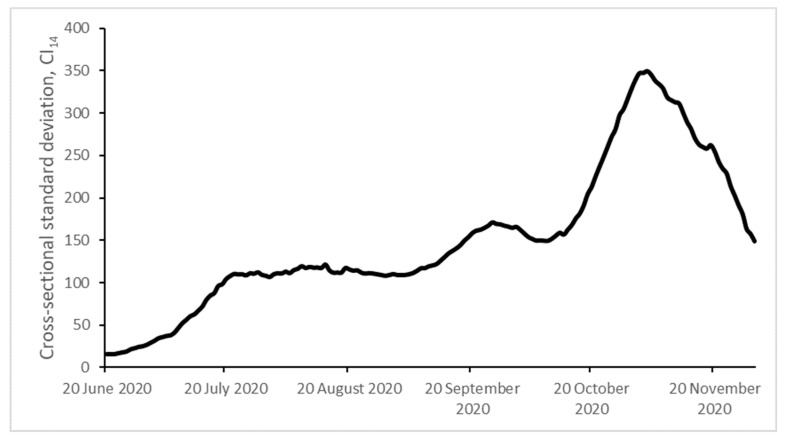
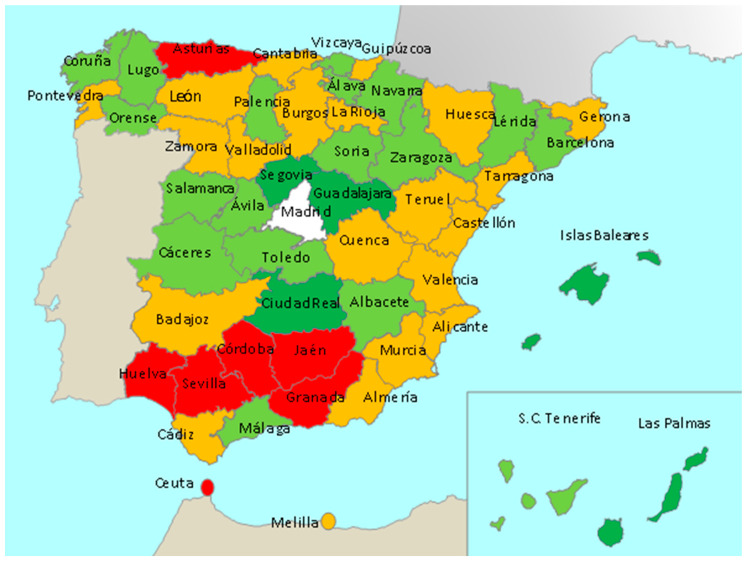
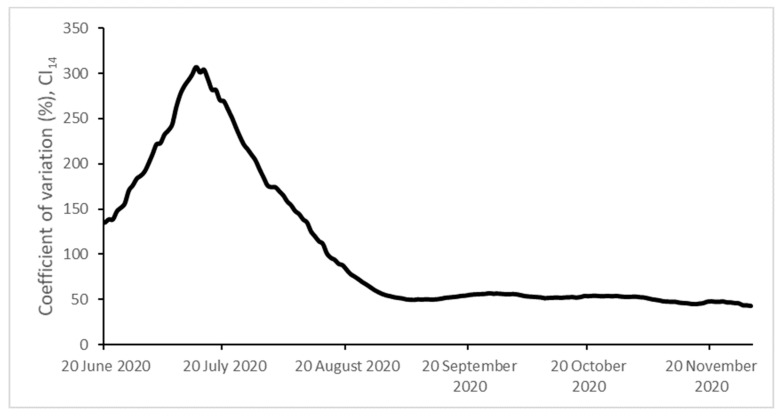
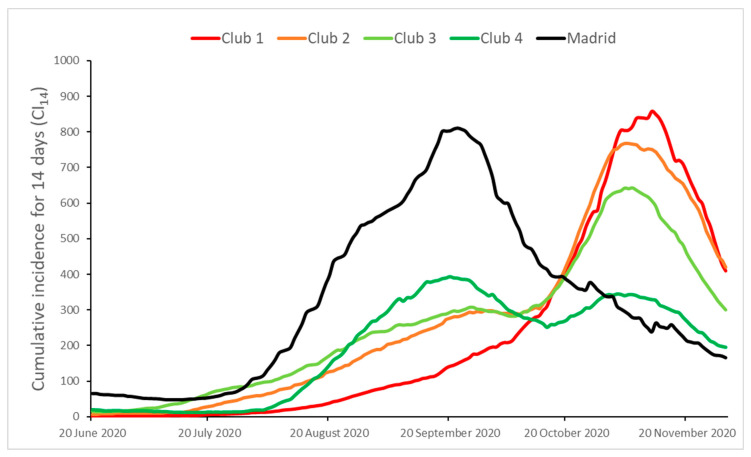
Spain experienced a second wave of the COVID-19 pandemic in autumn 2020, which has been approached with different measures by regional authorities. We analyze the presence of convergence in the cumulative incidence for 14 days (CI) in provinces and self-governing cities. The Phillips-Sul methodology was used to study the grouping of behavior between provinces, and an ordered logit model was estimated to understand the forces that drive creating the different convergence clubs. We reject the presence of a single pattern of behavior in the evolution of the CI across territories. Four statistically different convergence clubs and an additional province (Madrid) with divergent behavior are observed. Provinces with developed agricultural and industrial economic sectors, high mobility, and a high proportion of Central and South American immigrants had the highest level of CI. We show that the transmission of the virus is not homogeneous in the Spanish national territory. Our results are helpful for identifying differences in determinants that could explain the pandemic's evolution and for formulating hypotheses about the effectiveness of implemented measures.
西班牙在 2020 年秋季经历了第二波 COVID-19 疫情,各地区当局采取了不同的措施。我们分析了 14 天累计发病率(CI)在省份和自治区之间的趋同情况。菲利普斯-苏尔方法用于研究省份之间行为的分组,并估计有序逻辑模型以了解推动形成不同趋同俱乐部的力量。我们拒绝在整个领土上 CI 演变过程中存在单一的行为模式。观察到四个在 CI 演变方面具有统计学差异的趋同俱乐部和一个具有发散行为的额外省份(马德里)。农业和工业经济部门发达、流动性高、中美洲和南美洲移民比例高的省份的 CI 水平最高。我们表明,病毒在西班牙领土上的传播并不均匀。我们的结果有助于确定可能解释大流行演变的决定因素的差异,并提出关于实施措施有效性的假设。