Centre International de Recherche en Infectiologie (CIRI), Université de Lyon, Inserm U1111, CNRS, UMR5308, ENS de Lyon, Université Claude Bernard Lyon 1, 46 Allée d'Italie, 69007 Lyon, France.
Cells. 2021 May 11;10(5):1171. doi: 10.3390/cells10051171.
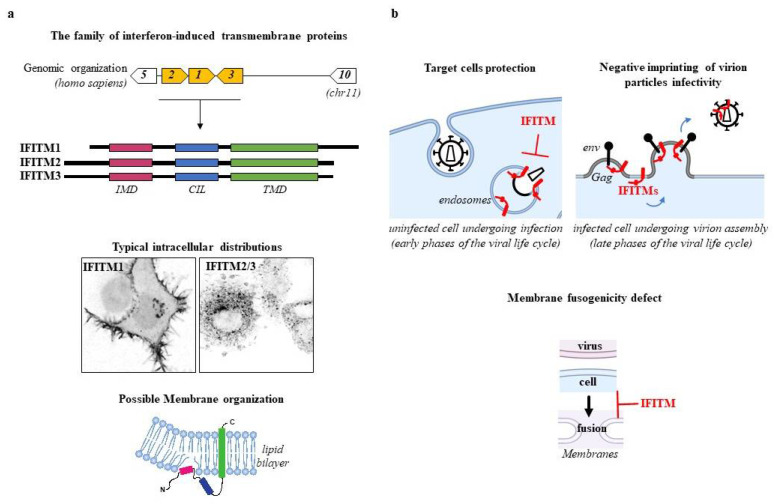
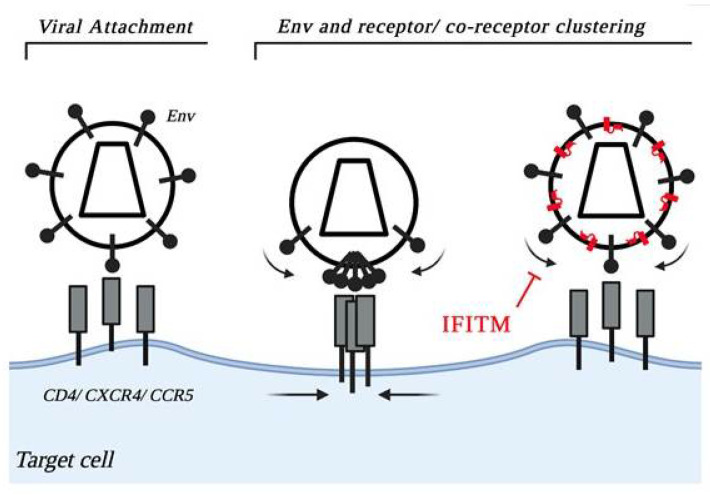
HIV-1 is a complex retrovirus that is adapted to replicate in cells of the immune system. To do so, HIV-1, like other viruses, developed strategies to use several cellular processes to its advantage, but had also to come to terms with an arsenal of cellular innate defense proteins, or antiviral factors, that target more or less efficiently, virtually every step of the virus replicative cycle. Among antiviral restriction factors, the family of interferon-induced transmembrane proteins (IFITMs) has emerged as a crucial component of cellular innate defenses for their ability to interfere with both early and late phases of viral replication by inhibiting cellular and viral membranes fusion. Here, we review the enormous advances made since the discovery of IFITMs as interferon-regulated genes more than thirty years ago, with a particular focus on HIV-1 and on the elements that modulate its susceptibility or resistance towards members of this family. Given the recent advances of the field in the elucidation of the mechanism of IFITM inhibition and on the mechanism(s) of viral resistance, we expect that future years will bring novel insights into the definition of the multiple facets of IFITMs and on their possible use for novel therapeutical approaches.
HIV-1 是一种复杂的逆转录病毒,适应在免疫系统的细胞中复制。为了做到这一点,HIV-1 像其他病毒一样,发展了利用几种细胞过程为其所用的策略,但也不得不应对一系列细胞固有防御蛋白或抗病毒因子,这些蛋白或因子或多或少地有效地针对病毒复制周期的几乎每一个步骤。在抗病毒限制因素中,干扰素诱导的跨膜蛋白(IFITM)家族因其能够通过抑制细胞和病毒膜融合来干扰病毒复制的早期和晚期阶段而成为细胞固有防御的关键组成部分。在这里,我们回顾了三十多年前发现 IFITM 作为干扰素调节基因以来所取得的巨大进展,特别关注 HIV-1 以及调节其对该家族成员易感性或抗性的因素。鉴于该领域在阐明 IFITM 抑制机制以及病毒抗性机制方面的最新进展,我们预计未来几年将对 IFITM 的多个方面有新的认识,并对其可能用于新的治疗方法有新的认识。