Sharma Ameya, Puri Vivek, Kumar Pradeep, Singh Inderbir, Huanbutta Kampanart
Chitkara College of Pharmacy, Chitkara University, Chandigarh 140401, India.
Chitkara University School of Pharmacy, Chitkara University, Solan 174103, India.
Polymers (Basel). 2021 May 8;13(9):1514. doi: 10.3390/polym13091514.
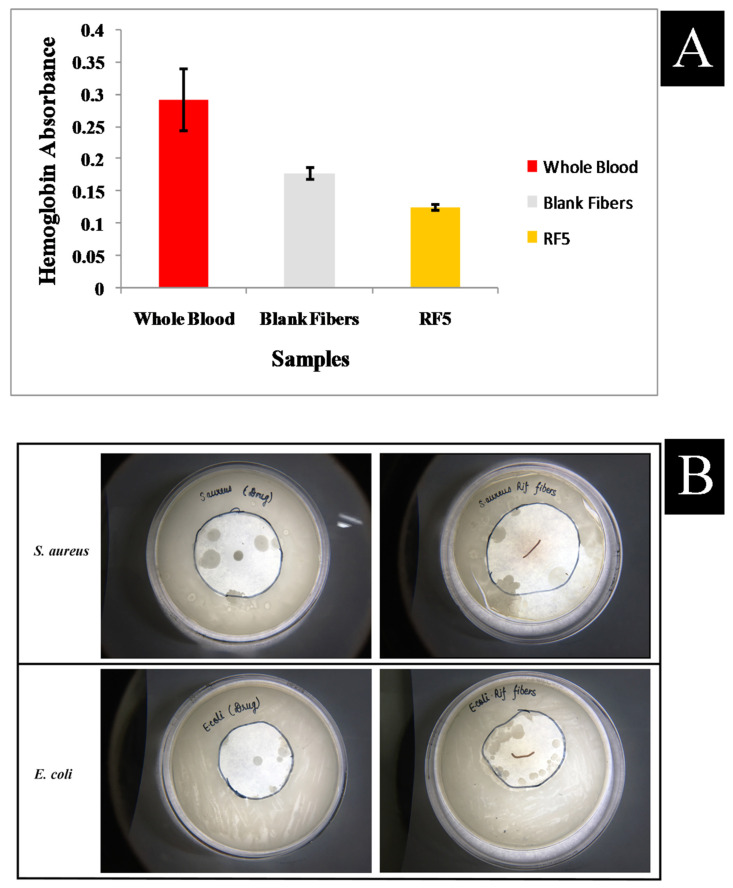
Various systematic phases such as inflammation, tissue proliferation, and phases of remodeling characterize the process of wound healing. The natural matrix system is suggested to maintain and escalate these phases, and for that, microfibers were fabricated employing naturally occurring polymers (biopolymers) such as sodium alginate, gelatin and xanthan gum, and reinforcing material such as nanoclay was selected. The fabrication of fibers was executed with the aid of extrusion-gelation method. Rifampicin, an antibiotic, has been incorporated into a biopolymeric solution. RF1, RF2, RF3, RF4 and RF5 were coded as various formulation batches of microfibers. The microfibers were further characterized by different techniques such as SEM, DSC, XRD, and FTIR. Mechanical properties and physical evaluations such as entrapment efficiency, water uptake and in vitro release were also carried out to explain the comparative understanding of the formulation developed. The antimicrobial activity and whole blood clotting of fabricated fibers were additionally executed, hence they showed significant results, having excellent antimicrobial properties; they could be prominent carriers for wound healing applications.
炎症、组织增殖和重塑阶段等各种系统阶段是伤口愈合过程的特征。天然基质系统被认为可以维持和促进这些阶段,为此,使用海藻酸钠、明胶和黄原胶等天然聚合物(生物聚合物)制造微纤维,并选择纳米粘土等增强材料。纤维的制造借助挤出-凝胶法进行。抗生素利福平已被掺入生物聚合物溶液中。RF1、RF2、RF3、RF4和RF5被编码为微纤维的不同配方批次。微纤维通过扫描电子显微镜(SEM)、差示扫描量热法(DSC)、X射线衍射(XRD)和傅里叶变换红外光谱(FTIR)等不同技术进一步表征。还进行了机械性能和物理评估,如包封率、吸水率和体外释放,以解释对所开发配方的比较理解。此外,还对制造的纤维进行了抗菌活性和全血凝血测试,结果显示它们具有显著效果,具有优异的抗菌性能;它们可能是伤口愈合应用的突出载体。