Department of Physiology, Faculty of Medicine, Universidad Autónoma de Madrid, C/Arzobispo Morcillo 2, 28029 Madrid, Spain.
Division of Neonatology Hospital Clínico San Carlos, Instituto de Investigación Sanitaria del Hospital Clínico San Carlos (IdISSC), C/Profesor Martin Lagos s/n, 28040 Madrid, Spain.
Nutrients. 2021 May 22;13(6):1766. doi: 10.3390/nu13061766.
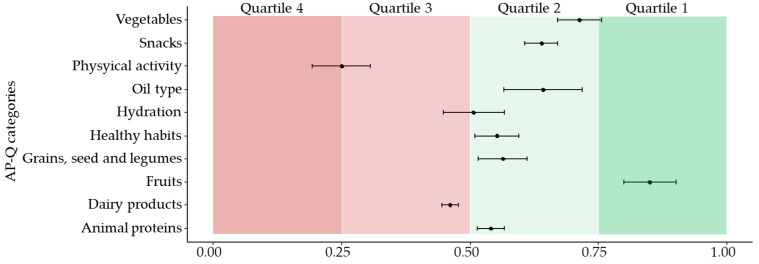
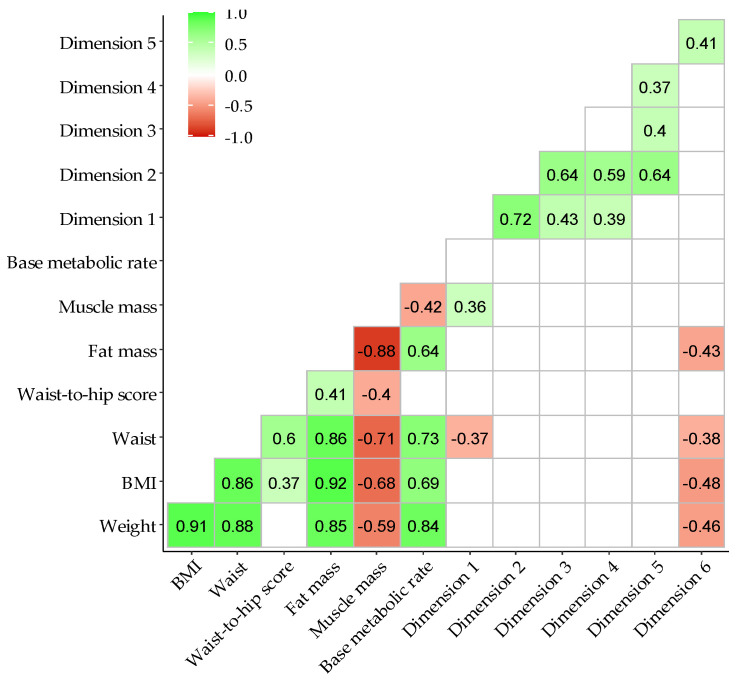
The first month of lactation is a vulnerable nutritional period for the mother. Our aims were (1) to evaluate the nutritional status of breastfeeding women in the first month of lactation, and (2) to explore different aspects of nutrition and lifestyle through a multidimensional approach. A total of 30 healthy breastfeeding women were enrolled in this study. Dietary pattern was assessed through a 72-hour dietary recall questionnaire (days 7 and 28 postpartum) and data were compared with Dietary Recommendation Values (DRV), and through the Adherence to Healthy Food Pyramid (HFP) questionnaire (day 28). Anthropometric parameters were evaluated by bioimpedance. Using factor analysis, nutritional dimensions were extracted, and linear regression models were used to analyze the association between anthropometric parameters and dimensions. Compared to the DRV, women showed insufficient energy, water, vitamin D, and potassium intake and excessive proteins, vitamins B1, B2, B3, B6, B12, and iron intake. We observed a moderate adherence to the HFP, with women being high in the fruits, vegetables, and oil categories, and low adherence to the physical activity, dairy products, and hydration categories. The nutritional dimension, including the HFP categories of physical activity, hydration, and animal protein intake together, was negatively associated with body weight (β = -3.7 ± 1.7; -value = 0.047). In conclusion, during the first month postpartum, breastfeeding women exhibited several nutritional imbalances and poor physical activity negatively influencing anthropometric parameters. We propose a multidimensional approach to assess the nutritional status of breastfeeding women as a tool to detect specific deficiencies, allowing for personalized counseling.
哺乳期的第一个月是母亲营养脆弱的时期。我们的目的是:(1) 评估哺乳期妇女在哺乳期第一个月的营养状况;(2) 通过多维方法探索营养和生活方式的不同方面。共有 30 名健康的母乳喂养妇女参与了这项研究。通过 72 小时膳食回顾问卷(产后第 7 天和第 28 天)评估饮食模式,并将数据与膳食推荐值(DRV)进行比较,同时通过健康食品金字塔(HFP)问卷(产后第 28 天)评估饮食模式。通过生物电阻抗评估人体测量参数。使用因子分析提取营养维度,并使用线性回归模型分析人体测量参数与维度之间的关系。与 DRV 相比,女性的能量、水、维生素 D 和钾摄入不足,蛋白质、维生素 B1、B2、B3、B6、B12 和铁摄入过多。我们发现 HFP 的依从性处于中等水平,女性在水果、蔬菜和油类方面较高,而在体力活动、乳制品和水合作用方面较低。营养维度,包括 HFP 类别的体力活动、水合作用和动物蛋白摄入,与体重呈负相关(β=-3.7±1.7;-值=0.047)。总之,产后第一个月,哺乳期妇女存在多种营养失衡,体力活动不足对人体测量参数产生负面影响。我们提出了一种多维方法来评估哺乳期妇女的营养状况,作为一种检测特定缺陷的工具,从而实现个性化咨询。