Yadav Pragya D, Nyayanit Dimpal A, Majumdar Triparna, Patil Savita, Kaur Harmanmeet, Gupta Nivedita, Shete Anita M, Pandit Priyanka, Kumar Abhinendra, Aggarwal Neeraj, Narayan Jitendra, Vijay Neetu, Kalawat Usha, Sugunan Attayur P, Munivenkatappa Ashok, Sharma Tara, Devi Sulochna, Majumdar Tapan, Jaryal Subhash, Bakshi Rupinder, Joshi Yash, Sahay Rima, Shastri Jayanti, Singh Mini, Kumar Manoj, Rawat Vinita, Dutta Shanta, Yadav Sarita, Krishnasamy Kaveri, Raut Sharmila, Biswas Debasis, Borkakoty Biswajyoti, Verma Santwana, Rani Sudha, Deval Hirawati, Patel Disha, Turuk Jyotirmayee, Malhotra Bharti, Fomda Bashir, Nag Vijaylakshmi, Jain Amita, Bhargava Anudita, Potdar Varsha, Cherian Sarah, Abraham Priya, Gopal Anjani, Panda Samiran, Bhargava Balram
Indian Council of Medical Research-National Institute of Virology (ICMR-NIV), Pune 411021, India.
Indian Council of Medical Research, New Delhi 110029, India.
Viruses. 2021 May 17;13(5):925. doi: 10.3390/v13050925.
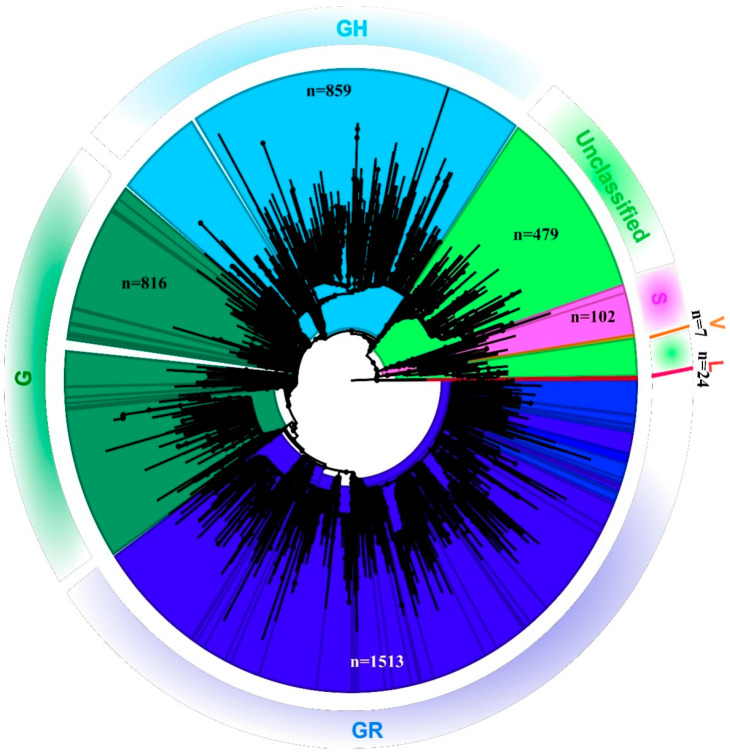
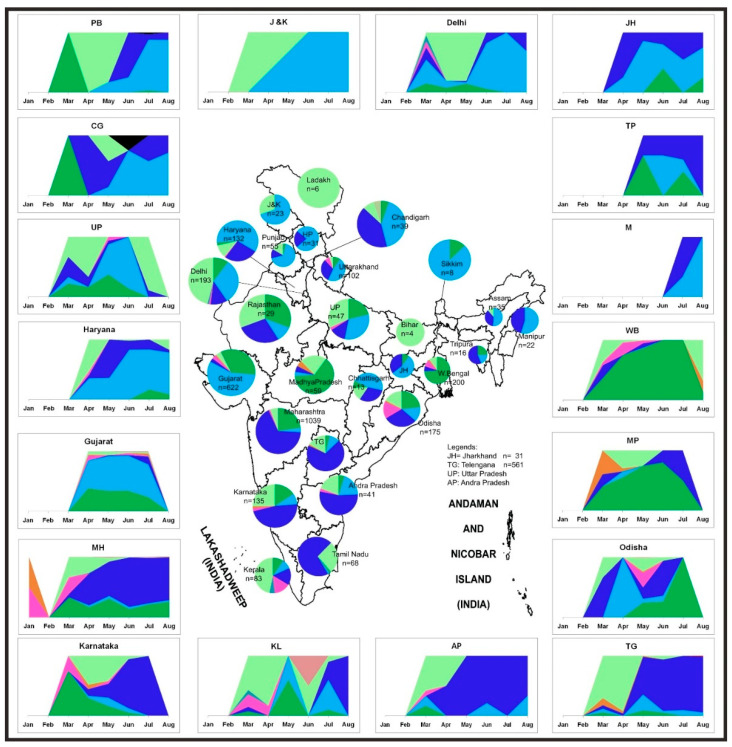
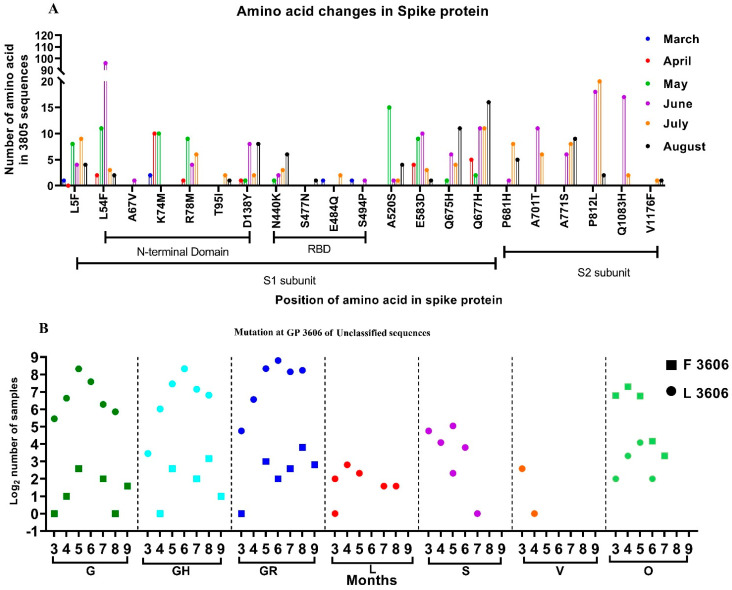
The number of Severe Acute Respiratory Syndrome Coronavirus-2 (SARS-CoV-2) cases is increasing in India. This study looks upon the geographic distribution of the virus clades and variants circulating in different parts of India between January and August 2020. The NPS/OPS from representative positive cases from different states and union territories in India were collected every month through the VRDLs in the country and analyzed using next-generation sequencing. Epidemiological analysis of the 689 SARS-CoV-2 clinical samples revealed GH and GR to be the predominant clades circulating in different states in India. The northern part of India largely reported the 'GH' clade, whereas the southern part reported the 'GR', with a few exceptions. These sequences also revealed the presence of single independent mutations-E484Q and N440K-from Maharashtra (first observed in March 2020) and Southern Indian States (first observed in May 2020), respectively. Furthermore, this study indicates that the SARS-CoV-2 variant (VOC, VUI, variant of high consequence and double mutant) was not observed during the early phase of virus transmission (January-August). This increased number of variations observed within a short timeframe across the globe suggests virus evolution, which can be a step towards enhanced host adaptation.
印度的严重急性呼吸综合征冠状病毒2(SARS-CoV-2)病例数正在增加。本研究着眼于2020年1月至8月期间在印度不同地区传播的病毒进化枝和变体的地理分布。每月通过印度各地的病毒核糖核酸检测实验室收集来自印度不同邦和中央直辖区代表性阳性病例的鼻咽拭子/口咽拭子,并使用下一代测序进行分析。对689份SARS-CoV-2临床样本的流行病学分析显示,GH和GR是在印度不同邦传播的主要进化枝。印度北部主要报告为“GH”进化枝,而南部报告为“GR”,但有一些例外。这些序列还分别揭示了来自马哈拉施特拉邦(2020年3月首次发现)和印度南部各邦(2020年5月首次发现)的单个独立突变——E484Q和N440K。此外,本研究表明,在病毒传播的早期阶段(1月至8月)未观察到SARS-CoV-2变体(变异株、需关注变异株、具有高影响的变异株和双突变体)。在全球范围内短时间内观察到的变异数量增加表明病毒在进化,这可能是朝着增强宿主适应性迈出的一步。