Su Yvonne C F, Ma Jordan Z J, Ou Tey Putita, Pum Leakhena, Krang Sidonn, Raftery Philomena, Kinzer Michael H, Bohl Jennifer, Ieng Vanra, Kab Vannda, Patel Sarika, Sar Borann, Ying Wong Foong, Jayakumar Jayanthi, Horm Viseth Srey, Boukli Narjis, Yann Sokhoun, Troupin Cecile, Heang Vireak, Garcia-Rivera Jose A, Sengdoeurn Yi, Heng Seng, Lay Sreyngim, Chea Sophana, Darapheak Chau, Savuth Chin, Khalakdina Asheena, Ly Sowath, Baril Laurence, Manning Jessica E, Simone-Loriere Etienne, Duong Veasna, Dussart Philippe, Sovann Ly, Smith Gavin J D, Karlsson Erik A
Programme in Emerging Infectious Diseases, Duke-NUS Medical School, 8 College Rd 169857, Singapore.
Virology Unit, World Health Organization COVID-19 Global Referral Laboratory, Institute Pasteur du Cambodge, 5 Preah Monivong Blvd (93), Phnom Penh 12201, Cambodia.
Virus Evol. 2022 Dec 16;9(1):veac121. doi: 10.1093/ve/veac121. eCollection 2023.
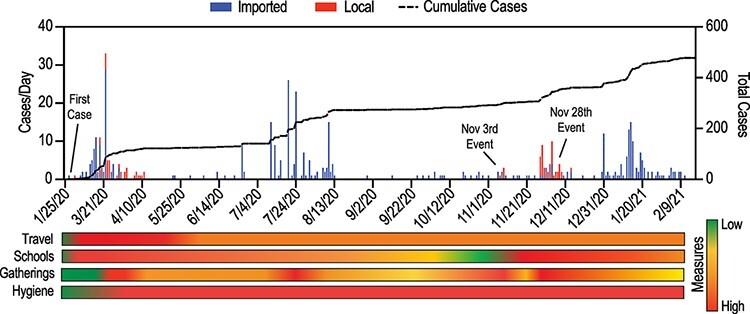
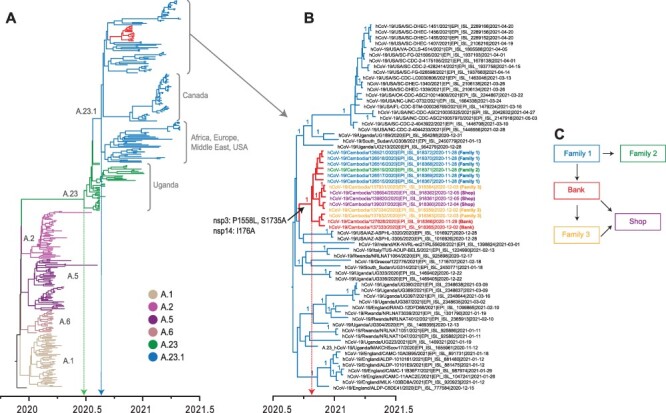
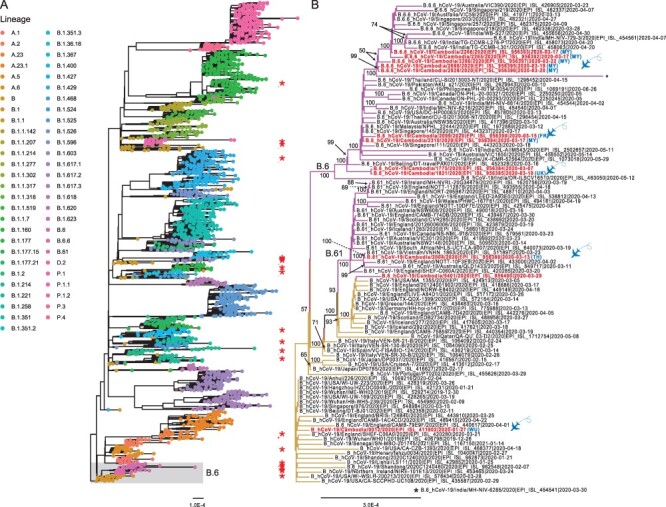
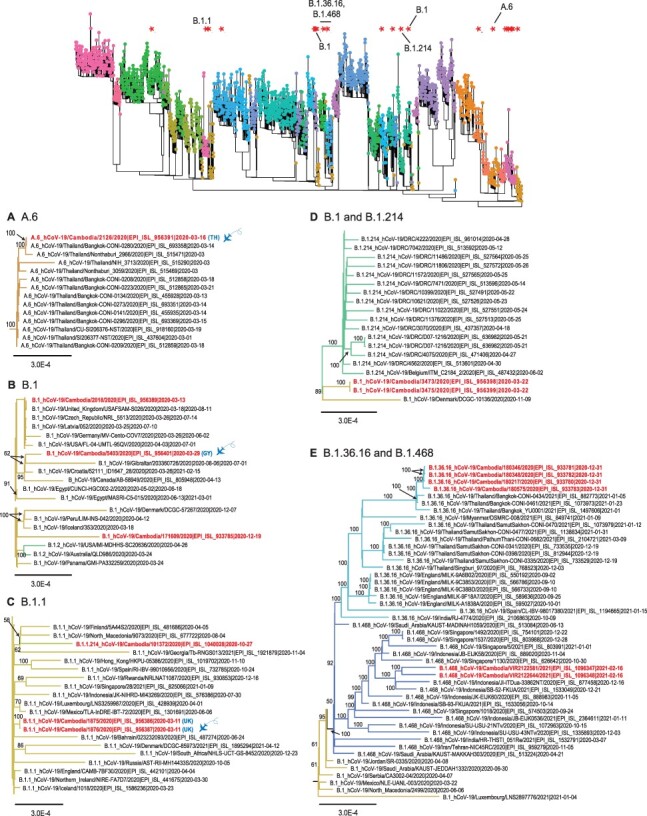
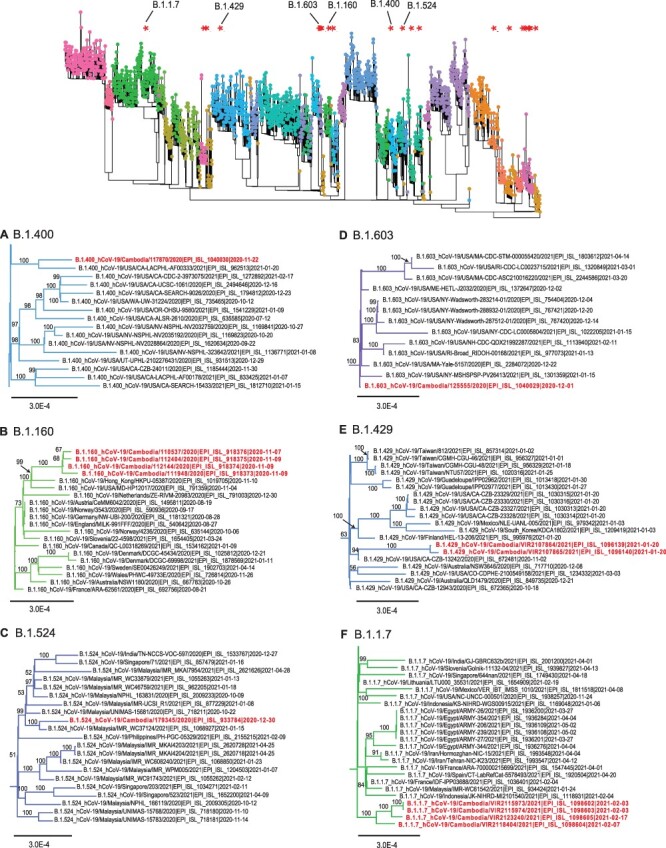
The first case of coronavirus disease 2019 (COVID-19) in Cambodia was confirmed on 27 January 2020 in a traveller from Wuhan. Cambodia subsequently implemented strict travel restrictions, and although intermittent cases were reported during the first year of the COVID-19 pandemic, no apparent widespread community transmission was detected. Investigating the routes of severe acute respiratory coronavirus 2 (SARS-CoV-2) introduction into the country was critical for evaluating the implementation of public health interventions and assessing the effectiveness of social control measures. Genomic sequencing technologies have enabled rapid detection and monitoring of emerging variants of SARS-CoV-2. Here, we detected 478 confirmed COVID-19 cases in Cambodia between 27 January 2020 and 14 February 2021, 81.3 per cent in imported cases. Among them, fifty-four SARS-CoV-2 genomes were sequenced and analysed along with representative global lineages. Despite the low number of confirmed cases, we found a high diversity of Cambodian viruses that belonged to at least seventeen distinct PANGO lineages. Phylogenetic inference of SARS-CoV-2 revealed that the genetic diversity of Cambodian viruses resulted from multiple independent introductions from diverse regions, predominantly, Eastern Asia, Europe, and Southeast Asia. Most cases were quickly isolated, limiting community spread, although there was an A.23.1 variant cluster in Phnom Penh in November 2020 that resulted in a small-scale local transmission. The overall low incidence of COVID-19 infections suggests that Cambodia's early containment strategies, including travel restrictions, aggressive testing and strict quarantine measures, were effective in preventing large community outbreaks of COVID-19.
2020年1月27日,柬埔寨确诊首例2019冠状病毒病(COVID-19),患者为一名来自武汉的旅行者。柬埔寨随后实施了严格的旅行限制措施,尽管在COVID-19大流行的第一年有间歇性病例报告,但未检测到明显的广泛社区传播。调查严重急性呼吸综合征冠状病毒2(SARS-CoV-2)传入该国的途径对于评估公共卫生干预措施的实施情况和评估社会控制措施的有效性至关重要。基因组测序技术能够快速检测和监测SARS-CoV-2的新兴变种。在此,我们检测了2020年1月27日至2021年2月14日期间柬埔寨的478例确诊COVID-19病例,其中81.3%为输入性病例。在这些病例中,对54个SARS-CoV-2基因组进行了测序,并与具有代表性的全球谱系一起进行了分析。尽管确诊病例数量较少,但我们发现柬埔寨的病毒具有高度多样性,属于至少17个不同的PANGO谱系。SARS-CoV-2的系统发育推断表明,柬埔寨病毒的遗传多样性源于来自不同地区的多次独立引入,主要是东亚、欧洲和东南亚。大多数病例迅速被隔离,限制了社区传播,尽管2020年11月金边出现了一个A.23.1变种集群,导致了小规模的局部传播。COVID-19感染的总体低发病率表明,柬埔寨的早期遏制策略,包括旅行限制、积极检测和严格的检疫措施,在预防COVID-19的大规模社区爆发方面是有效的。