O'Brien Mara H, Pitot Henry C, Chung Sang-Hyuk, Lambert Paul F, Drinkwater Norman R, Bilger Andrea
Department of Craniofacial Sciences, University of Connecticut Health Center, 263 Farmington Avenue, Farmington, CT 06030, USA.
McArdle Laboratory for Cancer Research, School of Medicine and Public Health, University of Wisconsin-Madison, 1111 Highland Ave, Madison, WI 53705, USA.
Cancers (Basel). 2021 May 13;13(10):2355. doi: 10.3390/cancers13102355.
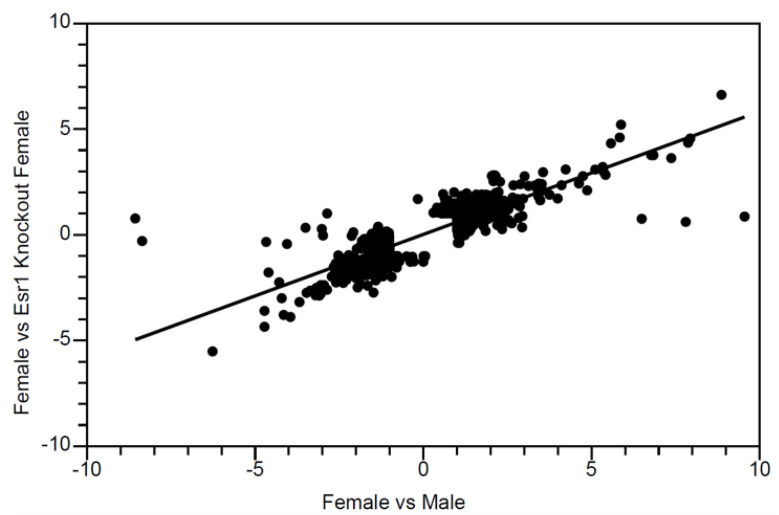
Estrogen protects females from hepatocellular carcinoma (HCC). To determine whether this protection is mediated by classic estrogen receptors, we tested HCC susceptibility in estrogen receptor-deficient mice. In contrast to a previous study, we found that diethylnitrosamine induces hepatocarcinogenesis to a significantly greater extent when females lack , which encodes Estrogen Receptor-α. Relative to wild-type littermates, knockout females developed 9-fold more tumors. Deficiency of , which encodes Estrogen Receptor-β, did not affect liver carcinogenesis in females. Using microarrays and QPCR to examine estrogen receptor effects on hepatic gene expression patterns, we found that germline deficiency resulted in the masculinization of gene expression in the female liver. Six of the most dysregulated genes have previously been implicated in HCC. In contrast, deletion specifically in hepatocytes of conditional null female mice (in which Cre was expressed from the albumin promoter) resulted in the maintenance of female-specific liver gene expression. Wild-type adult females lacking ovarian estrogen due to ovariectomy, which is known to make females susceptible to HCC, also maintained female-specific expression in the liver of females. These studies indicate that mediates liver cancer risk, and its control of sex-specific liver gene expression involves cells other than hepatocytes.
雌激素可保护女性免受肝细胞癌(HCC)的侵害。为了确定这种保护作用是否由经典雌激素受体介导,我们检测了雌激素受体缺陷小鼠的HCC易感性。与之前的一项研究相反,我们发现当雌性小鼠缺乏编码雌激素受体α的 时,二乙基亚硝胺诱导肝癌发生的程度明显更高。相对于野生型同窝小鼠, 基因敲除的雌性小鼠产生的肿瘤多9倍。编码雌激素受体β的 基因缺失对雌性小鼠的肝癌发生没有影响。我们使用微阵列和定量聚合酶链反应来检测雌激素受体对肝脏基因表达模式的影响,发现种系 基因缺陷导致雌性肝脏基因表达男性化。其中六个失调最严重的基因此前已被证明与HCC有关。相比之下,在条件性基因敲除雌性小鼠(其中Cre由白蛋白启动子表达)的肝细胞中特异性缺失 ,可维持雌性特异性肝脏基因表达。因卵巢切除而缺乏卵巢雌激素的野生型成年雌性小鼠(已知这会使雌性易患HCC),其肝脏中也维持了雌性特异性表达。这些研究表明, 介导肝癌风险,其对性别特异性肝脏基因表达的控制涉及肝细胞以外的细胞。