Immunoassay/Immunosensors Lab, Institute of Nuclear & Radiological Sciences & Technology, Energy & Safety, National Centre for Scientific Research "Demokritos", P.O. Box 60037, 15310 Agia Paraskevi, Greece.
Immunopeptide Chemistry Lab, Institute of Nuclear & Radiological Sciences & Technology, Energy & Safety, National Centre for Scientific Research "Demokritos", P.O. Box 60037, 15310 Agia Paraskevi, Greece.
Biosensors (Basel). 2021 May 13;11(5):153. doi: 10.3390/bios11050153.
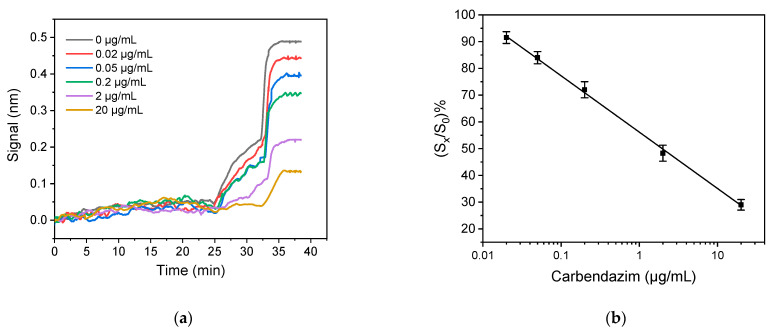
Carbendazim is a systemic benzimidazole-type fungicide with broad-spectrum activity against fungi that undermine food products safety and quality. Despite its effectiveness, carbendazim constitutes a major environmental pollutant, being hazardous to both humans and animals. Therefore, fast and reliable determination of carbendazim levels in water, soil, and food samples is of high importance for both food industry and public health. Herein, an optical biosensor based on white light reflectance spectroscopy (WLRS) for fast and sensitive determination of carbendazim in fruit juices is presented. The transducer is a Si/SiO chip functionalized with a benzimidazole conjugate, and determination is based on a competitive immunoassay format. Thus, for the assay, a mixture of an in-house developed rabbit polyclonal anti-carbendazim antibody with the standards or samples is pumped over the chip, followed by biotinylated secondary antibody and streptavidin. The WLRS platform allows for real-time monitoring of biomolecular interactions carried out onto the Si/SiO chip by transforming the shift in the reflected interference spectrum caused by the immunoreaction to effective biomolecular adlayer thickness. The sensor is able to detect 20 ng/mL of carbendazim in fruit juices with high accuracy and precision (intra- and inter-assay CVs ≤ 6.9% and ≤9.4%, respectively) in less than 30 min, applying a simple sample treatment that alleviates any "matrix-effect" on the assay results and a 60 min preincubation step for improving assay sensitivity. Excellent analytical characteristics and short analysis time along with its small size render the proposed WLRS immunosensor ideal for future on-the-spot determination of carbendazim in food and environmental samples.
多菌灵是一种具有广谱活性的苯并咪唑类杀菌剂,可防治破坏食品安全和质量的真菌。尽管多菌灵有效,但它是一种主要的环境污染物,对人类和动物都有危害。因此,快速可靠地测定水、土壤和食品样品中的多菌灵含量对于食品工业和公共卫生都非常重要。本文提出了一种基于白光反射光谱(WLRS)的光学生物传感器,用于快速灵敏地测定果汁中的多菌灵。换能器是一个功能化有苯并咪唑结合物的 Si/SiO 芯片,测定基于竞争性免疫分析格式。因此,对于该测定,将内部开发的兔多克隆抗多菌灵抗体与标准品或样品的混合物泵入芯片,然后加入生物素化的二级抗体和链霉亲和素。WLRS 平台允许通过将免疫反应引起的反射干涉光谱的位移转换为有效生物分子吸附层厚度,实时监测在 Si/SiO 芯片上进行的生物分子相互作用。该传感器能够在不到 30 分钟的时间内检测到果汁中的 20 ng/mL 多菌灵,具有高精度和精密度(内部和外部测定 CVs 分别≤6.9%和≤9.4%),应用简单的样品处理减轻了对测定结果的任何“基质效应”,并采用 60 分钟的预孵育步骤提高了测定的灵敏度。出色的分析特性和短的分析时间以及其小巧的尺寸使所提出的 WLRS 免疫传感器非常适合未来现场测定食品和环境样品中的多菌灵。