Department of Occupational Medicine, Hazardous Substances and Public Health, German Social Accident Insurance Institution for Health and Welfare Services, 22089 Hamburg, Germany.
Department of Work and Organizational Psychology, University of Hamburg, 20146 Hamburg, Germany.
Int J Environ Res Public Health. 2021 May 13;18(10):5198. doi: 10.3390/ijerph18105198.
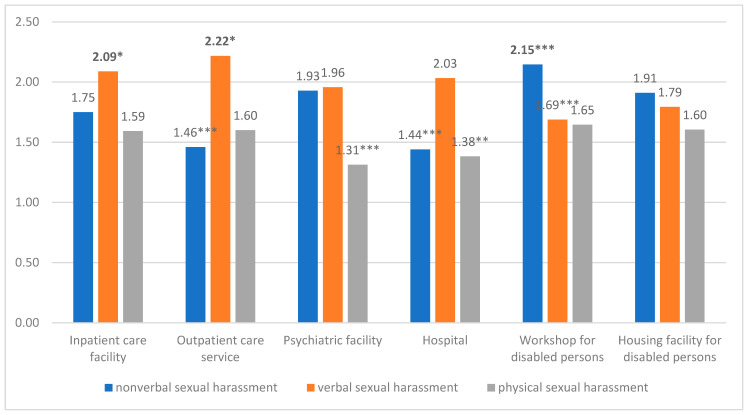
Social and healthcare workers are at high risk of experiencing sexual harassment in the workplace. Although sexual harassment is detrimental to people's well-being, only a few studies have systematically investigated social and healthcare workers' experiences of different forms of sexually harassing behaviors by patients, clients, and residents in Germany. This study aimed to address this gap by determining the prevalence rates and frequency of nonverbal, verbal, and physical sexual harassment by patients, clients, and residents against social and healthcare workers. In addition, we examined the associations of sexual harassment with workers' well-being and described employees' awareness of offers of organizational support for sexual harassment prevention and aftercare. Data were collected from = 901 employees working in a total of 61 facilities, including inpatient and outpatient care, psychiatric facilities, hospitals, and facilities for persons with disabilities. While the prevalence, frequency, and predominant forms of sexual harassment differed across sectors, the results indicated that nonverbal, verbal and physical sexual harassment were highly prevalent in social and healthcare work, with both men and women being affected. Furthermore, we found that sexual harassment was positively related to impaired well-being (e.g., depressiveness and psychosomatic complaints). In terms of support offers for sexual harassment prevention and aftercare, we found that approximately one-third of social and healthcare workers were not aware of any offers at their facilities. In addition to highlighting the problem of sexual harassment by patients, clients, and residents in social and healthcare settings, this study provides recommendations for the development of interventions and suggests several avenues for future research.
社交和医疗保健工作者在工作场所面临遭受性骚扰的高风险。尽管性骚扰对人们的健康有害,但只有少数研究系统地调查了德国的社交和医疗保健工作者在工作场所遭受来自患者、客户和居民的不同形式性骚扰行为的经历。本研究旨在通过确定非言语、言语和身体性骚扰的发生率和频率来解决这一差距,这些性骚扰来自患者、客户和居民针对社交和医疗保健工作者。此外,我们还研究了性骚扰与工作者福祉的关联,并描述了员工对组织提供的性骚扰预防和善后支持的了解。数据来自于总共 61 个设施的 901 名员工,这些设施包括住院和门诊护理、精神病院、医院和残疾人设施。尽管性骚扰的发生率、频率和主要形式在不同部门有所不同,但结果表明,非言语、言语和身体性骚扰在社交和医疗保健工作中非常普遍,男性和女性都受到影响。此外,我们发现性骚扰与福祉受损呈正相关(例如,抑郁和身心症状)。关于性骚扰预防和善后的支持措施,我们发现大约三分之一的社交和医疗保健工作者不知道他们所在设施有任何提供的措施。除了强调社交和医疗保健环境中患者、客户和居民的性骚扰问题外,本研究还为干预措施的制定提供了建议,并为未来的研究提出了几个方向。