Bellastella Giuseppe, Maiorino Maria Ida, Scappaticcio Lorenzo, De Bellis Annamaria, Mercadante Silvia, Esposito Katherine, Bellastella Antonio
Unit of Endocrinology and Metabolic Diseases, Department of Advanced Medical and Surgical Sciences, University of Campania "Luigi Vanvitelli", 80138 Naples, Italy.
Diabetes Unit, Department of Advanced Medical and Surgical Sciences, University of Campania "Luigi Vanvitelli", 80138 Naples, Italy.
Life (Basel). 2021 May 10;11(5):426. doi: 10.3390/life11050426.
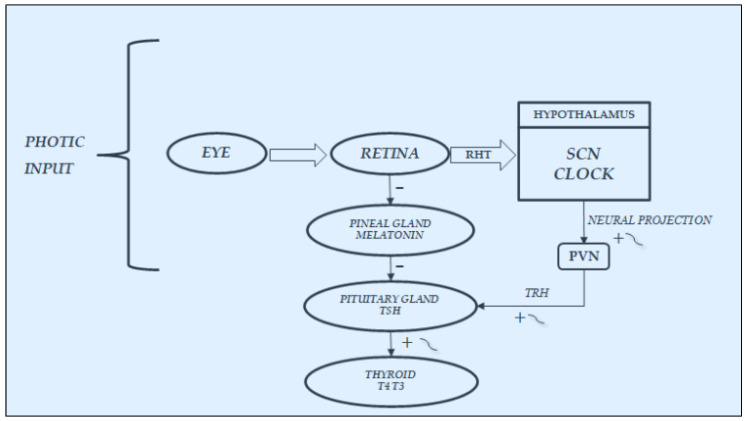
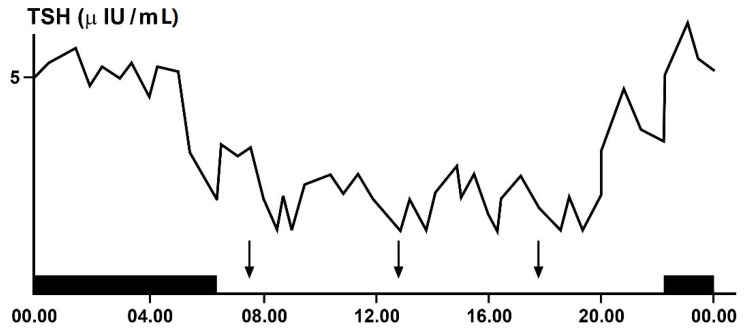
Chronobiology is the scientific discipline which considers biological phenomena in relation to time, which assumes itself biological identity. Many physiological processes are cyclically regulated by intrinsic clocks and many pathological events show a circadian time-related occurrence. Even the pituitary-thyroid axis is under the control of a central clock, and the hormones of the pituitary-thyroid axis exhibit circadian, ultradian and circannual rhythmicity. This review, after describing briefly the essential principles of chronobiology, will be focused on the results of personal experiences and of other studies on this issue, paying particular attention to those regarding the thyroid implications, appearing in the literature as reviews, metanalyses, original and observational studies until 28 February 2021 and acquired from two databases (Scopus and PubMed). The first input to biological rhythms is given by a central clock located in the suprachiasmatic nucleus (SCN), which dictates the timing from its hypothalamic site to satellite clocks that contribute in a hierarchical way to regulate the physiological rhythmicity. Disruption of the rhythmic organization can favor the onset of important disorders, including thyroid diseases. Several studies on the interrelationship between thyroid function and circadian rhythmicity demonstrated that thyroid dysfunctions may affect negatively circadian organization, disrupting TSH rhythm. Conversely, alterations of clock machinery may cause important perturbations at the cellular level, which may favor thyroid dysfunctions and also cancer.
时间生物学是一门研究生物现象与时间关系的科学学科,它有自身的生物学特性。许多生理过程受内在生物钟的周期性调节,许多病理事件也呈现出与昼夜节律相关的发生规律。甚至垂体 - 甲状腺轴也受中央生物钟的控制,垂体 - 甲状腺轴的激素表现出昼夜、超昼夜和年节律性。本综述在简要描述时间生物学的基本原理后,将聚焦于个人经验及关于此问题的其他研究结果,特别关注那些与甲状腺相关的内容,这些内容来自截至2021年2月28日的文献综述、荟萃分析、原创研究和观察性研究,并从两个数据库(Scopus和PubMed)获取。生物节律的首个输入信号由位于视交叉上核(SCN)的中央生物钟发出,它从下丘脑部位向下传递时间信号至卫星生物钟,这些卫星生物钟以分级方式协助调节生理节律性。节律组织的破坏可能促使包括甲状腺疾病在内的重要疾病的发生。多项关于甲状腺功能与昼夜节律性相互关系的研究表明,甲状腺功能障碍可能对昼夜节律组织产生负面影响,扰乱促甲状腺激素(TSH)节律。相反,生物钟机制的改变可能在细胞水平引起重要扰动,这可能促使甲状腺功能障碍以及甲状腺癌的发生。