Division of Nephrology and Hypertension, Vanderbilt University Medical Center, Nashville, TN 37232, USA.
Division of Nephrology, Department of Medicine, Kurume University School of Medicine, Kurume 830-0011, Japan.
Toxins (Basel). 2021 May 19;13(5):361. doi: 10.3390/toxins13050361.
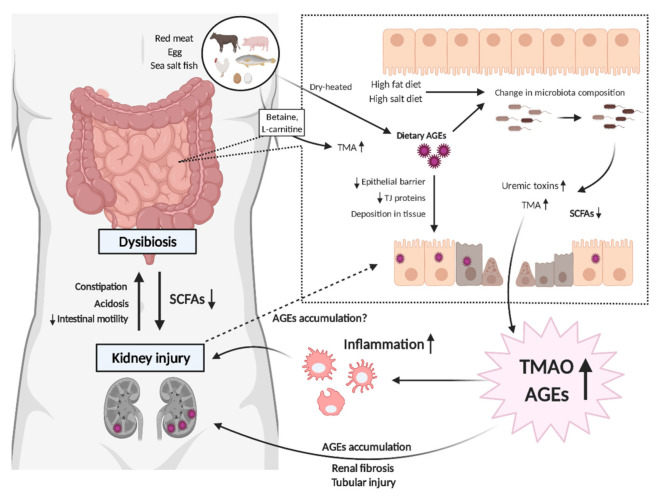
Chronic kidney disease (CKD) is a public health concern that affects approximately 10% of the global population. CKD is associated with poor outcomes due to high frequencies of comorbidities such as heart failure and cardiovascular disease. Uremic toxins are compounds that are usually filtered and excreted by the kidneys. With the decline of renal function, uremic toxins are accumulated in the systemic circulation and tissues, which hastens the progression of CKD and concomitant comorbidities. Gut microbial dysbiosis, defined as an imbalance of the gut microbial community, is one of the comorbidities of CKD. Meanwhile, gut dysbiosis plays a pathological role in accelerating CKD progression through the production of further uremic toxins in the gastrointestinal tracts. Therefore, the gut-kidney axis has been attracting attention in recent years as a potential therapeutic target for stopping CKD. Trimethylamine N-oxide (TMAO) generated by gut microbiota is linked to the progression of cardiovascular disease and CKD. Also, advanced glycation endproducts (AGEs) not only promote CKD but also cause gut dysbiosis with disruption of the intestinal barrier. This review summarizes the underlying mechanism for how gut microbial dysbiosis promotes kidney injury and highlights the wide-ranging interventions to counter dysbiosis for CKD patients from the view of uremic toxins such as TMAO and AGEs.
慢性肾脏病(CKD)是一个公共卫生关注点,影响着大约全球 10%的人口。由于心力衰竭和心血管疾病等合并症的高频率发生,CKD 与不良结局相关。尿毒症毒素是通常由肾脏过滤和排泄的化合物。随着肾功能下降,尿毒症毒素在全身循环和组织中蓄积,加速了 CKD 及并发合并症的进展。肠道微生物失调,定义为肠道微生物群落的失衡,是 CKD 的合并症之一。同时,肠道失调通过在胃肠道中产生更多的尿毒症毒素,在加速 CKD 进展方面发挥着病理性作用。因此,近年来,肠道-肾脏轴作为阻止 CKD 的潜在治疗靶点引起了人们的关注。肠道微生物产生的三甲胺 N-氧化物(TMAO)与心血管疾病和 CKD 的进展有关。此外,晚期糖基化终产物(AGEs)不仅促进 CKD,还导致肠道失调,破坏肠道屏障。本综述总结了肠道微生物失调如何促进肾脏损伤的潜在机制,并强调了从尿毒症毒素(如 TMAO 和 AGEs)的角度出发,针对 CKD 患者的广泛干预措施来对抗肠道失调。