Granzier Renée W Y, Ibrahim Abdalla, Primakov Sergey P, Samiei Sanaz, van Nijnatten Thiemo J A, de Boer Maaike, Heuts Esther M, Hulsmans Frans-Jan, Chatterjee Avishek, Lambin Philippe, Lobbes Marc B I, Woodruff Henry C, Smidt Marjolein L
Department of Surgery, Maastricht University Medical Center+, P.O. Box 5800, 6202 AZ Maastricht, The Netherlands.
GROW-School for Oncology and Developmental Biology, Maastricht University, P.O. Box 616, 6200 MD Maastricht, The Netherlands.
Cancers (Basel). 2021 May 18;13(10):2447. doi: 10.3390/cancers13102447.
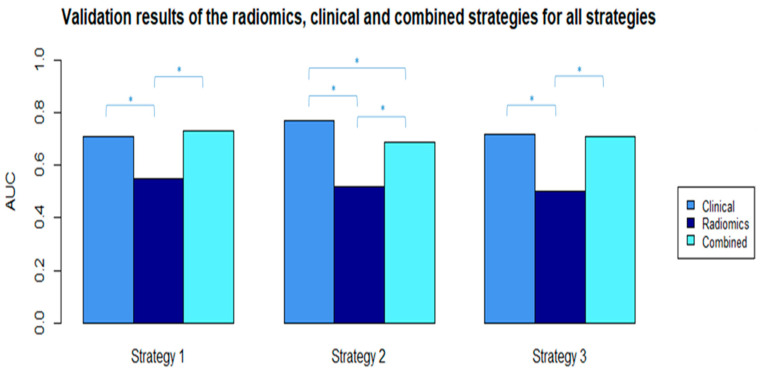
This retrospective study investigated the value of pretreatment contrast-enhanced Magnetic Resonance Imaging (MRI)-based radiomics for the prediction of pathologic complete tumor response to neoadjuvant systemic therapy in breast cancer patients. A total of 292 breast cancer patients, with 320 tumors, who were treated with neo-adjuvant systemic therapy and underwent a pretreatment MRI exam were enrolled. As the data were collected in two different hospitals with five different MRI scanners and varying acquisition protocols, three different strategies to split training and validation datasets were used. Radiomics, clinical, and combined models were developed using random forest classifiers in each strategy. The analysis of radiomics features had no added value in predicting pathologic complete tumor response to neoadjuvant systemic therapy in breast cancer patients compared with the clinical models, nor did the combined models perform significantly better than the clinical models. Further, the radiomics features selected for the models and their performance differed with and within the different strategies. Due to previous and current work, we tentatively attribute the lack of improvement in clinical models following the addition of radiomics to the effects of variations in acquisition and reconstruction parameters. The lack of reproducibility data (i.e., test-retest or similar) meant that this effect could not be analyzed. These results indicate the need for reproducibility studies to preselect reproducible features in order to properly assess the potential of radiomics.
这项回顾性研究探讨了基于治疗前对比增强磁共振成像(MRI)的放射组学在预测乳腺癌患者新辅助全身治疗后肿瘤病理完全缓解方面的价值。共有292例接受新辅助全身治疗并在治疗前接受MRI检查的乳腺癌患者(共320个肿瘤)被纳入研究。由于数据是在两家不同医院使用五台不同的MRI扫描仪并采用不同采集方案收集的,因此采用了三种不同的策略来划分训练和验证数据集。在每种策略中,使用随机森林分类器建立放射组学、临床和联合模型。与临床模型相比,放射组学特征分析在预测乳腺癌患者新辅助全身治疗后肿瘤病理完全缓解方面没有附加价值,联合模型的表现也没有显著优于临床模型。此外,为模型选择的放射组学特征及其性能在不同策略之间以及同一策略内部均有所不同。基于之前和当前的研究工作,我们初步将添加放射组学后临床模型未得到改善归因于采集和重建参数变化的影响。由于缺乏重复性数据(即重测或类似数据),无法对这种影响进行分析。这些结果表明,需要进行重复性研究以预先选择可重复的特征,以便正确评估放射组学的潜力。