
整合临床和基于CT的影像组学特征用于乳腺癌新辅助全身治疗病理完全缓解的治疗前预测
Integration of Clinical and CT-Based Radiomic Features for Pretreatment Prediction of Pathologic Complete Response to Neoadjuvant Systemic Therapy in Breast Cancer.
作者信息
Tsai Huei-Yi, Tsai Tsung-Yu, Wu Chia-Hui, Chung Wei-Shiuan, Wang Jo-Ching, Hsu Jui-Sheng, Hou Ming-Feng, Chou Ming-Chung
机构信息
Graduate Institute of Clinical Medicine, College of Medicine, Kaohsiung Medical University, Kaohsiung 807, Taiwan.
Department of Medical Imaging, Kaohsiung Medical University Hospital, Kaohsiung Medical University, Kaohsiung 807, Taiwan.
出版信息
Cancers (Basel). 2022 Dec 19;14(24):6261. doi: 10.3390/cancers14246261.
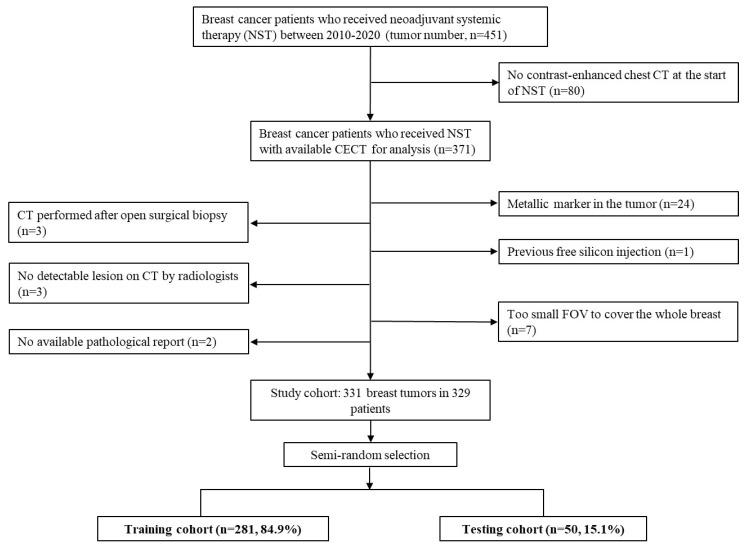
The purpose of the present study was to examine the potential of a machine learning model with integrated clinical and CT-based radiomics features in predicting pathologic complete response (pCR) to neoadjuvant systemic therapy (NST) in breast cancer. Contrast-enhanced CT was performed in 329 patients with breast tumors (n = 331) before NST. Pyradiomics was used for feature extraction, and 107 features of seven classes were extracted. Feature selection was performed on the basis of the intraclass correlation coefficient (ICC), and six ICC thresholds (0.7−0.95) were examined to identify the feature set resulting in optimal model performance. Clinical factors, such as age, clinical stage, cancer cell type, and cell surface receptors, were used for prediction. We tried six machine learning algorithms, and clinical, radiomics, and clinical−radiomics models were trained for each algorithm. Radiomics and clinical−radiomics models with gray level co-occurrence matrix (GLCM) features only were also built for comparison. The linear support vector machine (SVM) regression model trained with radiomics features of ICC ≥0.85 in combination with clinical factors performed the best (AUC = 0.87). The performance of the clinical and radiomics linear SVM models showed statistically significant difference after correction for multiple comparisons (AUC = 0.69 vs. 0.78; p < 0.001). The AUC of the radiomics model trained with GLCM features was significantly lower than that of the radiomics model trained with all seven classes of radiomics features (AUC = 0.85 vs. 0.87; p = 0.011). Integration of clinical and CT-based radiomics features was helpful in the pretreatment prediction of pCR to NST in breast cancer.
本研究的目的是检验一种整合了临床和基于CT的放射组学特征的机器学习模型在预测乳腺癌新辅助全身治疗(NST)的病理完全缓解(pCR)方面的潜力。在329例乳腺肿瘤患者(n = 331)接受NST之前进行了对比增强CT检查。使用Pyradiomics进行特征提取,提取了七类107个特征。基于组内相关系数(ICC)进行特征选择,并检查了六个ICC阈值(0.7 - 0.95)以确定能产生最佳模型性能的特征集。使用年龄、临床分期、癌细胞类型和细胞表面受体等临床因素进行预测。我们尝试了六种机器学习算法,并为每种算法训练了临床、放射组学和临床 - 放射组学模型。还构建了仅具有灰度共生矩阵(GLCM)特征的放射组学和临床 - 放射组学模型进行比较。使用ICC≥0.85的放射组学特征结合临床因素训练的线性支持向量机(SVM)回归模型表现最佳(AUC = 0.87)。在进行多重比较校正后,临床和放射组学线性SVM模型的性能显示出统计学上的显著差异(AUC = 0.69对0.78;p < 0.001)。使用GLCM特征训练的放射组学模型的AUC显著低于使用所有七类放射组学特征训练的放射组学模型(AUC = 0.85对0.87;p = 0.011)。整合临床和基于CT的放射组学特征有助于乳腺癌NST的pCR预处理预测。



 Zotero 插件