Moretti Gabriele, Aretini Paolo, Lessi Francesca, Mazzanti Chiara Maria, Ak Guntulu, Metintaş Muzaffer, Lando Cecilia, Filiberti Rosa Angela, Lucchi Marco, Bonotti Alessandra, Foddis Rudy, Cristaudo Alfonso, Bottari Andrea, Apollo Alessandro, Del Re Marzia, Danesi Romano, Mutti Luciano, Gemignani Federica, Landi Stefano
Department of Biology, Genetic Unit, University of Pisa, via Derna 1, 56126 Pisa, Italy.
Fondazione Pisana per la Scienza, Via Ferruccio Giovannini 13, 56017 San Giuliano Terme, Italy.
Cancers (Basel). 2021 May 18;13(10):2445. doi: 10.3390/cancers13102445.
Malignant pleural mesothelioma (MPM) is a fatal tumor with a poor prognosis. The recent developments of liquid biopsies could provide novel diagnostic and prognostic tools in oncology. However, there is limited information about the feasibility of this technique for MPMs. Here, we investigate whether cancer-specific DNA sequences can be detected in pleural fluids and plasma of MPM patients as free circulating tumor DNA (ctDNA).
We performed whole-exome sequencing on 14 tumor biopsies from 14 patients, and we analyzed 20 patient-specific somatic mutations with digital droplet PCR (ddPCR) in pleural fluids and plasma, using them as cancer-specific tumor biomarkers.
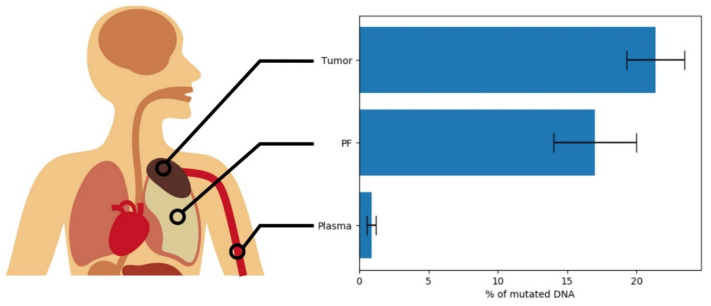
Most of the selected mutations could be detected in pleural fluids (94%) and, noteworthy, in plasma (83%) with the use of ddPCR. Pleural fluids showed similar levels of somatically mutated ctDNA (median = 12.75%, average = 16.3%, standard deviation = 12.3) as those detected in solid biopsies (median = 21.95%; average = 22.21%; standard deviation = 9.57), and their paired difference was weakly statistically significant ( = 0.048). On the other hand, the paired difference between solid biopsies and ctDNA from plasma (median = 0.29%, average = 0.89%, standard deviation = 1.40) was highly statistically significant ( = 2.5 × 10), corresponding to the important drop of circulating somatically mutated DNA in the bloodstream. However, despite the tiny amount of ctDNA in plasma, varying from 5.57% down to 0.14%, the mutations were detectable at rates similar to those possible for other tumors.
We found robust evidence that mutated DNA is spilled from MPMs, mostly into pleural fluids, proving the concept that liquid biopsies are feasible for MPM patients.
恶性胸膜间皮瘤(MPM)是一种预后较差的致命肿瘤。液体活检的最新进展可为肿瘤学提供新的诊断和预后工具。然而,关于该技术在MPM中的可行性信息有限。在此,我们研究MPM患者的胸腔积液和血浆中是否能检测到癌症特异性DNA序列作为游离循环肿瘤DNA(ctDNA)。
我们对14例患者的14份肿瘤活检组织进行了全外显子组测序,并使用数字液滴PCR(ddPCR)分析了胸腔积液和血浆中20个患者特异性体细胞突变,将其用作癌症特异性肿瘤生物标志物。
使用ddPCR,大多数选定的突变在胸腔积液(94%)中可检测到,值得注意的是,在血浆(83%)中也可检测到。胸腔积液中体细胞突变的ctDNA水平(中位数=12.75%,平均值=16.3%,标准差=12.3)与实体活检中检测到的水平相似(中位数=21.95%;平均值=22.21%;标准差=9.57),且两者的配对差异具有微弱的统计学意义(P=0.048)。另一方面,实体活检与血浆ctDNA之间的配对差异(中位数=0.29%,平均值=0.89%,标准差=1.40)具有高度统计学意义(P=2.5×10),这对应于血液中循环体细胞突变DNA的显著下降。然而,尽管血浆中ctDNA含量极少,从5.57%降至0.14%,但突变的检测率与其他肿瘤相似。
我们发现了有力证据,表明突变DNA从MPM中溢出,主要进入胸腔积液,证明了液体活检对MPM患者可行的概念。