School of Business, Hanyang University, 17 Haengdang-dong, Seongdong-gu, Seoul 04763, Korea.
College of Business Administration, Inha University, 100 Inha-ro, Michuhol-gu, Incheon 22212, Korea.
Int J Environ Res Public Health. 2021 May 18;18(10):5377. doi: 10.3390/ijerph18105377.
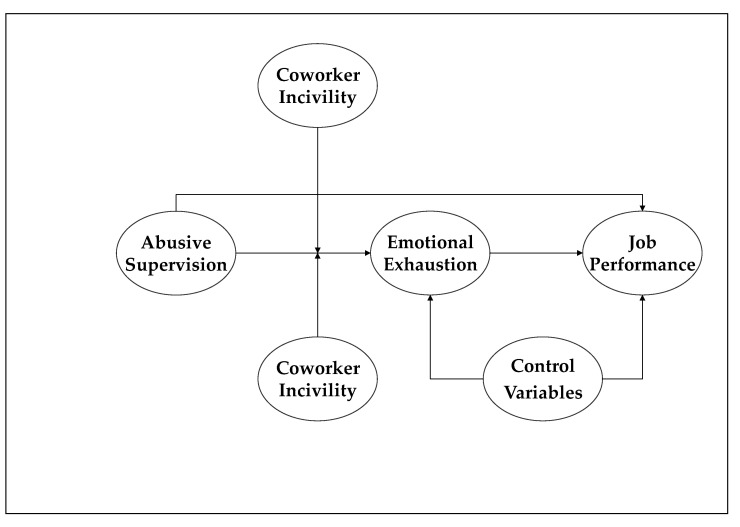
Despite the large body of research on workplace mistreatment, surprisingly few studies have examined the interaction effect of multiple interpersonal stressors on employee outcomes. To fill this gap, our research aimed to test the moderating effects of coworker incivility and customer incivility on the relationship between abusive supervision, emotional exhaustion, and job performance. Analyses conducted on 651 South Korean frontline service employees revealed that abusive supervision exerted a significant indirect effect on job performance through emotional exhaustion. Customer incivility strengthened the positive relationship between abusive supervision and emotional exhaustion, as well as the indirect effect of abusive supervision on job performance through emotional exhaustion. Our post hoc analysis demonstrated a three-way interaction between abusive supervision, coworker incivility, and customer incivility; the relationship between abusive supervision and emotional exhaustion was significantly positive only when coworker incivility was high and customer incivility was low. We discuss the implications of our findings for theory and practice.
尽管有大量关于工作场所虐待的研究,但令人惊讶的是,很少有研究考察多种人际压力源对员工结果的交互影响。为了填补这一空白,我们的研究旨在检验同事无礼和客户无礼对虐待性监督、情绪耗竭和工作绩效之间关系的调节作用。对 651 名韩国一线服务员工的分析表明,虐待性监督通过情绪耗竭对工作绩效产生显著的间接影响。客户无礼增强了虐待性监督与情绪耗竭之间的正向关系,以及虐待性监督通过情绪耗竭对工作绩效的间接影响。我们的事后分析还表明,虐待性监督、同事无礼和客户无礼之间存在三向交互作用;只有当同事无礼程度高且客户无礼程度低时,虐待性监督与情绪耗竭之间的关系才呈显著正相关。我们讨论了这些发现对理论和实践的意义。