Faculty of Health, Education and Environment, Toi Ohomai Institute of Technology, Tauranga 3112, New Zealand.
Te Huataki Waiora School of Health, The University of Waikato, Hamilton 3216, New Zealand.
Int J Environ Res Public Health. 2021 May 18;18(10):5398. doi: 10.3390/ijerph18105398.
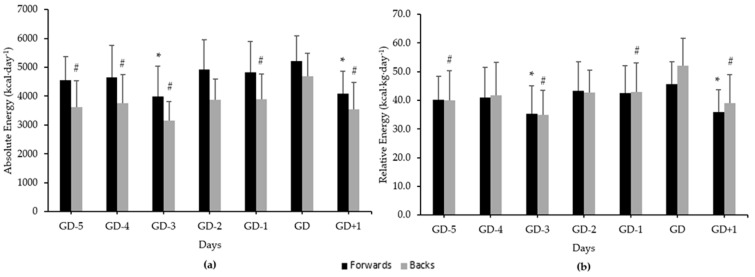
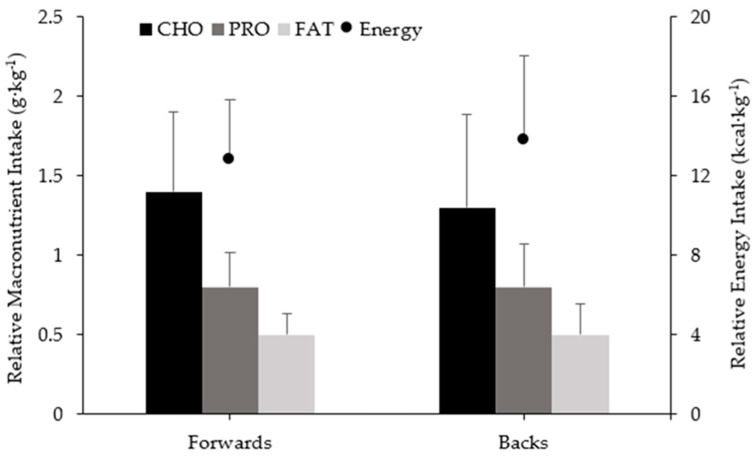
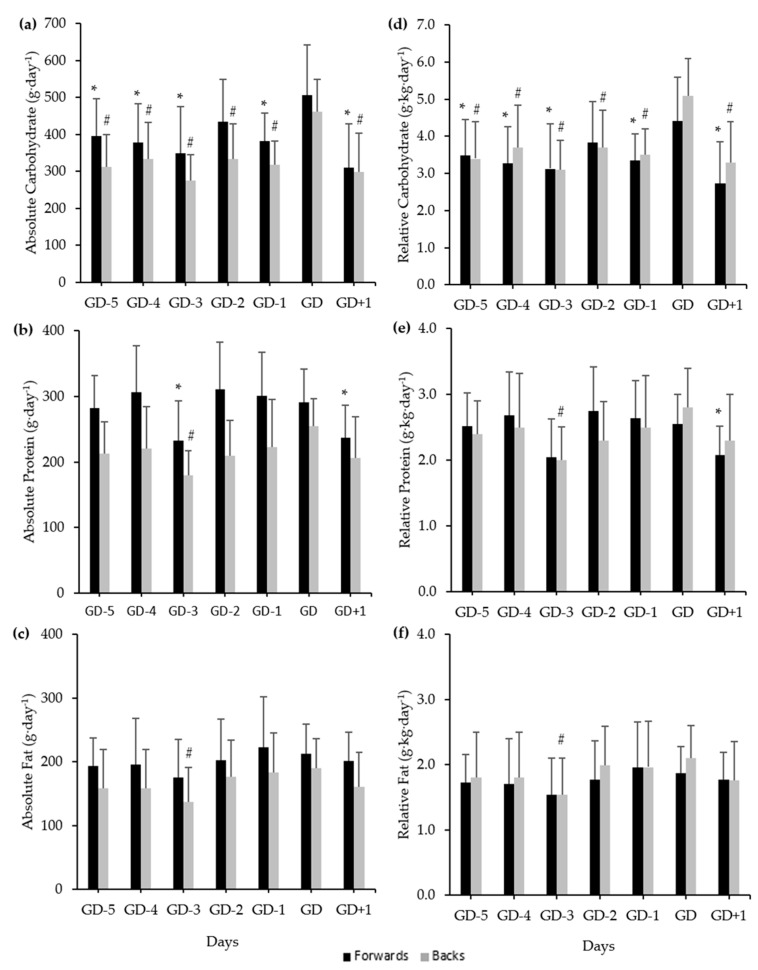
Thirty-four elite male professional rugby union players from the New Zealand Super Rugby championship completed dietary intakes via the Snap-N-Send method during a seven-day competition week. Mean seven-day absolute energy intake was significantly higher for forwards (4606 ± 719 kcal·day) compared to backs (3761 ± 618 kcal·day; < 0.01; = 1.26). Forwards demonstrated significantly higher mean seven-day absolute macronutrient intakes compared to backs ( < 0.03; = 0.86-1.58), but no significant differences were observed for mean seven-day relative carbohydrate (3.5 ± 0.8 vs. 3.7 ± 0.7 g·kg·day), protein (2.5 ± 0.4 vs. 2.4 ± 0.5 g·kg·day), and fat (1.8 ± 0.4 vs. 1.8 ± 0.5 g·kg·day) intakes. Both forwards and backs reported their highest energy (5223 ± 864 vs. 4694 ± 784 kcal·day) and carbohydrate (4.4 ± 1.2 vs. 5.1 ± 1.0 g·kg·day) intakes on game day, with ≈62% of total calories being consumed prior to kick-off. Mean pre-game meal composition for all players was 1.4 ± 0.5 g·kg carbohydrate, 0.8 ± 0.2 g·kg protein, and 0.5 ± 0.2 g·kg fat. Players fell short of daily sports nutrition guidelines for carbohydrate and appeared to "eat to intensity" by increasing or decreasing energy and carbohydrate intake based on the training load. Despite recommendations and continued education, many rugby players select what would be considered a "lower" carbohydrate intake. Although these intakes appear adequate to be a professional RU player, further research is required to determine optimal dietary intakes.
34 名来自新西兰超级橄榄球锦标赛的精英男性职业橄榄球联盟球员通过 Snap-N-Send 方法在为期一周的比赛中完成了饮食摄入。与后卫(3761 ± 618 kcal·day)相比,前锋的平均 7 天绝对能量摄入量明显更高(4606 ± 719 kcal·day;<0.01;= 1.26)。与后卫相比,前锋的平均 7 天绝对宏量营养素摄入量明显更高(<0.03;= 0.86-1.58),但平均 7 天相对碳水化合物(3.5 ± 0.8 vs. 3.7 ± 0.7 g·kg·day)、蛋白质(2.5 ± 0.4 vs. 2.4 ± 0.5 g·kg·day)和脂肪(1.8 ± 0.4 vs. 1.8 ± 0.5 g·kg·day)摄入量没有观察到显著差异。前锋和后卫都报告说,他们在比赛日的能量(5223 ± 864 vs. 4694 ± 784 kcal·day)和碳水化合物(4.4 ± 1.2 vs. 5.1 ± 1.0 g·kg·day)摄入量最高,大约 62%的总热量在开球前消耗。所有球员的赛前膳食组成平均为 1.4 ± 0.5 g·kg 碳水化合物、0.8 ± 0.2 g·kg 蛋白质和 0.5 ± 0.2 g·kg 脂肪。球员没有达到每日运动营养指南的碳水化合物摄入量,并且似乎通过根据训练负荷增加或减少能量和碳水化合物摄入量来“按强度进食”。尽管有建议和持续的教育,许多橄榄球运动员选择了被认为是“较低”的碳水化合物摄入量。尽管这些摄入量对于成为一名职业橄榄球运动员来说似乎足够,但需要进一步研究来确定最佳饮食摄入量。