Gato René, Menéndez Zulema, Prieto Enrique, Argilés Rafael, Rodríguez Misladys, Baldoquín Waldemar, Hernández Yisel, Pérez Dennis, Anaya Jorge, Fuentes Ilario, Lorenzo Claudia, González Keren, Campo Yudaisi, Bouyer Jérémy
Instituto Pedro Kourí, Autopista Novia del Mediodia, La Lisa, La Habana 11400, Cuba.
Centro de Aplicaciones Tecnológicas y Desarrollo Nuclear, Calle 30 y 5ta ave. Miramar, La Habana 11300, Cuba.
Insects. 2021 May 18;12(5):469. doi: 10.3390/insects12050469.
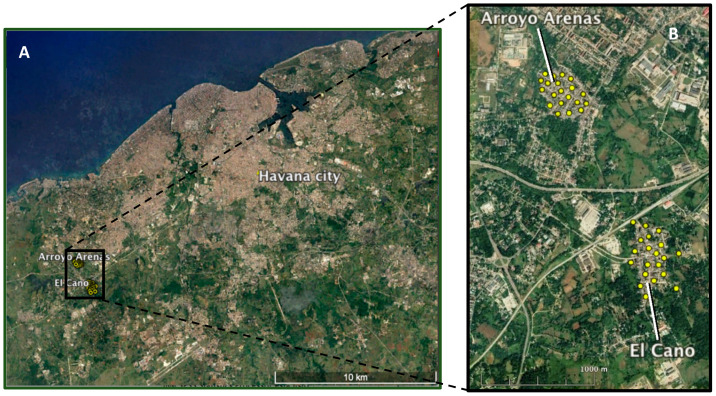
Dengue virus infections are a serious public health problem worldwide. is the primary vector of dengue in Cuba. As there is no vaccine or specific treatment, the control efforts are directed to the reduction of mosquito populations. The indiscriminate use of insecticides can lead to adverse effects on ecosystems, including human health. The sterile insect technique is a species-specific and environment-friendly method of insect population control based on the release of large numbers of sterile insects, ideally males only. The success of this technique for the sustainable management of agricultural pests has encouraged its evaluation for the population suppression of mosquito vector species. Here, we describe an open field trial to evaluate the effect of the release of irradiated male on a wild population. The pilot trial was carried out in a suburb of Havana and compared the mosquito population density before and after the intervention, in both untreated control and release areas. The wild population was monitored by an ovitrap network, recording frequency and density of eggs as well as their hatch rate. A significant amount of sterility was induced in the field population of the release area, as compared with the untreated control area. The ovitrap index and the mean number of eggs/trap declined dramatically after 12 and 5 weeks of releases, respectively. For the last 3 weeks, no eggs were collected in the treatment area, clearly indicating a significant suppression of the wild target population. We conclude that the sterile males released competed successfully and induced enough sterility to suppress the local population.
登革病毒感染是全球严重的公共卫生问题。在古巴,[某种蚊子]是登革热的主要传播媒介。由于没有疫苗或特效治疗方法,防控工作主要致力于减少蚊虫数量。不加区分地使用杀虫剂会对包括人类健康在内的生态系统产生不利影响。昆虫不育技术是一种针对特定物种且环境友好的昆虫种群控制方法,基于释放大量不育昆虫,理想情况下仅释放雄性昆虫。该技术在农业害虫可持续管理方面的成功促使人们对其用于抑制蚊虫传播媒介物种数量进行评估。在此,我们描述一项野外试验,以评估释放经辐照的雄性[某种蚊子]对野生种群的影响。该试点试验在哈瓦那郊区进行,比较了未处理对照区和释放区干预前后的蚊虫种群密度。通过诱蚊产卵器网络对野生种群进行监测,记录蚊卵的频率、密度及其孵化率。与未处理对照区相比,释放区的野外种群产生了大量不育个体。释放12周和5周后,诱蚊产卵器指数和每个诱蚊产卵器的平均蚊卵数分别大幅下降。在最后3周,处理区未收集到蚊卵,清楚地表明野生目标种群受到了显著抑制。我们得出结论,释放的不育雄性成功竞争并诱导了足够的不育个体,从而抑制了当地[某种蚊子]种群。