Singh Chandra K, Chhabra Gagan, Patel Arth, Chang Hao, Ahmad Nihal
Department of Dermatology, University of Wisconsin, Madison, WI 53705, USA.
William S. Middleton VA Medical Center, Madison, WI 53705, USA.
Nutrients. 2021 May 30;13(6):1867. doi: 10.3390/nu13061867.
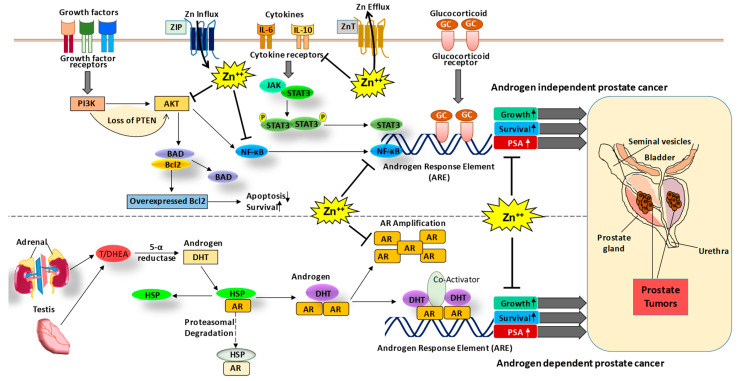
Studies have suggested an important role of the trace element zinc (Zn) in prostate biology and functions. Zn has been shown to exist in very high concentrations in the healthy prostate and is important for several prostatic functions. In prostate cancer (PCa), Zn levels are significantly decreased and inversely correlated with disease progression. Ideally, restoration of adequate Zn levels in premalignant/malignant prostate cells could abort prostate malignancy. However, studies have shown that Zn supplementation is not an efficient way to significantly increase Zn concentrations in PCa. Based on a limited number of investigations, the reason for the lower levels of Zn in PCa is believed to be the dysregulation of Zn transporters (especially ZIP and ZnT family of proteins), metallothioneins (for storing and releasing Zn), and their regulators (e.g., Zn finger transcription factor RREB1). Interestingly, the level of Zn in cells has been shown to be modulated by naturally occurring dietary phytochemicals. In this review, we discussed the effect of selected phytochemicals (quercetin, resveratrol, epigallocatechin-3-gallate and curcumin) on Zn functioning and proposes that Zn in combination with specific dietary phytochemicals may lead to enhanced Zn bioaccumulation in the prostate, and therefore, may inhibit PCa.
研究表明微量元素锌(Zn)在前列腺生物学和功能中发挥着重要作用。锌在健康前列腺中以非常高的浓度存在,并且对多种前列腺功能至关重要。在前列腺癌(PCa)中,锌水平显著降低,且与疾病进展呈负相关。理想情况下,在癌前/恶性前列腺细胞中恢复足够的锌水平可能会阻止前列腺恶性肿瘤的发生。然而,研究表明补充锌并非显著提高前列腺癌中锌浓度的有效方法。基于有限的研究,前列腺癌中锌水平较低的原因被认为是锌转运蛋白(特别是ZIP和锌转运体(ZnT)蛋白家族)、金属硫蛋白(用于储存和释放锌)及其调节因子(如锌指转录因子RREB1)的失调。有趣的是,细胞中的锌水平已被证明受天然存在的膳食植物化学物质调节。在本综述中,我们讨论了选定的植物化学物质(槲皮素、白藜芦醇、表没食子儿茶素-3-没食子酸酯和姜黄素)对锌功能的影响,并提出锌与特定膳食植物化学物质联合使用可能会增强锌在前列腺中的生物积累,因此可能抑制前列腺癌。