Department of Orthodontics, Kyung Hee University Dental Hospital, Seoul 02447, Korea.
Department of Convergence Medicine, Asan Medical Center, Asan Medical Institute of Convergence Science and 8 Technology, Seoul 02447, Korea.
Sensors (Basel). 2021 May 30;21(11):3798. doi: 10.3390/s21113798.
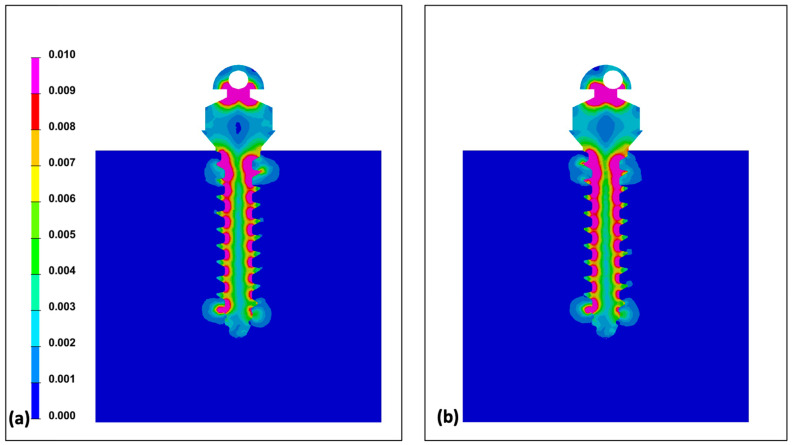
The orthodontic miniscrew is driven into bone in a clockwise direction. Counter-clockwise rotational force applied to the implanted miniscrew can degrade the stability. The purpose of this three-dimensional finite element study was to figure out the effect of shifting the miniscrew head hole position from the long axis. Two miniscrew models were developed, one with the head hole at the long axis and the other with an eccentric hole position. One degree of counter-clockwise rotation was applied to both groups, and the maximum Von-Mises stress and moment was measured under various wire insertion angles from -60° to +60°. All Von-Mises stress and moments increased with an increase in rotational angle or wire insertion angle. The increasing slope of moment in the eccentric hole group was significantly higher than that in the centric hole group. Although the maximum Von-Mises stress was higher in the eccentric hole group, the distribution of stress was not very different from the centric hole group. As the positive wire insertion angles generated a higher moment under a counter-clockwise rotational force, it is recommended to place the head hole considering the implanting direction of the miniscrew. Clinically, multidirectional and higher forces can be applied to the miniscrew with an eccentric head hole position.
正畸微螺钉沿顺时针方向旋入骨内。施加于植入微螺钉的逆时针旋转力会降低稳定性。本三维有限元研究的目的是研究将微螺钉头部孔位置从长轴上偏移的影响。建立了两个微螺钉模型,一个头部孔位于长轴上,另一个头部孔偏心。两组均施加 1 度逆时针旋转,测量各种插入角度从-60°到+60°时的最大 Von-Mises 应力和力矩。随着旋转角度或插入角度的增加,所有 Von-Mises 应力和力矩均增加。偏心孔组的力矩增加斜率明显高于中心孔组。尽管偏心孔组的最大 Von-Mises 应力较高,但应力分布与中心孔组差异不大。由于正插入角度在逆时针旋转力下产生更高的力矩,因此建议根据微螺钉的植入方向放置头部孔。临床上,可以将偏心头部孔位置的微螺钉应用于多方向和更高的力。